
Formal Verification of ESNs: Bridging the Gap Between User Freedom and Enterprise Control
Formal Verification of Authorization Policies for Enterprise Social Networks Using PlusCal-2
This paper presents a formal verification framework for Enterprise Social Networks (ESNs) using PlusCal-2 and TLA+. It proposes a federated authorization model that bridges user-centric and enterprise-centric policies, allowing for the automatic detection of access control conflicts via model checking.
TL;DR
Enterprise Social Networks (ESNs) like Yammer create a unique security headache: users want to share documents freely (Social Logic), but corporations must enforce strict data silos (Enterprise Logic). This paper introduces a formal verification approach using PlusCal-2 and TLA+ to model these conflicting worlds. By treating authorization as a state-space problem, the authors can automatically detect "policy collisions" where a user is simultaneously allowed and denied access.
Perspective: The Hybrid Conflict
The authors correctly identify a fundamental tension in modern ESNs. In a standard enterprise, RBAC (Role-Based Access Control) rules all. In a social network, User-Centric ACLs rule. In an ESN, you have both. When a user from the "Healthcare" department collaborates with the "Police" department in a federated federation, who has the final say?
Existing tools like XACML are too verbose and lack the logical rigor to check for contradictions across distributed domains. This is where Formal Methods—the same tools Amazon uses to verify AWS S3 and DynamoDB—come into play.
Methodology: High-Level Modeling with PlusCal-2
The core of the paper is the translation of human-readable access policies into a mathematical model. They use an ABAC (Attribute-Based Access Control) foundation because it is more expressive than roles alone.
1. The Authorization Architecture
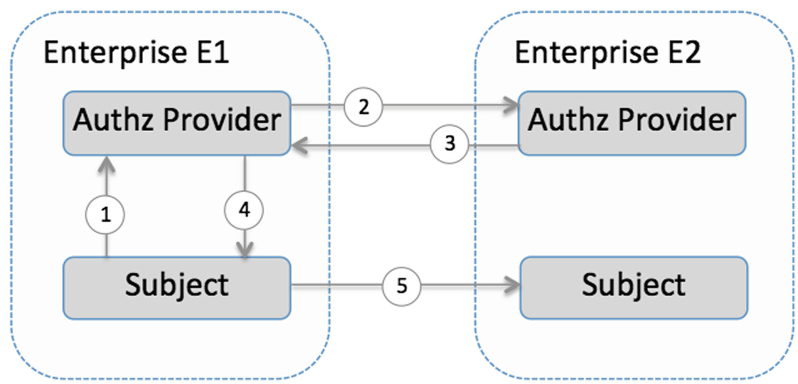
The proposed Architecture places an Authorization Provider (AzP) at the center of each enterprise. It doesn't just look at one policy; it aggregates User Policies (UP) and Enterprise Policies (EP).
2. Formal Logic and Invariants
The clever part is how they define a conflict. In PlusCal-2, they define an Invariant (Inv0). An invariant is a condition that must always be true.
The condition is simple: for any request, the set of actions must not contain both "allow" and "deny."
If the intersection of these policies leads to a contradiction, the model checker (TLC) triggers an alarm.
Experiments: The "Genny" Case Study
The authors modeled a scenario involving a child protection case involving Alice and Genny. Alice grants Genny access to a database (R4), but an underlying enterprise policy forbids it.
By running the TLC Model Checker, they generated a "Counter Example." Instead of a vague system error, the tool provides a trace showing exactly which variables and policies led to the state:
<<"Genny", "R4">> :> [status |-> {"deny", "allow"}]
This output is the "Smoking Gun"—it proves that the federation's logic is flawed before a single line of production code is deployed.

Critical Insight: Why This Matters
The real value here isn't just "finding bugs." It's the move toward Logic-as-Code.
- Inductive Bias: The authors assume that most ESN conflicts are local or federated overlaps. By modeling the "Request Pool" as a non-deterministic set, they cover all possible user behaviors without having to simulate every single user click.
- Scalability: While formal methods often suffer from the "State Space Explosion" problem, the authors use "Atomic" blocks in PlusCal-2 to group operations, keeping the verification fast and manageable.
Conclusion & Future Look
While the paper provides a robust proof-of-concept, a current limitation is the manual effort required to translate existing XML/XACML policies into PlusCal-2. The authors' future plan to automate this translation is the "missing link" for industry adoption. In an era of Zero Trust, being able to prove your authorization logic is sound is no longer a luxury—it's a requirement.