
Trust as an Incentive: How Social Networks Solve the Cooperation Paradox
Forming Social Networks of Trust to Incentivize Cooperation
This paper introduces a decentralized model for incentivizing cooperation in social dilemmas (modeled via the Prisoner’s Dilemma) by forming dynamic social networks of trust. It demonstrates that when self-interested agents prioritize interactions with partners of similar cooperation levels, clusters of cooperative nodes emerge, effectively isolating defectors and correlating higher payoffs with higher cooperation.
TL;DR
In a world without central authority, how do we stop "free-riders" from ruining decentralized systems? This paper proposes a model where individuals form "Social Networks of Trust." By simply being picky about who they play with—seeking partners at least as cooperative as themselves—agents naturally form clusters. The result? Cooperative agents get rich together, while defectors end up lonely and broke.
The "Tragedy" of Decentralization
Whether it's P2P file sharing or mobile ad-hoc networks, we face a classic Social Dilemma. From a purely selfish perspective, the "optimal" strategy is to consume resources without contributing any (defection). Prior work often looks toward complex reputation systems or "monetary" schemes. However, these are often "brittle"—they can be gamed by liars or require massive overhead to synchronize "who is good" across a global network.
The authors of this paper ask a simpler question: Can we use the structure of relationships themselves to enforce honesty?
Methodology: The Architecture of Pickiness
The model uses the Prisoner's Dilemma (PD) as its engine. In every round, a node must decide:
- Who to invite?
- Whose invitation to accept?
1. The Threshold Mechanism
Every node has a private cooperation level (). They use this to set two barriers:
- : I will only ask you to play if you've been at least as "good" as I am.
- : I will only accept your invite if your past behavior meets a percentage () of my standards.
2. Triadic Closure (The "Friend-of-a-Friend" Effect)
To speed up network formation, the model introduces Triadic Closure. If you form a relationship with me, you are automatically introduced to my "circle." This mimics human social dynamics and allows cooperative "cliques" to grow rapidly.
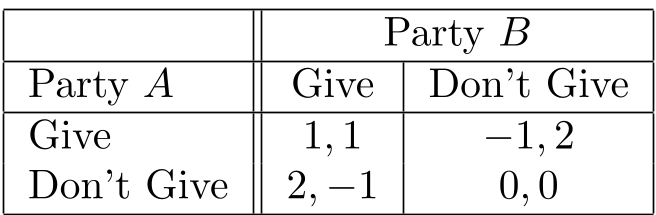 Table 1: The standard PD payoff matrix used to calculate utility.
3. Probabilistic Selection
Nodes don't just pick at random. They use Weights (). If we have a successful history (), the probability of me picking you again skyrockets. This creates a "gravity" that keeps cooperative nodes bound together.
Experimental Results: Cooperation Pays Off
In standard random interactions, defectors (low cooperation) usually get the highest payoff because they exploit everyone (see Figure 2 in the paper).
However, under this Social Network model, the script is flipped:
- Payoff Correlation: Higher cooperation levels lead to higher total payoffs. The "selfish" incentive is now to be cooperative so you can gain entry into high-trust clusters.
- Density of Ties: High-cooperation nodes have significantly more neighbors. They are "popular" because they are reliable partners.
- Isolation of Defectors: Low-cooperation nodes fail to maintain relationships. They are forced to interact with other defectors or are ignored entirely, leading to a "Utility Desert."
 Figure 7: A snapshot of the social network. Notice the dense clusters of high-cooperation nodes (light colored/high values) vs. the sparsely connected defectors.
Critical Insight: Why This Works
The brilliance of this approach is its Robustness. It doesn't require a "Global Reputation Score." It only requires "Local Memory" ().
Because the relationship is bidirectional, a defector cannot "force" a relationship with a high-cooperator. The moment the defector starts acting selfishly, the average payoff drops below the cooperator's threshold, and the link is severed—no permission required.
Limitations and Future Outlook
While the proof-of-concept is strong, the study uses a small population (20 nodes). In the real world:
- Scalability: How do these clusters form in a network of millions?
- Dynamic Strategies: What if a node acts "good" for 100 rounds just to pull off a "mega-heist" (whitewashing/sybil attacks)?
Despite these questions, the paper provides a vital blueprint for Socially-Aware Engineering. By designing protocols that mimic human "pickiness," we can build decentralized systems that are naturally resistant to the selfish "tragedy" that plagues so many modern digital commons.