
Beyond Content: Decoding Forum Identities through Behavior and Social Graphs
Forum User Profiling by Incorporating User Behavior and Social Network Connections
This paper introduces an ensemble learning framework for forum user profiling, specifically targeting growth value prediction. The method integrates multi-dimensional features, including temporal user behaviors, content semantics, and social network embeddings (LINE and PUHE), achieving the second-place rank in the SMP CUP 2017 competition.
TL;DR
To accurately predict user "growth values" and interests in massive communities like CSDN, simple text analysis is no longer enough. This paper presents a robust ensemble framework that combines temporal behavior tracking with social network embeddings. By utilizing LINE for structural proximity and a custom PUHE for word-preference links, the researchers achieved top-tier performance at the SMP CUP 2017 competition.
The Challenge: Why Your "Bio" Doesn't Tell the Whole Story
Online forum data is notoriously messy. A user might post once but browse and "upvote" hundreds of times. This latent behavior contains rich information about interests that isn't captured in text. Furthermore, the social topology—who you follow and who follows you—defines your "status" and "influence" within the ecosystem.
Previous methods struggled because they treated user features as isolated vectors. The core insight of this paper is that identity is defined by interaction: both with the system (behavior) and with other users (social graph).
Methodology: The Dual-Engine Engine of Profiling
The framework splits user representation into two distinct engines:
1. User Behavior Embeddings (The "What" and "When")
Instead of just looking at total post counts, the authors track behavior over 12 months. This captures "activity curves"—identifying whether a user is a rising star or a fading veteran.
- Content Statistics: Max/Min/Mean lengths of blogs and messages.
- Behavioral Sparsity: Mapping upvotes, favorites, and comments into temporal buckets to see how a user's habits change over time.
2. Social Network Connection Embeddings (The "Who" and "Where")
This is the core technical contribution. The authors recognize that users with similar roles occupy similar positions in the network.
- Structural Context: Using
LINE(Large-scale Information Network Embedding) to preserve 1st-order (direct links) and 2nd-order (shared neighbors) proximities. - PUHE (Post-User Heterogeneous Embedding): This goes beyond the follower graph. It creates an artificial link between a user and a word if they use that word in their posts, allowing the model to map users into a latent space based on linguistic style.
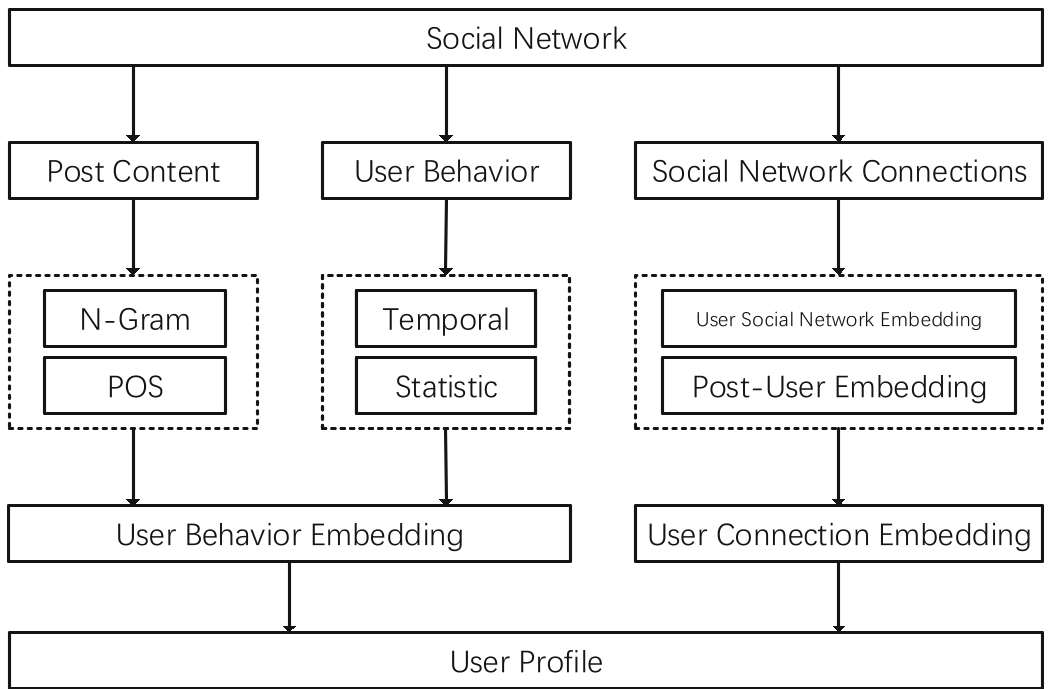 Figure 1: The overall architecture of the proposed user profiling approach.
Why it Works: The Physics of Ego-Networks
The paper places significant emphasis on Ego-Networks. By calculating the "clustering coefficient" (how connected your friends are to each other) and "effective eccentricity" (how far you are from the rest of the graph), the model can distinguish between a niche expert and a general community influencer.
 Figure 2: Visualization of neighborhoods and clustering logic.
Results & Competition Performance
The model was tested on the CSDN dataset, which includes 1 million blog documents but only 3,000 labeled growth value samples. This is a "small data" problem in a "big data" environment.
| Model Architecture | Relative Error (%) |
|---|---|
| Behavior Baseline | 72.82 |
| Baseline + Network Stats | 73.16 |
| Full Architecture (Ensemble) | 75.22 |
The addition of LINE and PUHE provided the most significant jump in performance, proving that the social context is more predictive of growth than pure statistical behavior.
Critical Insight & Conclusion
The success of this approach highlights a shift in user profiling: moving from feature engineering to representation learning.
Takeaway: In any platform with social interaction, your most valuable data isn't what a user says, but where they sit in the network and how their engagement rhythm fluctuates. While this work uses XGBoost and shallow embeddings, it paves the way for modern Graph Neural Networks (GNNs) to perform even deeper relational reasoning in social media analysis.
Limitations: The model relies on a 12-month window for behavior; it might struggle with cold-start problems for brand-new users who haven't yet established a network or a historical behavioral footprint.