
Forward or Ignore: Decoding the DNA of Viral Social Content on SINA Weibo
Forward or ignore: User behavior analysis and prediction on microblogging
This paper presents a quantitative analysis and prediction framework for user forwarding behavior on SINA Weibo. By identifying four key influence factors and utilizing Support Vector Machines (SVM), the authors achieve an 85.36% accuracy rate in predicting whether a user will forward or ignore a message.
TL;DR
Why do some posts go viral while others die in obscurity? This study tackles this question by analyzing SINA Weibo—China's largest microblogging platform at the time—to quantify the factors driving user behavior. By shifting the perspective from general diffusion models to machine learning-based classification, the research achieves an 85.36% accuracy in predicting user actions, proving that "Interest is King" in the social media ecosystem.
Background: The SINA Weibo Frontier
In 2011, SINA Weibo was a burgeoning digital home for 200 million users. While Western platforms like Twitter had been dissected by researchers, Weibo remained a "black box." The authors of this paper set out to provide the first quantitative study on how information moves across this specific landscape, focusing on the binary choice every user makes: Forward or Ignore.
Problem & Motivation: Beyond Random Processes
Existing models often treated information spread like a virus (epidemic models) or a random Markov process. However, human behavior is rarely random. The authors argued that these models were too "top-down" and lacked the "bottom-up" nuance of individual choice. They identified a need for a model that accounts for who the user is, what they like, and how they are connected to the source.
Methodology: The Four Pillars of Influence
The researchers identified four key dimensions to categorize user behavior:
- User Authority: Quantified using the HITS algorithm to determine the "status" of a user.
- User Activity: A ratio of a user's total interactions (posts/forwards) against the platform's total volume.
- User Preference: Calculated via Jaccard similarity. This is split into User-vs-Content (does the message match the user's history?) and User-vs-User (similar interests between the receiver and the publisher).
- Social Relations: Distinguishing between one-way "parasocial" relationships (weak ties) and mutual "two-way" follows (strong ties).
Architecture of Prediction
Instead of complex differential equations alone, the authors treated prediction as a Pattern Classification task. They mapped these four factors into a feature vector and used a Support Vector Machine (SVM) to classify the outcome as 1 (Forward) or 0 (Ignore).
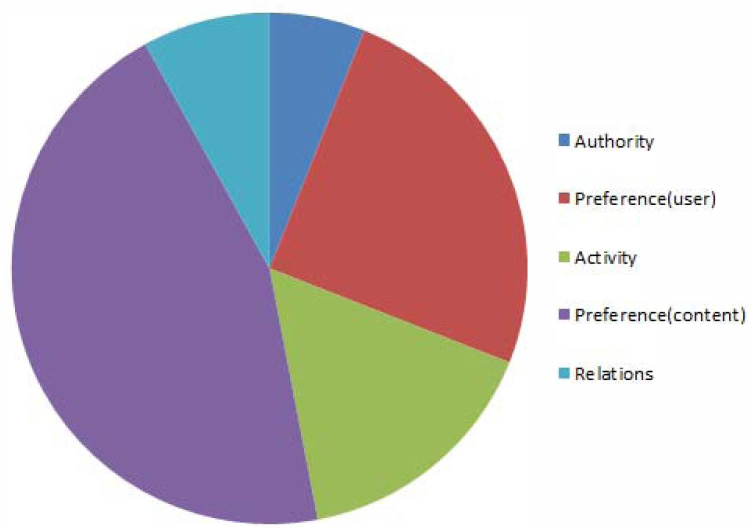 Figure: Analysis showing that User Preference for Content is the dominant factor in decision-making.
Experiments & Results: What Actually Matters?
The study utilized a dataset of 6,956 messages. The results were illuminating:
- Accuracy: The SVM model successfully predicted user behavior with 85.36% accuracy.
- The "Interest" Factor: As shown in the chart above, content preference is the single most important factor. If a user is interested in a topic, they are highly likely to forward it, regardless of the publisher's "authority."
- Activity Patterns: High-activity users act as the "amplifiers" of the network. There is a strong correlation between a user's general activity level and their likelihood to forward any given message.
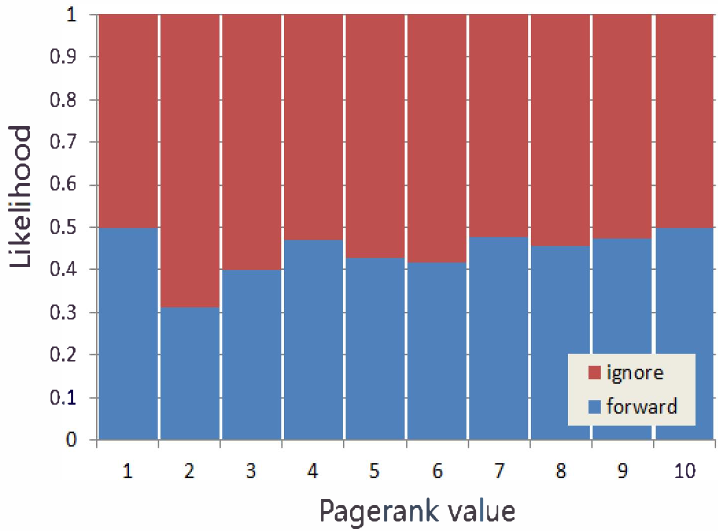 Figure: The data demonstrates a tight relation between user activity levels and the probability of forwarding.
Transmission Dynamics: The Math of the Crowd
Beyond individual behavior, the authors proposed a dynamic equation based on transmission dynamics theory to model the overall flow. They discovered that:
- Initial Degree Distribution (how many people the first poster reaches) determines the total eventual coverage.
- Posting Time matters; traffic peaks at 11 AM and 10 PM, aligning with daily human "biological clocks."
- Inactive Users act as "firewalls" that significantly reduce the speed and reach of information spreading.
Critical Analysis & Conclusion
Takeaway
This work shifted the focus of social media analysis from "Who is talking?" to "Who is listening and why?" By proving that content-user alignment (Preferences) outweighs social status (Authority), the paper laid the groundwork for the recommendation-heavy social media algorithms we see today (like TikTok or Douyin).
Limitations
While the SVM approach was highly effective for 2011, the model is limited by the "bag-of-words" style of similarity. Modern NLP (Transformers/LLMs) would now be used to better capture the semantic nuances of user preference. Additionally, the study focuses on a snapshot in time; social dynamics on Weibo have evolved significantly with the rise of professional content creators (KOLs).
Future Outlook
The authors suggest that future work should explore more complex situations and different types of message transmission mechanisms—a prediction that has come true as researchers now grapple with multi-modal content (video) and the spread of misinformation in increasingly complex social echoes.