
FreeCast: Revolutionizing Free-Viewpoint Video with 5D-GMRF and Graceful Delivery
FreeCast: Graceful Free-Viewpoint Video Delivery
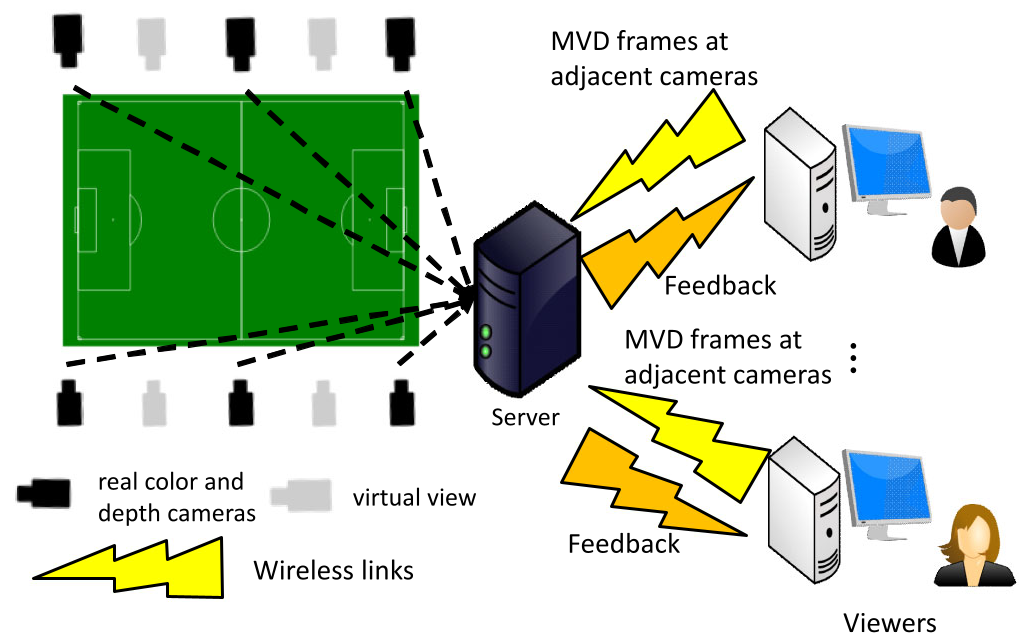
This paper introduces FreeCast, a novel wireless multi-view plus depth (MVD) video delivery scheme that utilizes a 5D Discrete Cosine Transform (5D-DCT) and a multidimensional Gaussian Markov Random Field (GMRF) model. It achieves a "graceful" quality transition relative to wireless channel conditions, significantly outperforming digital and chunk-based analog schemes in band-limited environments.
TL;DR
Wireless Free-Viewpoint Video (FVV) is often plagued by the "cliff effect"—the sudden total loss of quality when the signal drops. FreeCast eliminates this by ditching digital quantization for an analog-style 5D-DCT approach. By modeling video data as a 5D Gaussian Markov Random Field (GMRF), it reduces the metadata required to protect signals by over 99%, enabling high-quality, switchable-angle video even in narrow bandwidths.
Background: The Cliff vs. The Slope
In conventional digital video systems (like HEVC or AVC), if your Wi-Fi signal drops slightly below a specific threshold, the bitstream breaks, and the video freezes—this is the cliff effect. Conversely, even if your signal is perfect, your quality is capped by the encoder's bitrate.
"Graceful delivery" (inspired by SoftCast) aims to make video quality look like an analog signal: as the channel SNR improves, the video quality improves linearly. However, applying this to Multi-view Plus Depth (MVD) data creates a massive metadata overhead. To tell the receiver how to scale the received noisy signals, you'd normally need to send millions of power-scaling factors, which eats up the bandwidth you were trying to save.
Methodology: The Core Innovations
1. 5D-DCT Architecture
Instead of treating frames as isolated 2D images, FreeCast exploits correlations across five dimensions:
- Spatial: Horizontal and Vertical.
- Temporal: Successive frames.
- Inter-view: Similarities between adjacent cameras.
- Texture-Depth: The structural relationship between the color image and its depth map.
By applying a 5D-DCT, the system packs the energy into a few coefficients, which are then scaled and transmitted directly.
2. Overhead Reduction via 5D-GMRF
The breakthrough in FreeCast is the use of a fitting function. Instead of sending the power () of every single coefficient, the authors model the power spectrum using a multidimensional GMRF. Through this, the entire power distribution of the 5D-DCT block is approximated by just 9 parameters (, , , , and the DC component).
This reduces the metadata from ~2.9 bits/pixel to a negligible 5.4e-7 bits/pixel—a reduction of several orders of magnitude.
Experimental Performance
FreeCast was tested against standard 3D-HEVC (digital) and "Chunk-based" analog schemes.
The Bandwidth Advantage
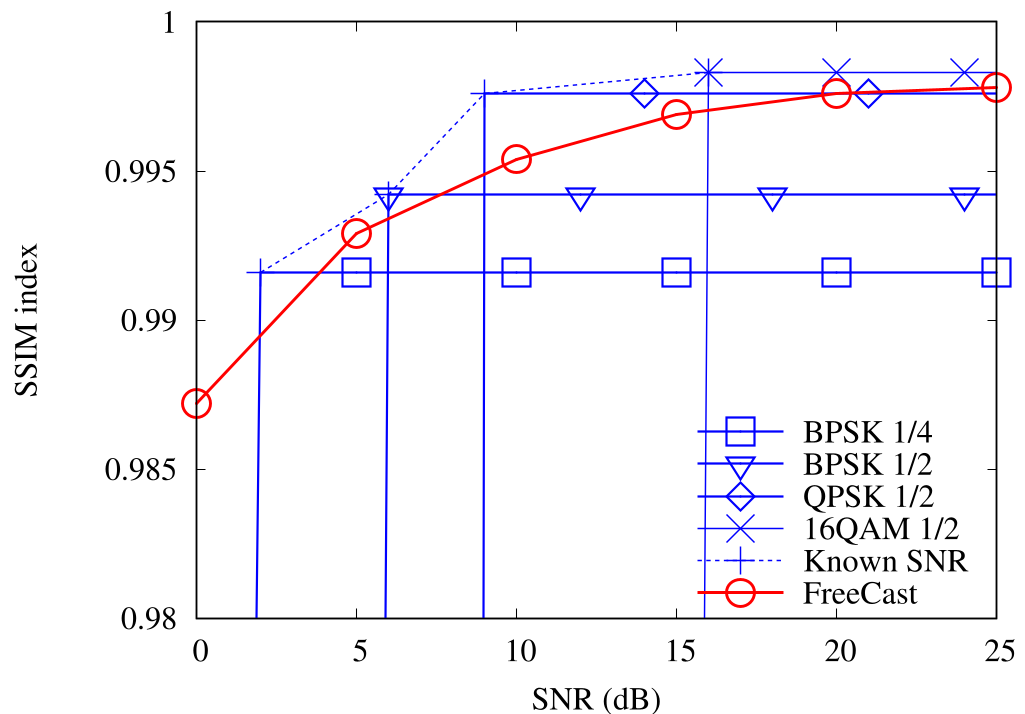
In narrowband environments (37.5 Msymbols/s), FreeCast maintains high SSIM (Structural Similarity) while other schemes collapse because their metadata consumes all available transmission power.
- SSIM Gain: +0.127 over existing graceful schemes.
- Visual Fidelity: As seen in the snapshots, FreeCast maintains details (like the texture of the "Balloons") that are blurred out in chunk-based schemes.
Visual Quality Comparison
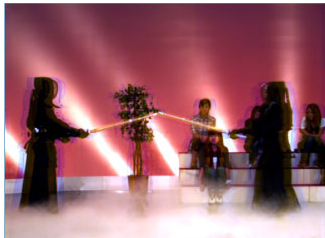
The snapshots below demonstrate the practical benefit. While chunk-based methods introduce severe blurring at low bandwidths, FreeCast remains crisp.
Deep Insight: Why it Works
The genius of FreeCast lies in its parameterization of uncertainty. In wireless communication, the receiver's error is proportional to the scaling factor used at the transmitter. By using a 5D-GMRF model, the receiver can "reconstruct" the optimal MMSE (Minimum Mean-Square Error) filter gain for every pixel without the transmitter actually sending those gains. It relies on the physical intuition that natural video signals follow predictable decay patterns in the frequency domain.
Critical Analysis & Conclusion
Takeaway
FreeCast successfully extends the concept of "Soft" video delivery to the complex world of Free-Viewpoint Video. It effectively solves the metadata bottleneck that previously made analog-style streaming impractical for multi-view data.
Limitations
- Complexity: 5D-DCT is computationally expensive compared to standard 2D transforms.
- High Resolution: The paper notes that fitting errors increase with high-resolution videos (1280x960), suggesting the 1st-order GMRF might need higher-order extensions for 4K/8K content.
- PAPR: High-dimensional transforms can lead to a high Peak-to-Average Power Ratio, which is a challenge for mobile device power amplifiers.
Future Work
The next frontier is likely Hybrid digital-analog systems that use digital layers for base metadata and analog layers for residual refinements, potentially incorporating Compressive Sensing to improve loss resilience.