
Beyond Coordinates: Mining Universal Semantic Mobile Patterns in LBSNs
Frequent Semantic Trajectory Sequence Pattern Mining in Location-Based Social Networks
The paper introduces the Frequent Semantic Trajectory Sequence Pattern Mining (FSTS-PM) problem for Location-Based Social Networks (LBSNs). It proposes the Modified PrefixSpan (MP) algorithm, which optimizes frequent mobile pattern discovery by decoupling it from fixed location coordinates and integrating spatial-temporal constraints, achieving superior efficiency over traditional post-filtering methods.
TL;DR
Researchers have moved past simple GPS tracking to define FSTS-PM (Frequent Semantic Trajectory Sequence Pattern Mining). By focusing on semantic labels (e.g., "Work" to "Gym") rather than exact latitude/longitude, and introducing the Modified PrefixSpan (MP) algorithm, this work allows for the discovery of universal human behavior patterns across different geographical regions with high computational efficiency.
Context & Motivation: The "Coordinate Trap"
Standard trajectory mining has a fundamental flaw: it is geographically tethered. If User A follows a "Home → Cafe → Library" routine in New York and User B does the same in London, traditional algorithms see no similarity because their coordinates are thousands of miles apart.
Furthermore, current semantic-aware models often treat time and distance as "afterthoughts"—filtering results only after the heavy lifting of sequence mining is done. This leads to massive overhead from processing sequences that are eventually discarded.
Methodology: The Modified PrefixSpan (MP)
The core innovation lies in the MP Algorithm, which transforms the classic PrefixSpan growth strategy into a constraint-aware engine.
1. Problem Redefinition
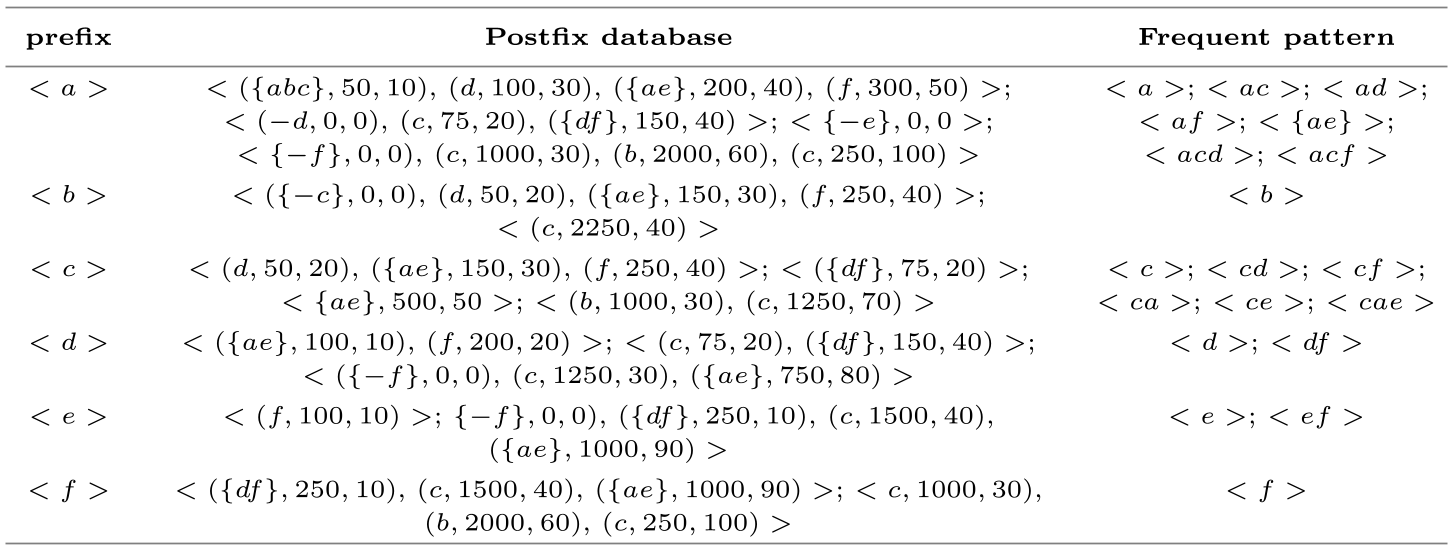
The authors define a Semantic Postfix not just as a subsequence, but as a triplet of (Semantic Labels, Relative Distance, Time Interval). A pattern is only "frequent" if:
- The semantic items match the prefix.
- The spatial distance .
- The time interval .
2. Integration of Constraints
Instead of mining all semantic sequences and then checking limits, the MP algorithm applies and filters during the creation of the postfix database. If a trajectory point fails the spatial or temporal gap requirement relative to the current prefix, it is pruned immediately.
Experimental Validation
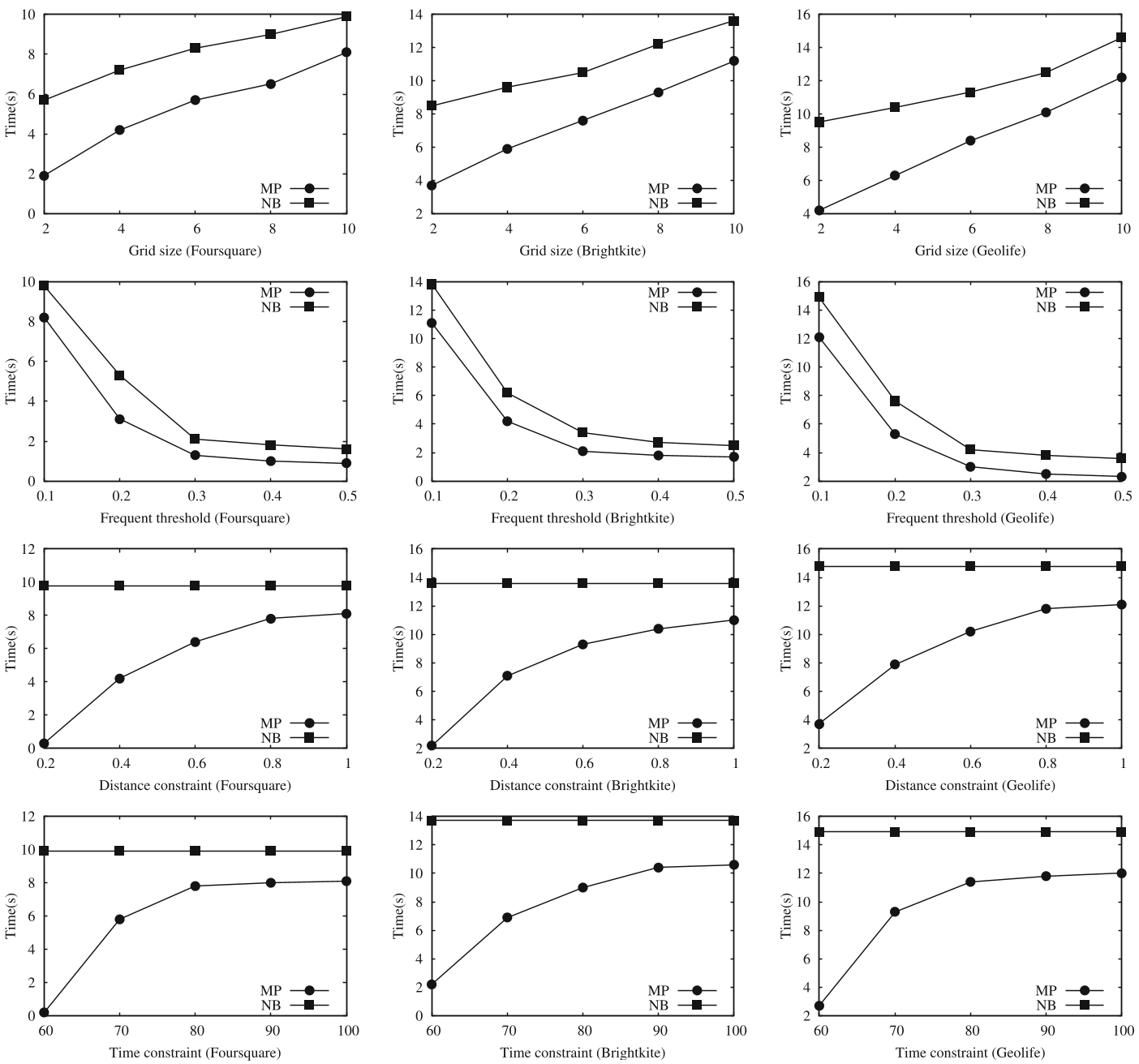
The authors compared MP against a Naive Baseline (NB) using three major LBSN datasets: Foursquare, Brightkite, and Geolife.
Key Findings:
- Efficiency: The MP algorithm's runtime is significantly lower than NB because it prunes the search tree much earlier.
- Sensitivity: As the distance constraint () or time constraint () becomes stricter, MP’s performance improves further, whereas NB remains slow because it must always mine the full set of sequences first.
- Scalability: Even with larger grid sizes or lower support thresholds (which usually spike complexity), MP maintains a manageable computational trajectory.
Critical Insight & Future Outlook
This paper successfully bridges the gap between purely spatial and purely semantic mining. By treating distance and time as relational constraints rather than absolute attributes, the MP algorithm uncovers "Behavioral Templates" that apply globally.
Limitations: The model assumes Euclidean distance, which may not reflect real-world travel constraints (like traffic or subway routing). Future iterations could benefit from integrating network distance or Hidden Markov Models (HMM) to handle the uncertainty of intermittent check-ins.
Conclusion: For developers in recommendation systems or urban planning, this approach offers a blueprint for identifying high-value behavioral sequences without being restricted by the sparsity of specific location data.