
Where is my Friend? Bridging the Gap Between Simple Tags and Precise Person Identification
Where is my Friend?- Person identification in Social Networks
This paper introduces a weakly supervised framework for person identification and localization in social network images using a Latent Max-Margin formulation. By leveraging Off-the-shelf CNN features (OverFeat) and a Latent SVM, the method successfully identifies tagged individuals in diverse poses and environments without requiring bounding-box annotations during training.
TL;DR
Researchers from UC Berkeley and IIT Kanpur have developed a method to find and localize your friends in social media photos using only image-level tags (e.g., "Alice is in this photo"). By treating the exact location of the person as a "latent" (hidden) variable and using a powerful max-margin framework combined with deep learning features, the system can identify people even when their faces are turned away or partially hidden.
Background & Positioning
In the landscape of computer vision, we usually see two extremes: Face Recognition, which requires clear frontal shots, and Person Re-identification, which matches people across different cameras (often relying on consistent clothing). This paper carves out a middle ground: Weakly Supervised Person Identification. It addresses the "Social Network Scenario" where labels are plentiful (tags) but spatial data is missing.
The Core Challenge: Ambiguity
Why is this hard? When you have a group photo tagged with "Chandler," the computer faces two types of ambiguity:
- Data Association: Which of the five people in the photo is actually Chandler?
- Classification Accuracy: Is that detected blob actually a person, or just a piece of furniture that looks like one?
Existing methods like the Viola-Jones face detector are notoriously brittle—this paper notes that roughly 36-39% of faces are missed in real-world social photos because people aren't always looking directly at the camera.
Methodology: The Latent Max-Margin Approach
The authors' "Aha!" moment was realizing that if we can't see the location in the training data, we should let the model infer it as a hidden parameter.
1. Generating Hypotheses (DPM)
Instead of looking everywhere, the system uses a Deformable Part Model (DPM) to find all potential human candidates. They intentionally set a low threshold to ensure they don't miss any friends, even if it creates more "noise."
2. Deep Feature Representation
Each candidate box is passed through OverFeat (a pre-trained Convolutional Neural Network). They use a Spatial Pyramid approach, breaking the person's image into levels (1x1 and 2x2) to capture both global appearance and local details.
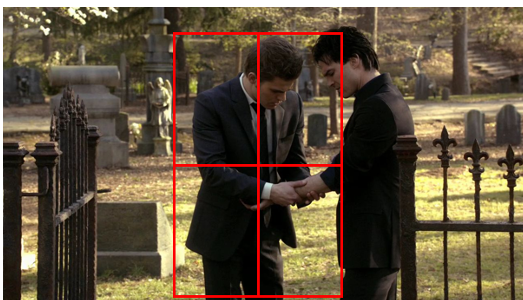 Figure: The Spatial Pyramid representation used to encode person candidates. This multi-level approach captures more discriminative features than a single global crop.
3. Latent SVM Training
The model learns to find a weight vector that maximizes the score for the "correct" person while minimizing scores for everyone else. Since we don't know who the correct person is during training, the algorithm alternates between guessing the friend's location and updating the classifier's weights.
Experimental Battleground
The researchers tested the model on three custom datasets: Chandler (Friends TV show), Obama (Political photos), and a Social Network Dataset (Facebook).
Key Findings:
- The Power of 2-Levels: Using a 2-level pyramid significantly boosted results. On the Social Network dataset, they achieved 94.85% Average Precision (AP).
- Face vs. Body: Adding explicit facial features helped, particularly when the face was visible, but the "Body" features from the CNN were the real workhorse for non-frontal poses.
- Context Matters: The model performed better when negative samples came from the same environment (contextual), forcing the Latent SVM to learn personal features rather than just background differences.
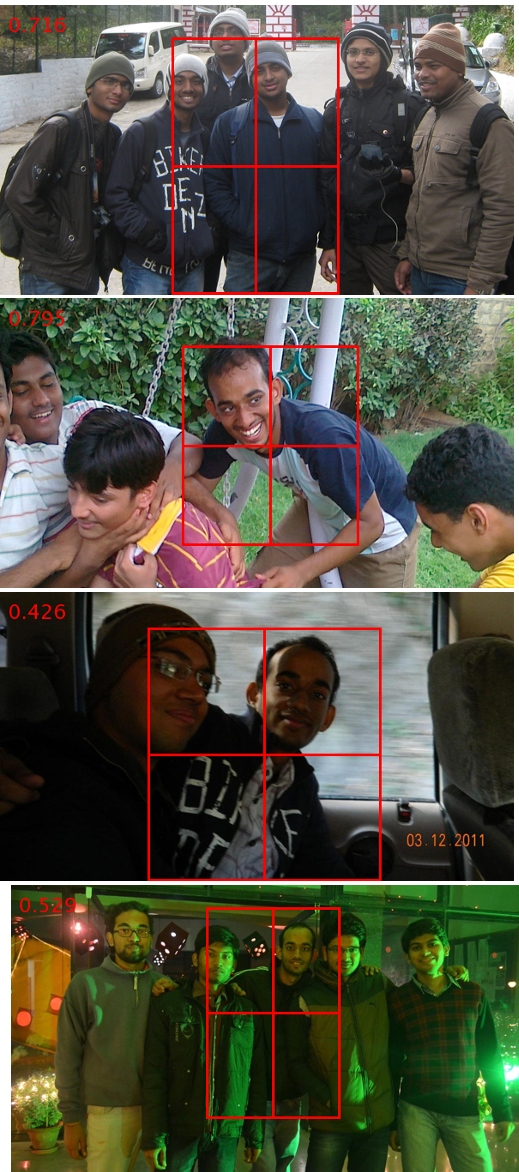 Figure: Successful localization and identification of "Chandler" and "Obama" across varied environments and poses.
Critical Insight & Future Outlook
The primary takeaway is that Weak Supervision is enough. You don't need a human to draw 10,000 boxes to teach a computer to find a specific person. By combining the physical intuition of "where a person might be" (DPM) with the high-dimensional discriminative power of CNNs, we can build robust identification systems.
Limitations: The system still struggles with extreme crowding where person detectors merge two people into one box. Future work could benefit from End-to-End training where the person detector and the latent classifier are optimized simultaneously using modern architectures like Faster R-CNN or Vision Transformers.
Conclusion
This paper serves as a foundational bridge, showing how to leverage the "noisy" but abundant data of social media to perform high-precision computer vision tasks. It effectively identifies "Friends" in the wild, regardless of their pose or the camera angle.