
FRBTA: Beyond Proximity—Redefining LBSN Friend Recommendations via Semantic Activity and Hierarchical Trust
Friend Recommendation Algorithm Based on User Activity and Social Trust in LBSNs
The paper proposes FRBTA (Friend Recommendation Based on Trust and Activity), a hybrid recommendation algorithm for Location-Based Social Networks (LBSNs). It integrates semantic activity preferences extracted via TF-IDF from user-generated content with a multi-layered social trust model (direct, indirect, auxiliary, and global) to improve recommendation accuracy.
TL;DR
Standard friend recommendations in Location-Based Social Networks (LBSNs) like Instagram often suggest people just because they visit the same spots. FRBTA (Friend Recommendation Based on Trust and Activity) breaks this mold by analyzing why you are there (Semantic Activity) and how much you actually interact (Social Trust). By combining TF-IDF-based activity profiling with a complex trust decay model, it achieves superior precision over traditional social-link or preference-only baselines.
Problem & Motivation: The Location Trap
Why do current systems fail? Imagine User A is a "Foodie" at a high-end restaurant, while User B is a "Professional Photographer" at the same spot. A location-centric algorithm would recommend them to each other, but their interests—and therefore their social compatibility—are fundamentally misaligned.
The authors identify three core gaps:
- Lack of Semantic Context: Missing the "behavioral" meaning behind the GPS coordinate.
- Binary Social Links: Treating all "follows" as equal without considering "likes" or "comments" (auxiliary trust).
- Static Ranking: Ignoring the global influence of a user versus local direct trust.
Methodology: The Core of FRBTA
The FRBTA algorithm operates on two primary engines: Activity Similarity and Social Trust.
1. Semantic Activity Profiling
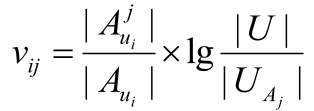
The system extracts keywords from photo tags and comments, then maps them to a standard taxonomy (e.g., Foursquare categories). It builds a User-Activity Matrix (UAM) where importance is weighted by a customized TF-IDF formula:
2. Multi-Layered Social Trust
Trust isn't just a "Follow" button. FRBTA decomposes it into:
- Direct Trust (): Based on the "Follow" relationship.
- Indirect Trust (): Transitive trust through mutual connections (with path decay).
- Auxiliary Trust (): Derived from "likes" and "comments," capturing active engagement.
- Global Social Trust (): A normalized measure of a user's overall authority/popularity in the network.
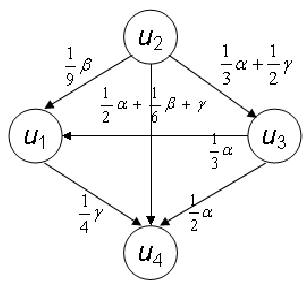 Figure: Visualizing the local trust network (a) versus final weighted trust (b).
Experiments & Results
The authors tested FRBTA against CFR (Common Friend Recommendation) and PSR (Preference Similarity Recommendation) using a massive Sydney-based Instagram dataset (100k photos, 8k users).
Key Findings:
- Hyper-parameter Sensitivity: The study found that and provide the best balance for precision. Interestingly, local trust () was found to be significantly more important than global authority ().
- Preference vs. Trust: Results showed that while users value similar interests, they prioritize recommendations from sources they "trust." The optimal weight for activity similarity was found at , suggesting a 60/40 split between behavior and trust.
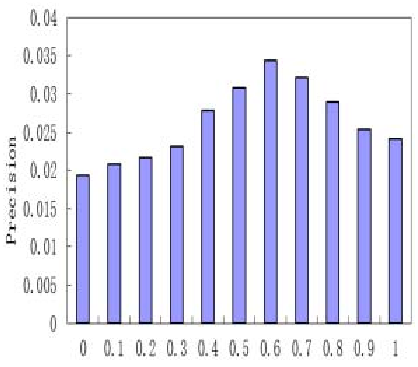 Figure: FRBTA clearly outperforms PSR and CFR in both Precision and Recall.
Critical Analysis & Conclusion
Takeaway
FRBTA proves that in the age of UGC, "Context is King." By differentiating between the physical location and the semantic activity, the model moves closer to human-like social intuition.
Limitations
- Computational Complexity: Calculating indirect trust paths (even with a limit of path length 3) can be computationally expensive as the user graph grows to millions of nodes.
- Cold Start: The model relies on existing interaction data (likes/follows). New users with no activity or social links would still struggle to receive high-quality recommendations.
Future Work: Integrating Graph Neural Networks (GNNs) could automate the feature extraction of trust paths, potentially replacing manual path traversal with learned embeddings.