
Beyond the Mutual Friend: Reinventing Social Discovery through Spatial Intimacy and Weighted Voronoi Diagrams
Friend Recommendation for Location-Based Mobile Social Networks
This paper introduces a hybrid friend recommendation system for Location-Based Mobile Social Networks (LBMSNs) that integrates real-world mobility data with social interests. It features a novel weighted Voronoi diagram approach and Longest Common Subsequence (LCS) pattern matching to calculate multi-dimensional user similarity.
TL;DR
Most social apps recommend friends based on who you already know. This paper argues we should be looking at where you go and what you actually like. By combining GPS dwell time (processed via Weighted Voronoi Diagrams) and Facebook interests (via LCS pattern matching), the authors propose a recommendation engine that mirrors real-life social serendipity.
The Problem: The "Friends-of-Friends" Trap
If you've ever been recommended a stranger just because you share a distant acquaintance, you've experienced the limits of current recommendation systems. These systems lack cognitive context. They treat social networks as static graphs rather than dynamic human interactions.
The authors identify two missing pillars in modern social discovery:
- Dwell Time: It's not just about being at the same place; it's about how long you stay there.
- Semantic Interests: "Music" and "Classical Music" are related, but simple keyword matching fails to see the connection.
Methodology: The Core Engine
The authors use a brilliant geometric approach to solve the spatial similarity problem.
1. Spatial Intimacy via Weighted Voronoi Diagrams
Instead of simple GPS proximity, the system creates an Affinity Diagram.
- The Intuition: If you spend more time (dwell time) at a landmark, your "influence" or "presence" there is stronger.
- The Math: The dwell time is converted into a weight that adjusts the Voronoi cell boundaries. In this model, longer dwell time leads to a smaller, more concentrated area, allowing for a more precise overlap calculation between users.
The Location Similarity () is defined as the intersection of two users' Voronoi areas over their union:
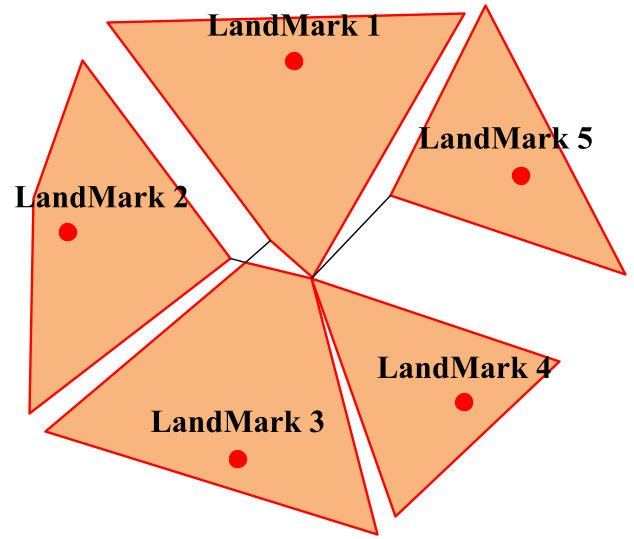 Figure: The weighted Voronoi diagram adjusts based on dwell time weights.
2. Semantic Interest Matching
To bridge the gap between "Classical Music" and "Classical Opera," the system uses Longest Common Subsequence (LCS). This allows the system to recognize that users have overlapping interests even if the strings aren't identical, providing a much higher "Acceptable Degree" of recommendation than binary matching.
Experiments and Results
The researchers tested this on users in Tainan, Taiwan, using ten specific landmarks (e.g., Tainan Confucius Temple, National University of Tainan).
Key Findings:
- Flexibility: By introducing a parameter , users can decide if they want friends who live/haunt the same places () or friends who share their hobbies ().
- The Accuracy Gap: In a test case, two users had a 77.72% location similarity and 66.67% interest similarity. With a standard threshold of 75%, a user preferring interest () would receive the recommendation, whereas a balanced user () would not.
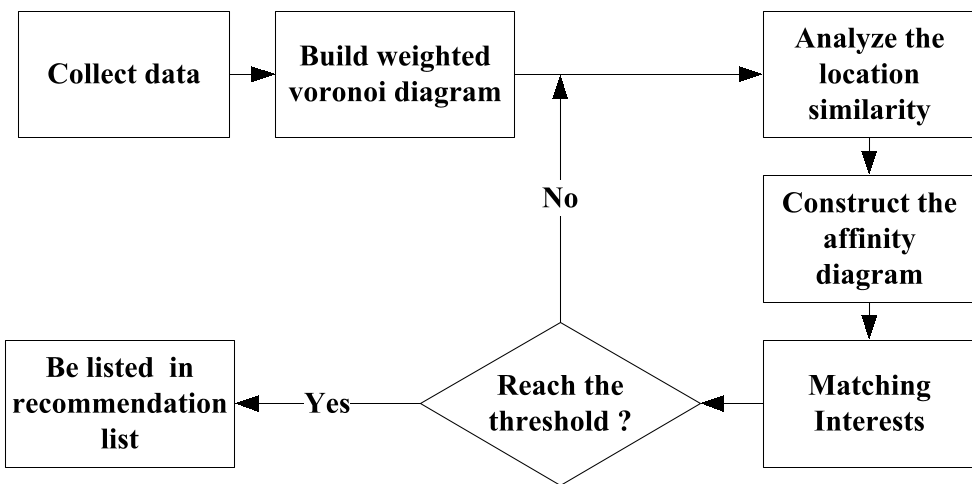 Figure: The data flow from GPS/Facebook to the Recommendation Server.
Critical Insight: Why This Matters
The true innovation here is the Weighted Voronoi approach. While most LBS (Location Based Services) use simple radius-based "check-ins," this paper treats space as a continuous, weighted manifold defined by human behavior (dwell time). It transitions from "You were here" to "You belong here."
Limitations & Future Work
The current model relies heavily on Facebook data, which may be sparse or outdated for some users. The authors suggest that Event-based concepts—such as simultaneous attendance at a concert or sports match—will be the next evolution of this "Physical + Social" hybrid model.
Conclusion
This work provides a rigorous framework for moving social recommendations into the physical world. By quantifying "Spatial Intimacy," we can move away from algorithmic bubbles and toward meaningful, real-world connections.