
Bridging the Digital Divide: Fusing Online Social Graphs with Offline Mobility for Serendipitous Meetings
Friend Recommendation Using Offline and Online Social Information for Face-To-Face Interactions
2016-05-01
Summary
Problem
Method
Results
Takeaways
Abstract
This paper introduces a hybrid friend recommendation system that facilitates serendipitous face-to-face interactions by fusing offline location history with online social network data. Using Coupled Matrix and Tensor Factorization (CMTF), the authors successfully predict potential friendships that transcend simple proximity, achieving a 3x improvement in recommendation accuracy over baseline methods.
## TL;DR
Socializing in the modern era is often polarized: we are either hyper-connected online or isolated in physical spaces. This paper presents a recommendation system that uses **Coupled Matrix and Tensor Factorization (CMTF)** to suggest potential friends who share both your physical haunts (captured via Bluetooth beacons) and your broader online social circle (Facebook). The result? A recommendation accuracy (MAP@5) over **300% higher** than traditional location-based methods.
## The Motivation: Why Proximity Isn't Enough
Existing recommendation engines usually fall into two traps:
1. **Online-Only**: Recommends people with similar interests but no physical proximity, making face-to-face interaction impossible.
2. **Offline-Only**: Recommends people simply because they visit the same coffee shop, ignoring whether you actually share a social "vibe" or mutual acquaintances.
The authors argue that true "serendipity" happens at the intersection of **place** and **personal network**. To solve this, they treat friendship recommendation as a data fusion problem.
## Methodology: The Power of CMTF
The core technical innovation lies in how the authors handle "heterogeneous" data.
### 1. Data Representation
* **The Tensor (Offline)**: A 3D array (User $ imes$ User $ imes$ Place). Each cell represents the frequency of two users overlapping at a specific location (e.g., Dunkin' Donuts).
* **The Matrix (Online)**: A 2D array (User $ imes$ User) representing connection scores calculated using a modified Katz centrality. This captures not just direct friends, but friends-of-friends (up to 3 hops).
### 2. The "Coupling" Insight
Because common datasets are sparse (you don't visit every place, and you aren't friends with everyone), standard factorization fails. By using **Coupled Matrix and Tensor Factorization**, the system shares the "User" latent factors between the matrix and the tensor. This allows the online social structure to "inform" the missing values in the offline location data, and vice versa.
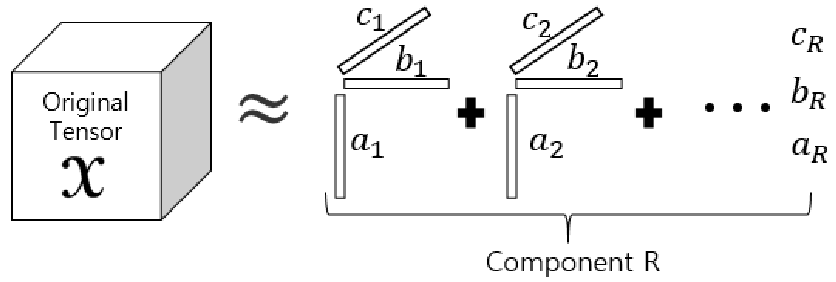
*Fig 1: The CMTF model where the User axis is shared to bridge location visit history and Facebook network data.*
## Experimental Results: Proving the Hybrid Advantage
The authors deployed a real-world system called "Serendipiter" at KAIST, using Bluetooth beacons across 27 locations.
### Quantitative Breakthrough
The performance gap between the hybrid model (UUPUU) and the location-only model (UUP) is staggering.
* **MAP@5**: The hybrid model scored **0.745** vs. the baseline's **0.215** for general interest.
* **MRR (Top 1)**: The inclusion of online social data made the first recommendation significantly more likely to be relevant.
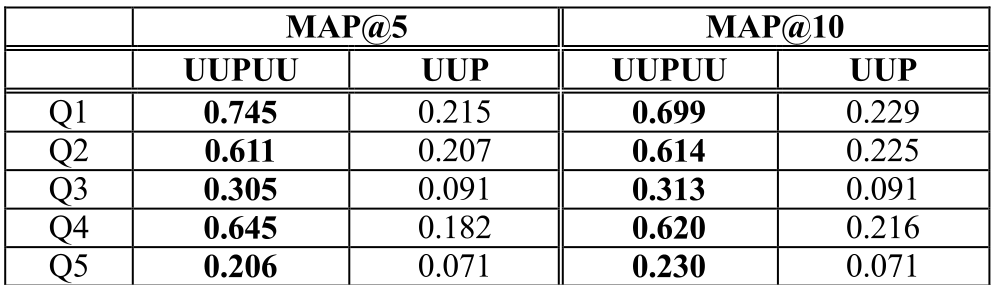
*Table: Comparison of Mean Average Precision (MAP) showing the superiority of the fused data approach.*
### Qualitative "Real-World" Readiness
Crucially, the authors didn't just measure "clicks." They asked participants if they would **eat a meal** or **chat** with the recommended person. The hybrid model showed much higher scores in these "extrinsic" social categories, proving that online social links are a strong proxy for real-world compatibility.
## Critical Analysis & Future Outlook
**The Takeaway**: This work proves that location history is too noisy to stand alone. Social context acts as a "denoiser," filtering out coincidental proximity and highlighting meaningful social potential.
**Limitations**:
* **Scale**: The study was limited to 12 primary participants and 50 simulated profiles. A larger-scale deployment is needed to test the "cold start" problem for new users.
* **Privacy**: Fusing Facebook data with fine-grained indoor location (Beacon-based) raises significant privacy concerns that weren't the focus of this technical paper.
**Future Work**: The authors plan to include temporal data (visit time) and specific user interests to further refine the "latent factors" in the factorization process. This could eventually lead to "smart city" social apps that facilitate high-quality networking in real-time.