
Beyond Similarity: Enhancing LBSN Friend Recommendations with Preference Coverage
Friend Recommendation Considering Preference Coverage in Location-Based Social Networks
The paper introduces the Friend Recommendation considering Preference Coverage Problem (FRPCP) in Location-Based Social Networks (LBSNs). It proposes the FRPC-A greedy algorithm, which balances traditional preference similarity with a novel Shannon entropy-based "preference coverage" metric to satisfy users' information-seeking demands.
TL;DR
Commercial Location-Based Social Networks (LBSNs) often recommend friends who are "too similar," resulting in redundant information and limited social utility. This paper proposes a novel framework that balances Preference Similarity with Preference Coverage, ensuring that new friends not only share common ground but also fill in the gaps in a user's "long-tail" interests.
Background: The Homophily Trap
In social recommendation, the concept of homophily—the tendency of individuals to associate with similar others—is a double-edged sword. While it ensures high recommendation "precision" (people you are likely to vibe with), it often ignores the informational utility of a friendship.
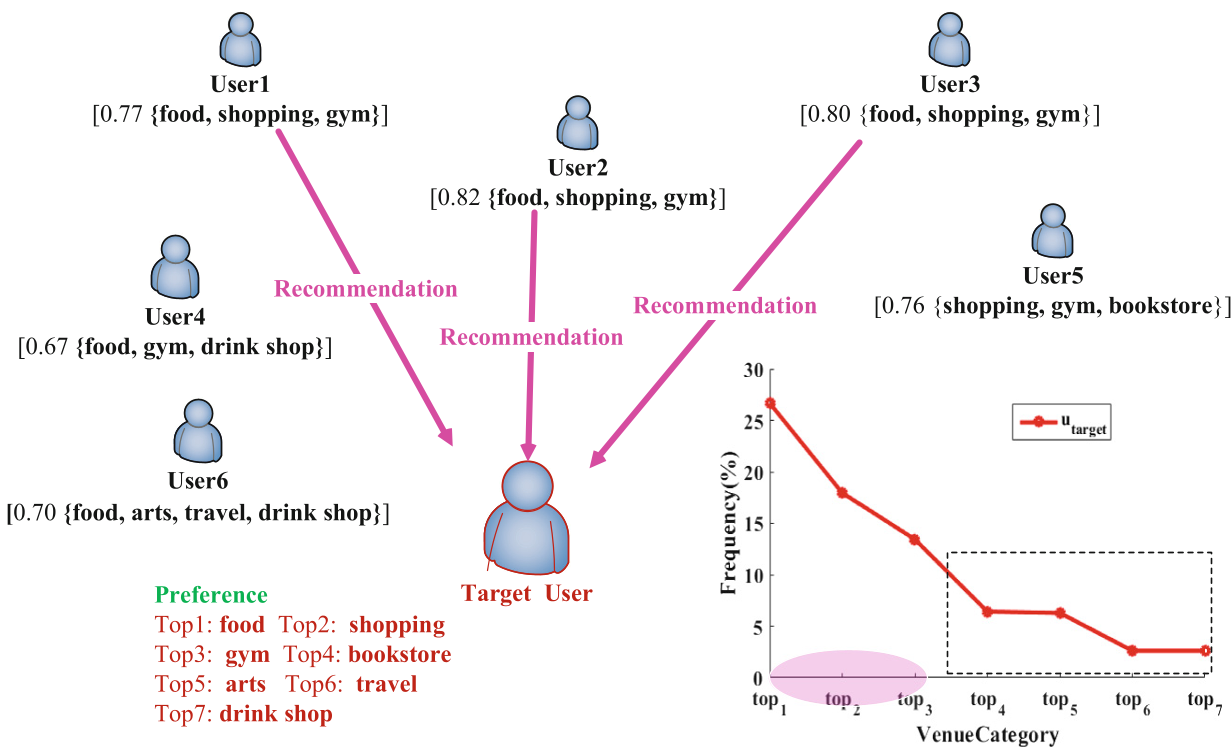
The authors observe that POI preferences in LBSNs follow a Power-law distribution (Fig 1). Most users have a few strong preferences (head) and many weak ones (long tail). If the system only recommends people similar to your "head" preferences, you miss out on experts who could provide valuable information about your "long-tail" interests.
Methodology: Bridging the Long Tail
The core of this work is the Friend Recommendation considering Preference Coverage Problem (FRPCP). The authors treat this as an optimization task with two objectives:
- Similarity (): Traditional Pearson correlation of POI category frequencies.
- Coverage (): A metric rooted in Information Theory (Shannon Entropy) that measures how well a set of potential friends covers the target user's spectrum of interests, particularly those in the long tail.
Mathematizing Intuition
The "demand" for information on a category is calculated using point-information entropy: Categories that a user visits less frequently (long tail) have higher weights, incentivizing the system to find friends who are experts in those specific niche areas.
The FRPC-A Greedy Algorithm
Since the problem is NP-hard, the authors leverage the Monotone Submodularity of their objective function. They prove that their greedy selection strategy provides a near-optimal solution with a bounded approximation ratio.

Experimental Insights
The researchers validated their approach using the Foursquare and Gowalla datasets.
1. Superior Diversity without Accuracy Loss
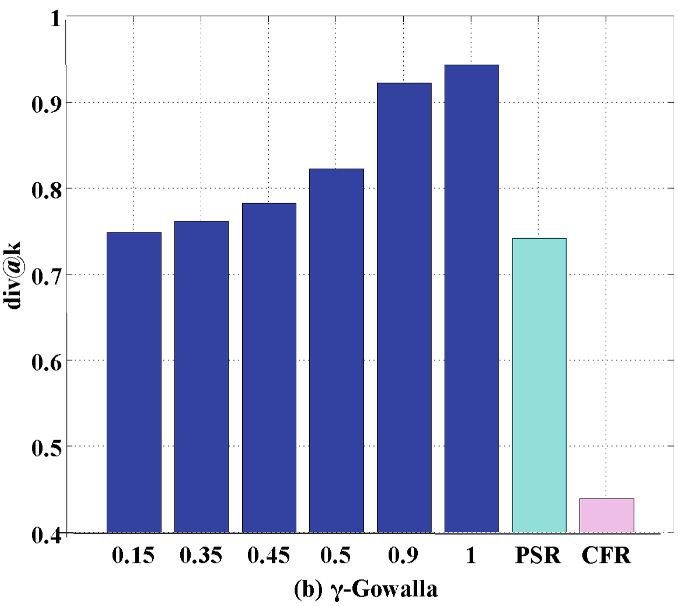
Traditional methods like PSR (Preference Similarity) and CFR (Common Friends) failed to provide diverse POI information. As shown in the "Comparison of Preference Coverage" (Fig 4), the FRPC-A method maintains a significantly higher diversity score across varying target users.
2. Robustness in Recommendation Quality
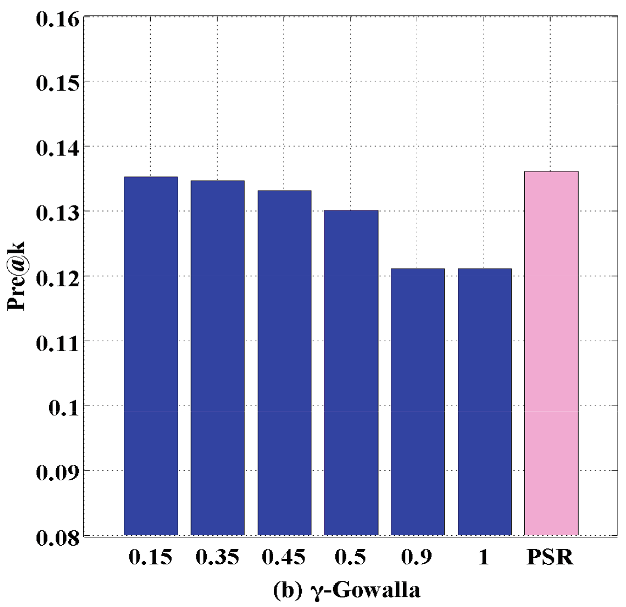
Critically, the gain in diversity does not come at the expense of traditional metrics. The Precision@k and Recall@k (Figs 5 & 6) remained consistent with PSR, proving that you can satisfy informational needs without recommending "irrelevant" strangers.
Critical Analysis & Conclusion
The brilliance of this paper lies in its recognition that redundancy is the enemy of utility. By shifting the focus from "finding more people like you" to "finding people who complete your knowledge," the authors provide a more functional path for social platforms.
Limitations: The model primarily relies on check-in frequency data. Future iterations could incorporate semantic analysis of user comments or temporal patterns (e.g., finding a friend who knows the "nightlife" scene to complement your "daytime" habits).
Closing Takeaway: For developers and researchers in the LBSN space, this work serves as a reminder: A better recommendation engine doesn't just mirror the user; it expands their world.