
FriendLink: Mastering the "Small World" for Precision Link Prediction
Friendlink: Link prediction in social networks via bounded local path traversal
This paper introduces FriendLink, a novel link prediction algorithm for Online Social Networks (OSNs) that utilizes bounded local path traversal. It calculates node similarity by aggregating unique pathways of varying lengths (up to distance L) using a specific attenuation factor, achieving state-of-the-art accuracy in friend recommendations.
TL;DR
FriendLink is a high-performance link prediction algorithm that moves beyond simple common-neighbor checks. By intelligently traversing all paths up to a bounded length (typically ), it captures deeper social nuances that local methods miss, while remaining exponentially faster than global algorithms like Katz or Random Walk with Restart (RWR).
Background: The Gap in Social Graph Mining
In the landscape of Online Social Networks (OSNs), recommending "People You May Know" is a cornerstone feature. Traditionally, research has been split into two camps:
- Local Methods (FOAF/Jaccard): Extremely fast but myopic. They only see people who share common friends (length-2 paths).
- Global Methods (Katz/RWR): Highly accurate as they consider the entire graph structure, but they require matrix inversions—making them impossible to run on massive live networks.
The authors of FriendLink identify a "sweet spot" based on the Small-World Hypothesis: if any two people are connected by roughly six degrees of separation, we don't need to calculate the entire graph. We just need to look a little bit further than the immediate neighbors.
Methodology: The Logic of Bounded Traversal
FriendLink's core innovation is its similarity measure, which counts path sequences between nodes and . The formula incorporates a critical attenuation factor:
Why this works:
- Length Weighting: The factor ensures that a path of length 2 (direct common friend) carries more weight than a path of length 3 (friend of a friend of a friend).
- Normalization: By dividing by the product of , the algorithm accounts for the total possible paths in a graph of size , keeping similarity scores within a [0, 1] range.
- Cycle Avoidance: The algorithm specifically counts simple paths (no repeating nodes), preventing "echo chambers" in similarity scores.
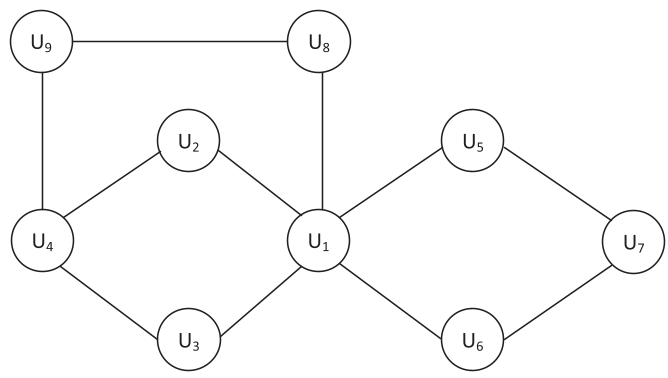 Figure 1: In this graph, while users and both share relationships with , is deemed a better recommendation because of the presence of more diverse paths through the network.
Experimental Insights
The authors tested FriendLink on two distinct datasets: Hi5 (sparse) and Epinions (dense small-world).
1. The Power of
One of the most striking findings is that increasing the traversal limit doesn't always help. Precision peaks at . Beyond this, the "noise" of distant connections begins to dilute the quality of the recommendation.
2. Efficiency vs. Effectiveness
FriendLink consistently outperformed RWR and Katz index in both speed and precision.
| Dataset | FriendLink Time | RWR Time | Katz Time |
|---|---|---|---|
| Epinions 49K | 245 sec | 380 sec | 460 sec |
| Hi5 63K | 340 sec | 520 sec | 617 sec |
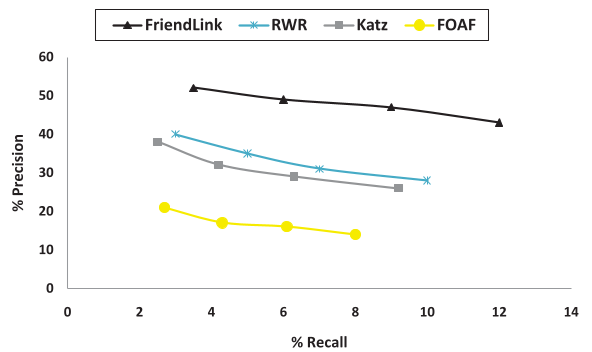 Figure 2: Precision-Recall curves show FriendLink (solid line) maintaining higher precision as recall increases compared to traditional local and global baselines.
Critical Analysis & Takeaways
The brilliance of FriendLink lies in its Inductive Bias. It acknowledges that social relationships are local by nature, but "local" is larger than just one hop.
Key Takeaways:
- Structural Context Matters: Local clustering coefficients significantly impact performance. FriendLink excels in "small-world" environments (like Epinions) where LCC is high.
- The 3-Hop Rule: For real-world production systems, traversing 3-hop paths provides the best ROI for recommendation accuracy.
Limitations: While faster than global methods, the complexity (where is average degree) can still be high for extremely dense networks. Future work should look into sampling-based path traversal to further reduce the computational footprint on "super-nodes" with thousands of edges.
Conclusion
FriendLink proves that you don't need a global view of the world to make a great friend recommendation; you just need to look two steps past your own front door.