
FriendRank: Decoding Social Bonds to Rescue Your Twitter Feed from Noise
FriendRank: A personalized approach for tweets ranking in social networks
This paper introduces FriendRank, a personalized tweet ranking model that prioritizes user friendships and personal interests. By integrating dynamic interaction frequency and time-decay factors, the approach achieves a significant performance leap, outperforming chronological sorting by 12x in DCG@150 metrics.
TL;DR
The sheer volume of tweets makes it impossible for users to find what they truly care about. FriendRank shifts the ranking paradigm from simple timelines to a "social-first" approach. By modeling the "temperature" of friendships using interaction frequency and time-decay, it successfully predicts which tweets a user will engage with, outperforming traditional chronological methods by over 1200% in ranking quality (DCG@150).
The "Chronological" Fallacy
Social networks traditionally rely on the Recency Bias—the assumption that the newest content is the most relevant. However, for a user following 500+ accounts, the "signal-to-noise" ratio drops precipitously. Prior research attempted to solve this via content matching, but it ignored a fundamental human truth: who posted it often matters more than what was posted.
Methodology: The Engineering of Friendship
The core innovation of FriendRank lies in how it quantifies the "Friendship Score" (). The authors treat social ties as dynamic entities that grow with heat (interaction) and cool down with neglect.
1. The Growth-Decay Mechanism
Friendships aren't static. The model uses two distinct phases:
- The Growth Phase: When a user retweets or replies, the score increases. Retweets are weighted more heavily () than replies (), reflecting a higher "intensity" of endorsement.
- The Cooling Phase: Using Newton's Law of Cooling, the model simulates the natural fading of social ties. If interaction stops, the friendship value decays exponentially over time:
2. Feature Fusion with ListNet
Beyond friendship, the model extracts six key interest features, including Tweet Text Relevance (calculated via word2vec embeddings) and structural indicators like Hashtag relevance and URL presence. These are fed into ListNet, a list-wise learning-to-rank algorithm that optimizes the entire permutation of tweets rather than just individual pairs.
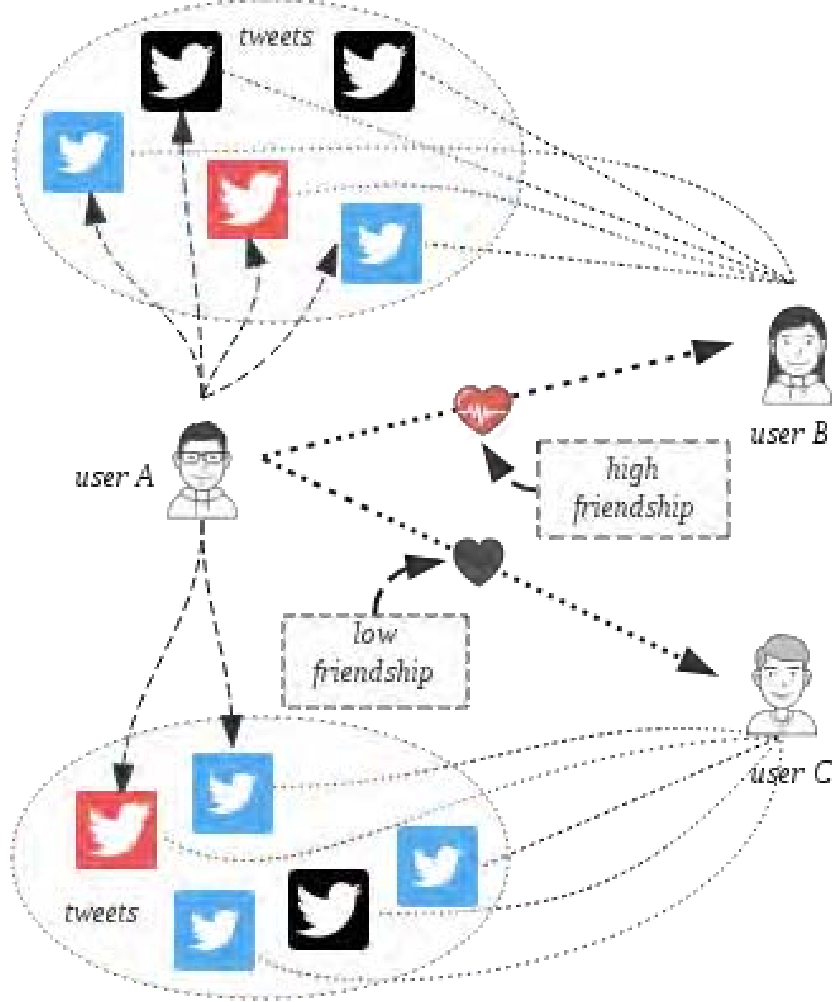 Figure 1: Conceptual visualization of how high-friendship ties (User B) prioritize even uninformative tweets for User A, while low-friendship ties (User C) result in ignored content.
Experimental Results: Friendship is the Signal
The authors crawled two months of real-world Twitter data (127,957 tweets). The results were stark:
- Chronological Ranking: Produced a DCG@100 of nearly zero.
- FriendRank: Delivered a DCG@100 of 0.2549.
The most telling insight came from an ablation study. When the friendship features were removed (leaving only content interest), the performance plummeted to baseline levels, proving that user friendships are the primary driver of engagement.
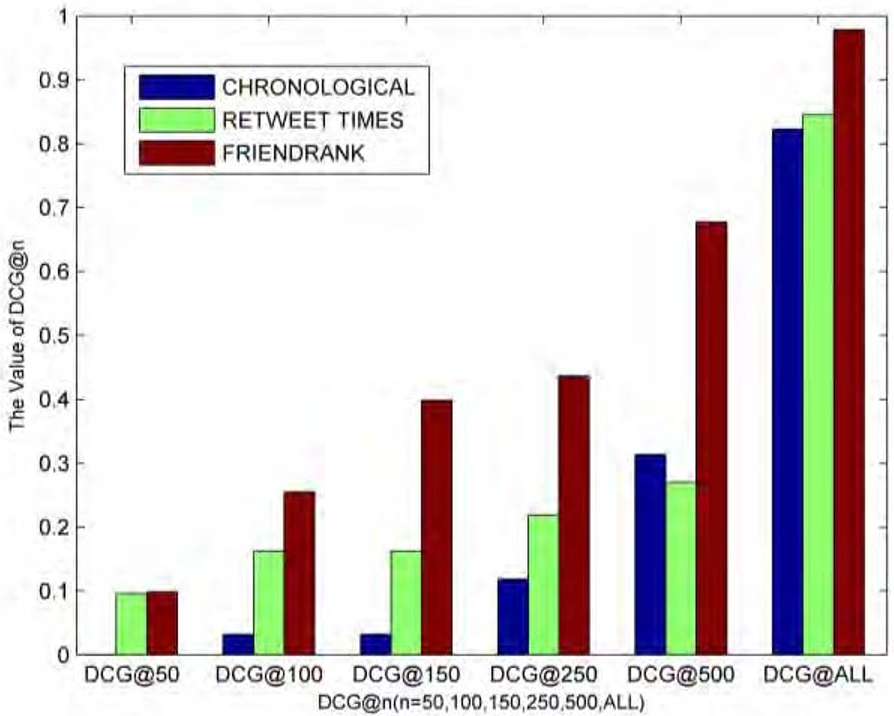 Figure 2: Performance trajectory of FriendRank vs. Baselines. Note the exponential climb of FriendRank as more tweets are considered.
Deep Insight & Conclusion
FriendRank demonstrates that social relevance is not just about "keywords" but about "momentum." By importing a concept from thermodynamics (Newton's cooling) into social graph analysis, the authors provided a mathematically elegant way to handle the volatility of digital relationships.
Limitations: The model currently treats all "non-interacting" relationships the same. It cannot yet distinguish between a "family member" you follow but don't tweet at, and a "stranger" you've simply forgotten.
Future Outlook: Integrating NLP sentiment analysis into the "Growth" formula (distinguishing between a friendly reply and a hostile one) could further refine these social scores, leading to a truly "human-centric" recommendation engine.