
FriendRouter: Revolutionizing Real-Time Pathfinding in Massive Social Networks
FriendRouter: real-time path finder in social networks
FriendRouter is a real-time path-finding tool for large-scale social networks that utilizes a bidirectional A* search combined with geographical heuristics. It achieves SOTA efficiency by expanding fewer than 40 nodes on average, delivering a 10^5 performance gain over the Dijkstra algorithm.
Executive Summary
TL;DR: FriendRouter is a specialized search engine capable of finding connections between social media users in real-time. By leveraging a bidirectional A* algorithm enhanced with geographical heuristics, it reduces the search space by a factor of compared to Dijkstra’s algorithm, typically exploring fewer than 40 nodes to bridge any two users.
Positioning: While the "Six Degrees of Separation" is a proven concept, actually finding those degrees in a graph of billions of edges is an NP-hard-like challenge in practical settings. FriendRouter serves as a bridge between theoretical graph theory and the practical constraints of modern Web APIs.
The "Small World" Paradox
In theory, you are only 3.74 to 4.67 hops away from anyone on Facebook or Twitter. However, if you tried to find that path using a Breadth-First Search (BFS), you would hit rate limits or exhaustion within seconds. The branching factor of social nodes is too high.
The core problem isn't the distance; it's the search volume. Standard algorithms don't know "where" to look, so they explore in every direction. FriendRouter's developers realized that social connections are not random—they are heavily influenced by geography.
Methodology: Geography as a Compass
The genius of FriendRouter lies in its two-phase, bidirectional approach:
- Backward Goalset Generation: Instead of searching for one specific target, the algorithm starts from the target's location and builds a "goalset" of ~1,400 nearby users (a "local cluster").
- Heuristic Forward Search: The search starts from the source using a custom A* cost function:
- : The number of hops from the start.
- : A penalty based on In-degree/Out-degree (preferring influencers) and Geographical distance to the target's home city.

By prioritizing nodes that live near the target or have high connectivity, the search "tunnels" through the graph rather than exploding outward.
Experimental Results: Efficiency Gain
The results are striking. In real-world tests on Twitter data, FriendRouter found paths across the network with surgical precision.
| From User | Through | To User | Nodes Explored |
|---|---|---|---|
| Bill Gates | Bill Gross > GreylockVC | Joe Hellerstein | 36 |
| Shakira | Ashton Kutcher | Alon Halevy | 8 |
| Leo DiCaprio | levie | Seemohan | 38 |
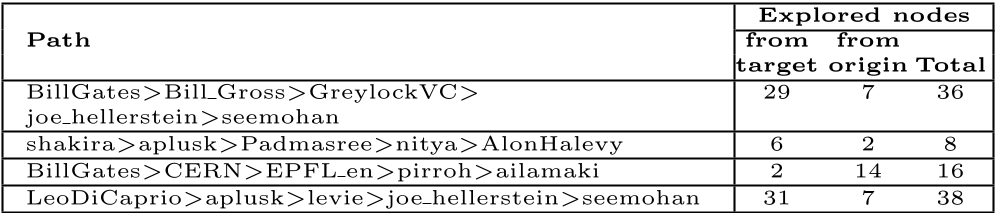
While Dijkstra would require reading a significant portion of the entire Twitter global graph, FriendRouter hits its target by looking at roughly the same number of people you'd find in a small classroom.
Critical Analysis & Conclusion
Takeaway
FriendRouter proves that Metadata is Power. By using city-level location data—often publicly available—the complexity of graph search can be collapsed. This is a vital lesson for engineers building recommendation systems or "mutual friend" features.
Limitations
- Geographical Accuracy: The heuristic relies on users reporting their home cities accurately.
- Optimality: Unlike Dijkstra, FriendRouter does not guarantee the absolute shortest path, only a "short" path. However, in a real-time application, a 5-hop path found in 100ms is vastly superior to a 4-hop path that takes 2 hours to calculate.
Future Outlook
As social networks move toward more privacy-centric models (hiding location), future iterations of FriendRouter may need to use "interest-based" heuristics (NLP on bios) to replace geographical data.