
Friends and Foes: Why Your Real Friends Matter More Than Your Ideological "Allies"
Friends and foes: Ideological social networking
This paper investigates the "Essembly" social network to analyze how distinct ideological relationship types—Friends, Allies, and Nemeses—influence user behavior. It reveals that while "Allies" share the highest ideological similarity, only "Friends" and "Nemeses" significantly impact voting participation and content discovery.
TL;DR
In the mid-2000s, while most social networks were obsessed with "collecting" friends, a unique platform called Essembly allowed users to label their connections as Friends, Allies, or Nemeses. This study reveals that while we agree most with our "Allies," we are primarily influenced by our "Friends" (social trust) and "Nemeses" (negative filtering). Surprisingly, pure ideological alignment (Allies) does very little to drive actual engagement.
The Problem: The "Friendship Dilution" Trap
Most social media platforms suffer from a semantic collapse where a "Friend" could be a spouse, a high school acquaintance, or a stranger you met at a conference. This creates a noisy signal for recommendation engines. As networks grow, the "friend" label becomes diluted, losing its power to serve as an effective content filter.
The authors hypothesized that by refining the semantic granularity of social connections—separating who we know from who we agree with—we could better understand how information truly spreads.
Methodology: The Essembly Lab
The researchers analyzed 1.4 million votes on "resolves" (controversial statements) from Essembly. They defined three distinct link types:
- Friend: Real-world personal relationship.
- Ally: Someone you don’t necessarily know but share ideological goals with.
- Nemesis: Someone whose worldview you find "psychotically skewed."
Using an Ideological Similarity Metric, they measured how much users in these groups actually agreed.
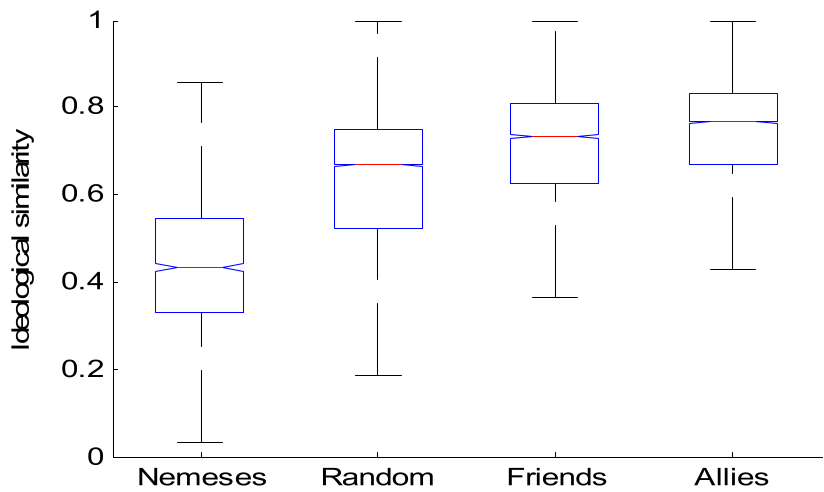 Figure: Distribution of ideological similarity across the three network types compared to random pairings.
Key Findings: The "Ally" Paradox
The results provided a fascinating look into the human psyche:
- Similarity ≠ Influence: Allies had the highest ideological similarity (Median 0.77). However, seeing an "Ally" vote on something did not increase the likelihood that a user would vote on it.
- The Power of Friends: Seeing just one Friend vote on a resolve made a user 48% more likely to engage. This suggests that interpersonal trust trumps ideological alignment.
- The Nemesis Filter: If two or more Nemeses voted on a resolve (and no friends did), engagement actually dropped by 14%. Users used Nemeses as a "negative filter"—if my enemy is talking about it, it’s probably not worth my time.
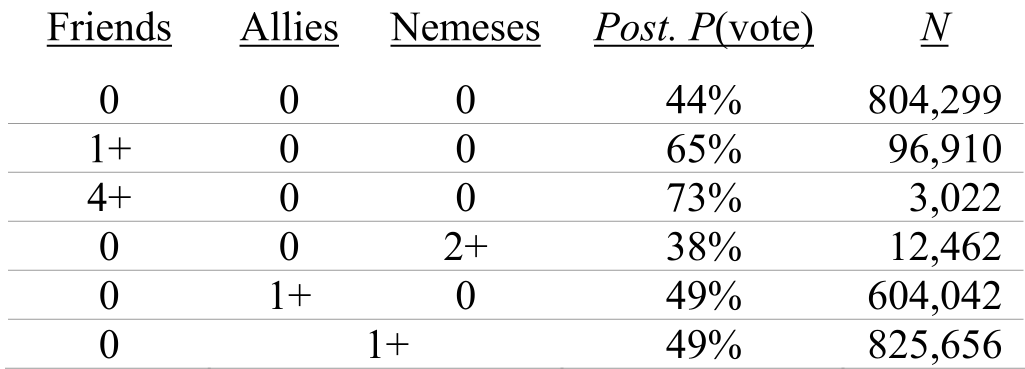 Table: Posterior probability of voting based on network activity.
Professional Insight: Why Does This Happen?
The authors suggest that we "curate" our friends based on a variety of factors, but we "trust" their judgment enough to follow their lead. Allies, while similar, lack the social capital to demand our attention. Conversely, the "Nemesis" relationship highlights a rare but powerful social dynamic: active avoidance.
Conclusion & Design Implications
The study offers a vital lesson for the architects of modern recommender systems and feed algorithms:
- Granularity is Key: Allowing users to classify ties (e.g., "Close Friend" vs "Follow") preserves the signal-to-noise ratio.
- The Utility of the "Nemesis": While it sounds negative, a "blacklist" or "foe" feature is actually a highly efficient content filtering tool.
- Social Capital > Collaborative Filtering: Algorithmic similarity (what "Allies" represent) is less persuasive than human-to-human recommendation (what "Friends" represent).
Ultimately, the paper proves that in the digital world, who we are socially connected to still dictates our attention more than who we simply agree with.