
Engineering Social Intelligence: A Deep Dive into SIoT Friendship Selection and Management
Friendship selection and management in social internet of things: A systematic review
This paper presents a Systematic Literature Review (SLR) on friendship selection and Relationship Management (RM) within the Social Internet of Things (SIoT). It proposes a novel five-category taxonomy (structure-based, community-based, ontology-based, recommendation-based, and others) to classify state-of-the-art strategies used by smart objects to establish and manage social ties for efficient service discovery.
Executive Summary
TL;DR: This paper provides a comprehensive systematic review of the Social Internet of Things (SIoT), focusing on how smart objects "befriend" one another to solve the scalability bottlenecks of traditional IoT. By analyzing 67 core studies, the authors categorize the mechanisms of social tie-management and identify the critical gap between theoretical network navigability and real-world dynamic deployment.
Academic Positioning: This is a high-level systematic literature review (SLR) that establishes a technical taxonomy for the SIoT domain. It acts as a foundational map for researchers looking to understand the intersection of Social Network Analysis (SNA) and IoT service discovery.
The Core Motivation: Why do Objects Need "Friends"?
In a world with billions of connected devices, finding a specific service provider (e.g., a smart parking sensor or a localized weather station) is like finding a needle in a global haystack. Traditional search methods are energy-expensive and slow.
The SIoT paradigm proposes a solution: Social Navigability. If a smart object can establish social relationships (based on ownership, co-location, or shared tasks), it can discover services by "asking" its neighbors, mimicking the "six degrees of separation" found in human social networks. The challenge, however, is Selection: which ties are worth keeping to minimize path length without exhausting hardware memory?
Methodology: The Five Strategies of Selection
The paper categorizes the existing literature into a taxonomy that represents the "intelligence" behind friendship:
1. Structure-based Strategies
These rely on the graph topology. Using metrics like Closeness Centrality and Betweenness Centrality, devices identify "hubs" (highly connected nodes) that can route queries faster.
2. Community-based Strategies
Here, the network is partitioned into "societies" of objects with common characteristics. Service discovery is restricted to these clusters, drastically reducing search space and improving efficiency.
3. Ontology-based Strategies
Leveraging the Semantic Web, these methods use RDF/OWL to describe device capabilities. It allows for "Reasoning"—deducing new friendships based on logical rules (e.g., "If Object A provides data that Object B needs, they should be friends").
4. Recommendation-based Strategies
Influenced by e-commerce, these apply collaborative filtering or neural networks to "suggest" relevant social ties to an object based on its historical behavior and user preferences.
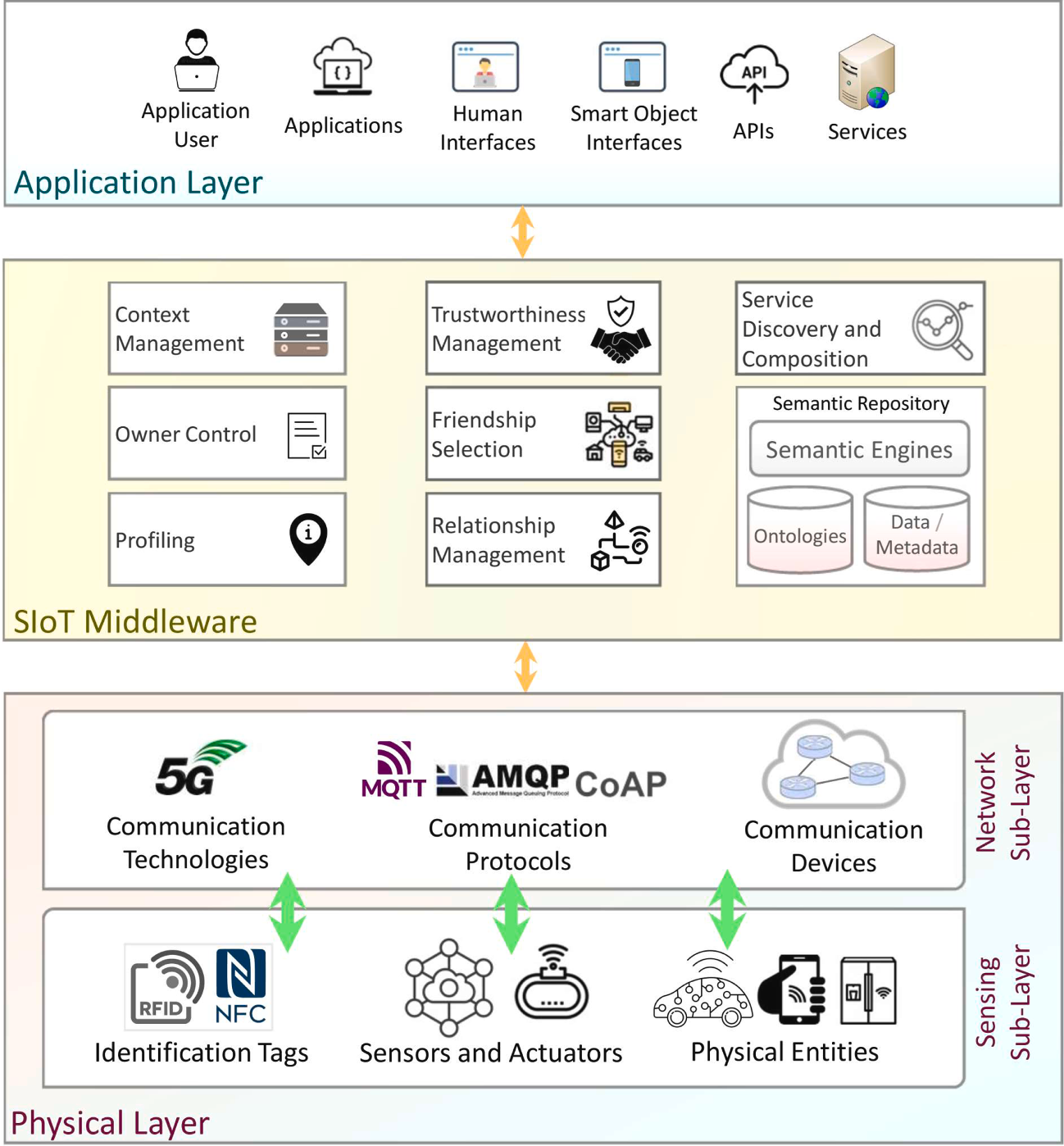 Figure 1: The standard three-layered architecture of SIoT integrating Physical, Middleware, and Application layers.
Critical Analysis of Results
The review highlights a significant trend: While Structure-based methods are the most researched, Recommendation-based strategies saw the highest growth in 2019-2020. This indicates a shift from static graph theory to data-driven AI.
However, a critical "Pain Point" remains: Mobility. Most current models assume static or semi-static devices. In a real-world SIoT (like a smart city), devices are constantly moving, causing social ties to break and reform. The current literature struggles with "Dynamic Topology," where the computational cost of updating the "Friend List" often exceeds the benefits of the relationship itself.
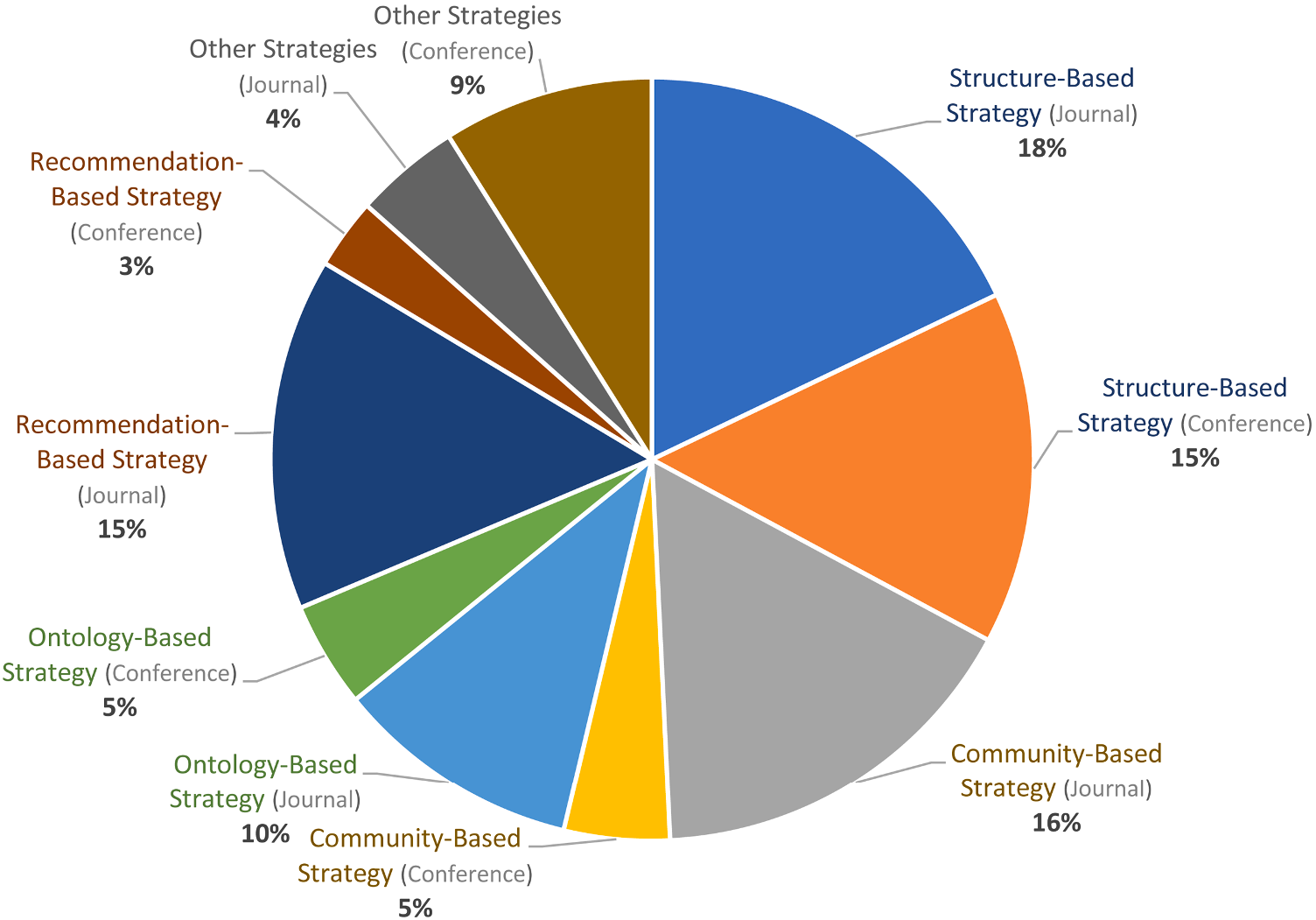 Figure 2: Distribution of strategies. Note the dominance of structure-based approaches and the rise of AI-driven recommendations.
Future Outlook: The Road to Social Intelligence
The paper concludes with a roadmap for the next generation of SIoT research:
- Meta-heuristic Solutions: Using Genetic Algorithms (GA) to find the global optimum for "Friendship Lists" to balance energy and navigability.
- Temporal Prediction: Understanding that an object's social needs change based on time (e.g., a smart light's social interaction peak occurs at night).
- Semantic RM: Moving toward autonomous agents that manage their own relationships without human intervention via fuzzy logic.
Conclusion
This review serves as a stark reminder that as we move toward an "Internet of Everything," the bottleneck is no longer connectivity, but Relationship Management. The transition from "Smart Objects" to "Social Objects" is essential for a scalable, searchable, and sustainable digital ecosystem.
Study Limitations: The review stops at 2020, missing the explosive recent growth in Transformer-based graph models and Large Language Models (LLMs) which could revolutionize semantic relationship management in the coming years.