
Friendships in the Air: Reimagining Social Links as High-Speed Wireless Shortcuts
Friendships in the air: Integrating social links into wireless network modeling, routing, and analysis
This paper proposes a novel framework for integrating social links into wireless network modeling and routing, shifting from using social ties merely for decision-making to treating them as a physical overlay for data transmission. By combining conventional P2P communication (WiFi/Bluetooth) with social-link-based overlays (Cellular/Satellite), the authors achieve superior message delivery performance in heterogeneous networks.
TL;DR
This research challenges the traditional separation of social networks and physical communication infrastructures. Instead of treating social links as mere metadata, the authors demonstrate that integrating them as a physical transmission "overlay" significantly optimizes message delivery. By utilizing a new Distance Discretization method and real-world radio testbeds, they prove that "social shortcuts" can effectively bypass physical distance limitations.
Background: Beyond Logic Topologies
In the current networking paradigm, we view our social connections (friends on Facebook, contacts in a phonebook) as a layer above the hardware. When you call a friend, the cellular network is the medium, and the friendship is the reason. This paper argues that the friendship itself should be a routing primitive. By combining conventional Peer-to-Peer (P2P) links like WiFi with "Social Links" (long-range connections via cellular/satellite/relays provided by social trust), we can build a more resilient heterogeneous network.
The Core Challenge: The Finite Node Problem
Most mathematical models for "Small-World" routing assume an infinite density of users. In reality, nodes are sparse. A packet might fail not just because of interference, but because there is literally no one standing in the right direction to pass it to.
Methodology: The Geometry of Routing
The authors solve this using Distance Discretization. They divide the field into "mini-rings" and use a recursive formula to calculate the probability of a packet jumping from ring to a closer ring .
Comprehensive Architecture
The model differentiates between:
- SRC (Short-Range Connections): Friends who are likely nearby.
- LRC (Long-Range Connections): Global social links that act as "wormholes" in the network.
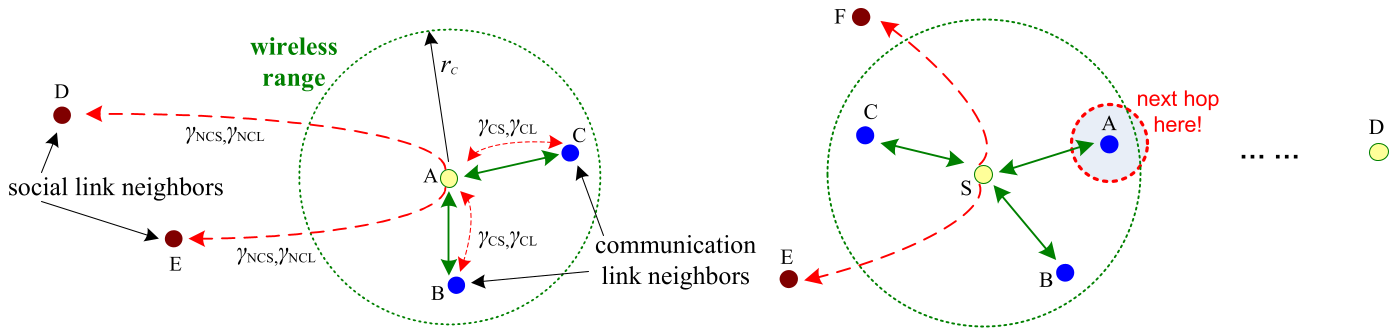 Fig 1: A visualization of how a node (A) manages both localized physical neighbors (B, C) and potential social links to distant nodes (D, E).
The mathematical core relies on the Thinning Theorem of Poisson Point Processes to calculate the success probability at each discretized step.
Experimental Insights: The "Distance Paradox"
Using the MIT Reality Mining dataset and RouterStation Pro hardware, the team discovered a fascinating counter-intuitive phenomenon.
The Insight: In greedy routing, a node further from the destination sometimes has a higher chance of successful delivery than a closer node. Why? A distant node ( in Fig 8) has a larger search area to find a "social neighbor" who can jump directly to the destination. A closer node has a smaller geometric "wedge" to search, making it more likely to hit a dead end.
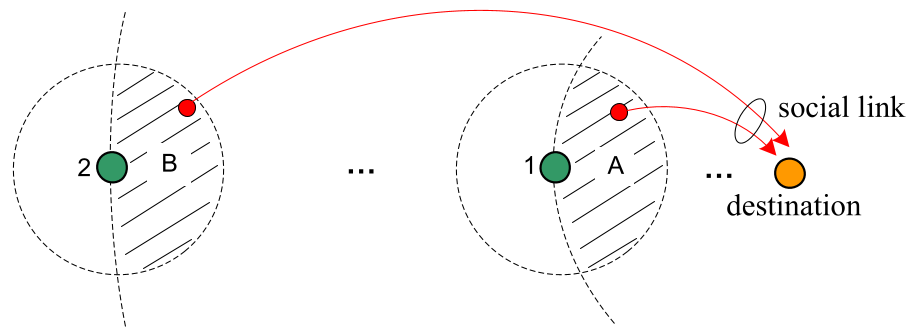 Fig 8: Demonstrating why distant nodes occasionally outperform closer ones in finding social shortcuts.
Performance Results
The experiments confirmed that while physical link failures are common, the social overlay provides a "safety net."
- Delay: Instead of increasing linearly with distance, the delay plateaus because social links "shortcut" the medium-to-long range hops.
- Accuracy: The analytical model matched the testbed within a 9.3% average deviation, proving the discretization technique is highly reliable for real-world systemic prediction.
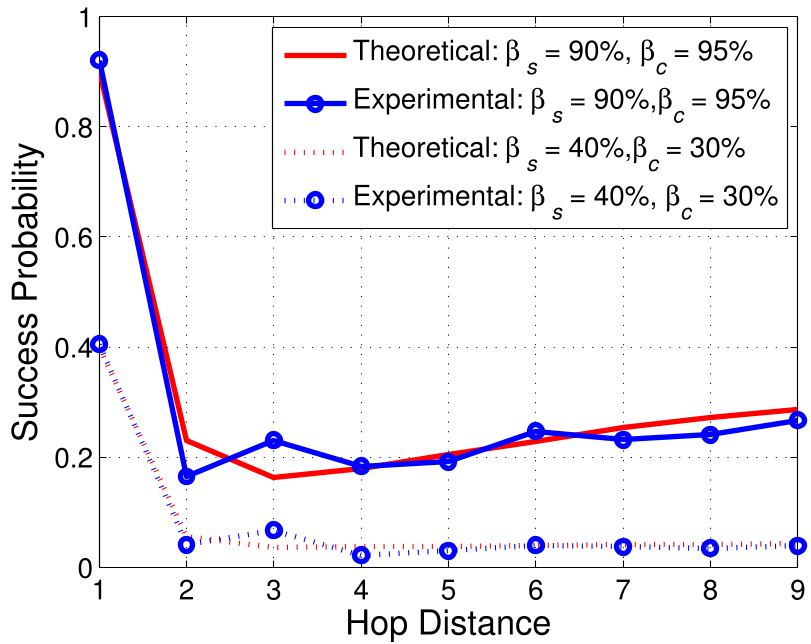 Fig 7: Measurements showing how social link reliability (lower failure probability) significantly boosts end-to-end success.
Critical Analysis & Conclusion
Takeaway
Integrating social links isn't just a "nice-to-have" for social media apps; it is a fundamental optimization for emergency broadcasts and key exchanges. By treating a trusted social link as a high-priority routing path, we can bypass congested or unreliable local physical nodes.
Limitations
The study uses static nodes. In highly mobile environments (like cars or drones), the "Distance Discretization" would need to account for rapidly changing ring memberships. Furthermore, the 21-node testbed, while high-fidelity, is small compared to modern urban densities.
Future Outlook
As we move toward 6G and Integrated Sensing and Communication (ISAC), the "social link" might evolve into a "trust-based semantic link," where the network routes data not based on who is closest, but on who is most socially reliable to carry the information.