
FriPEL: Unmasking the "Mutual Effect" in Social Media Privacy Education
FriPEL: Friendship Privacy Educational Labware
This paper introduces FriPEL, an interactive educational labware designed to teach students about friendship privacy on social media. It features a controlled environment where students use different query strategies (Random K, Rank K, and Top K) to demonstrate how simple search behaviors can inadvertently disclose private user relationships.
TL;DR
Social media privacy isn't just about what you hide; it’s about what your friends reveal. FriPEL (Friendship Privacy Educational Labware) is a hands-on tool developed by researchers to teach students how "Friend Search Engines" can leak private data. By interacting with real Twitter data, students witness how different display strategies either fail (leading to privacy breaches) or succeed (balancing sociability and security).
The Invisible Threat: Why Your Privacy Settings Fail
Most users believe that if they set their friends list to "private," they are safe. However, in a connected graph, every edge has two endpoints. If User A is private but User B is public, the relationship is still discoverable.
Conventional methods currently used in the industry face two massive hurdles:
- Direct Exposure: Querying the same user multiple times with random results eventually reveals their full list.
- Mutual Effect: Privacy is compromised when a relationship is revealed via a query on the other party in the friendship, exceeding the "K" limit of allowed visible friends.
Methodology: Balancing Sociability and Privacy
The heart of FriPEL is the comparison of three algorithmic strategies for displaying search results. The goal is to maximize Sociability (showing high-impact, popular users) while maintaining a strict K-privacy threshold.
- Random K: Pick K friends at random. (Vulnerable to repeated queries).
- Rank K: Pick the most "socially impactful" K friends. (Vulnerable to the Mutual Effect).
- Top K: A sophisticated approach that tracks how many times a user has been exposed across the entire system. If showing a friend would push that friend's total visibility over the limit K, the system chooses a different candidate or hides the edge.
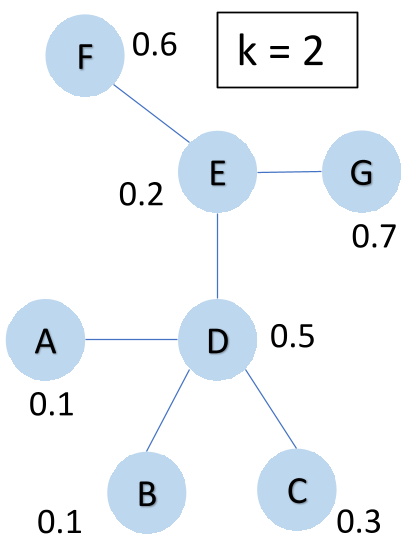 Figure 1: Comparison of strategies. Note how Top K blocks the display of certain nodes to prevent a privacy breach even if those nodes have high sociability impact.
The FriPEL Experience: Hands-on Learning
The labware is built on a modern stack (Spring, Hibernate, MySQL) and uses the Twitter API to fetch real-world follower data. Users log in via OAuth and perform actual queries, which are then visualized using Cytoscape Web.
The system provides immediate visual feedback:
- Red Nodes: Recently queried users.
- Green Nodes: Compromised users (those whose privacy has been breached because more than K of their friends are now visible in the graph).
- Real-time Charts: Tracking the "Attack Effectiveness" vs. "Site Sociability."
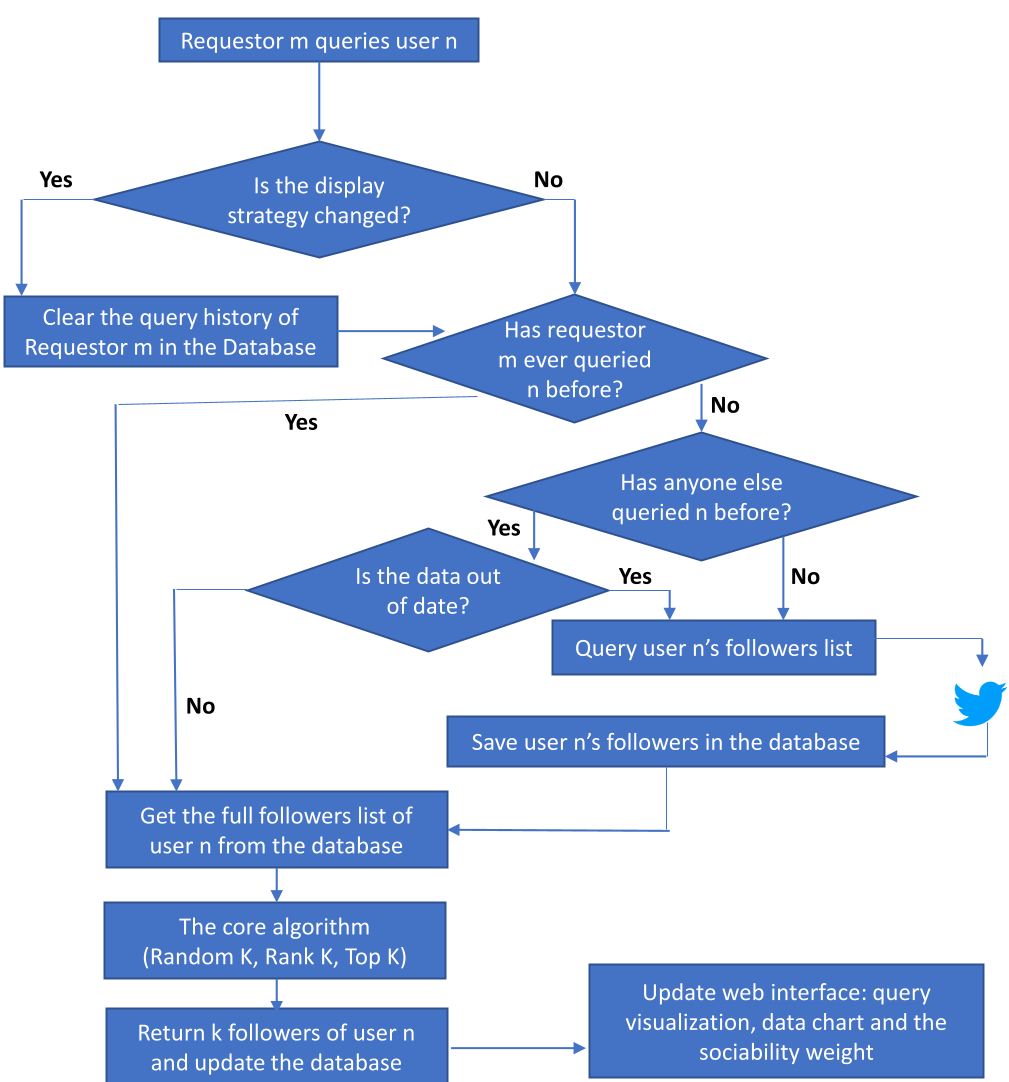 Figure 2: The system flow demonstrating the interaction between the local database (to minimize API calls) and the live Twitter interface.
Experimental Results & Student Insights
The pilot study at Prairie View A&M University analyzed 30 students. The results were stark:
- Awareness Leap: Students entered the lab with moderate awareness but left with a significantly higher understanding of "Anonymization Mechanisms" and "Privacy Disclosure."
- Interest Surge: Undergraduate students, in particular, showed a massive spike in interest in cybersecurity after seeing their own "friends" (anonymized via IDs) being compromised in the graph.
- Strategy Validation: Students empirically confirmed that while Random K and Rank K led to a high number of "Green" (compromised) nodes, the Top K strategy maintained zero compromises while keeping sociability scores respectably high.
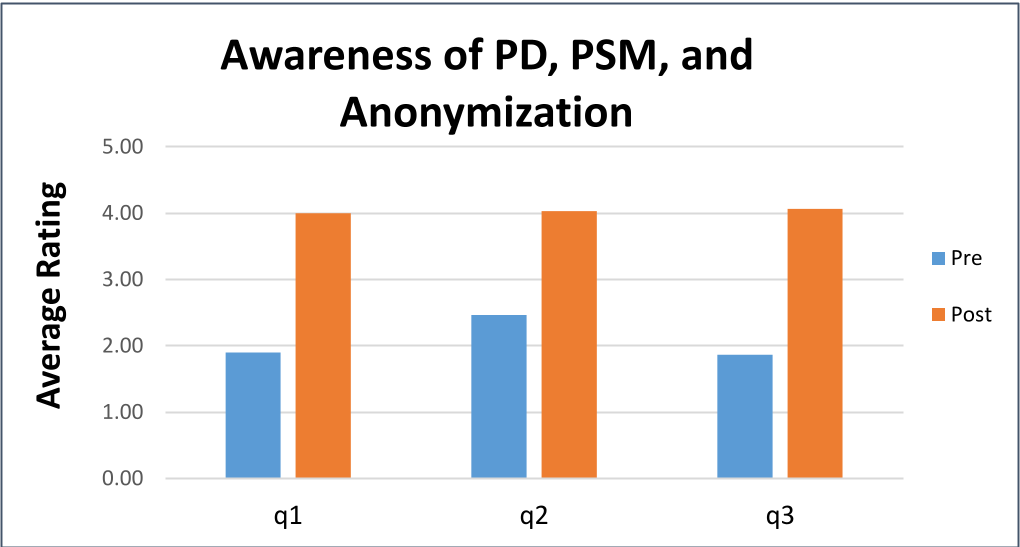 Figure 3: Quantitative evidence of the lab's impact on student awareness levels.
Critical Analysis & Future Outlook
The FriPEL project proves that active defense training is superior to passive reading. By "attacking" the privacy of a mock network, students learn the algorithmic difficulty of maintaining data privacy in a highly connected world.
Limitations: Currently, the system relies on node weights (sociability impact) that are randomly assigned for educational purposes. In a real-world deployment, these weights would be derived from complex PageRank or engagement metrics, which might introduce new side-channel vulnerabilities.
The Road Ahead: As we move toward Web3 and decentralized social networks, tools like FriPEL will be essential. The next evolution of this research should focus on "Collusion Attacks," where multiple requestors share their query results to map an entire hidden network—a challenge that even the current Top K strategy may struggle to solve completely.