
Beyond Words: Unifying Language and Motor Learning via the "Gavagai" Lens
From Language to Motor Gavagai: Unified Imitation Learning of Multiple Linguistic and Non-linguistic Sensorimotor Skills
This paper introduces a unified imitation learning framework that treats linguistic and nonlinguistic skills as structurally identical sensorimotor problems. By extending the classical "Gavagai" problem of language acquisition to the motor domain, the authors demonstrate a system that enables a robot to concurrently resolve ambiguities in task identity, communicative channels (speech/gestures), and coordinate frames (framings) through cross-situational observation.
TL;DR
Is language special, or is it just another sensorimotor skill? This paper argues for the latter. By reframing the "Gavagai" problem—the inherent ambiguity of word meanings—as a general imitation learning challenge, the authors present a robot that learns to draw shapes, push objects, and respond to speech/gestures without being told in advance which signals were "language" and which were just physical context.
The "Gavagai" Problem: From Meadows to Motors
In 1960, philosopher Willard Van Orman Quine proposed a thought experiment: a linguist sees a native point to a rabbit and say "Gavagai." Does it mean "rabbit," "scurrying," or "undetached rabbit parts"? This is the Language Gavagai Problem.
The authors argue that a robot learning to throw a stone at a snake faces the exact same ambiguity:
- Context Ambiguity: Is the snake's position relevant, or the tree's?
- Modality Ambiguity: Is the teacher's shout a command, or just noise?
- Framing Ambiguity: Should the movement be remembered relative to the robot, the snake, or the tree?
By treating these as a single Motor Gavagai Problem, the research breaks down the wall between "linguistic" and "nonlinguistic" learning.
Methodology: The Unified Architecture
The core of the paper is a framework that doesn't discriminate between a sound wave and an object's X-Y coordinates.
1. The Generalized Context
Everything the robot perceives—speech MFCCs projected into a 3D manifold, hand gestures, and object positions—is bundled into a single vector. The robot doesn't know that "speech" is meant to be a command; it has to discover its relevance.
2. The Grouping & Framing Logic
How does the robot learn without labels?
- Similarity Estimation: It compares trajectories across demonstrations.
- Coordinate Framings: It tests different systems of reference (e.g., Object-centered vs. Absolute). A task like "draw a circle around the object" only looks consistent in an object-centered frame.
- The EM-style Grouping: An iterative algorithm clusters demonstrations that look similar in a specific framing. This defines a "Task."
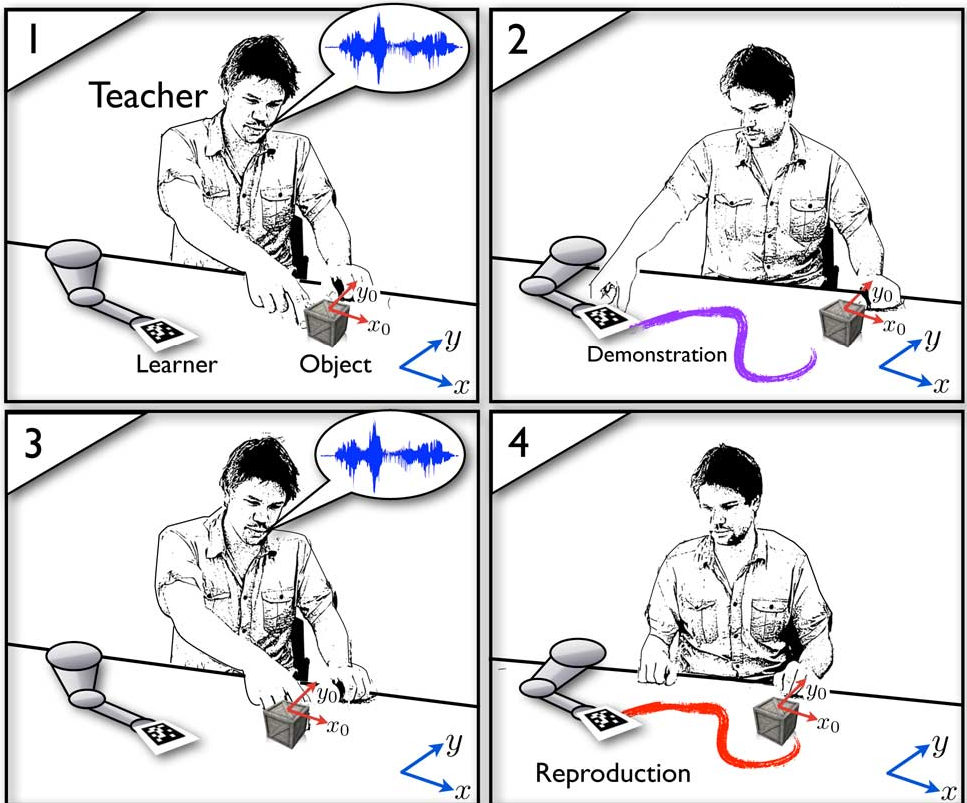 Figure 1: The robot perceives a multifaceted context (Objects, Speech, Gestures) and must infer which dimensions trigger which motor response.
3. Execution via ILO-GMR
Once a task is identified, the robot uses Incremental Local Online Gaussian Mixture Regression (ILO-GMR). This allows the robot to handle the "how-to" part of the skill, mapping the current state to the required motor speed in real-time.
Experimental Proof: Discovering the "Linguistic Channel"
The authors conducted two primary experiments to test the architecture's limits.
Experiment 1: Non-labeled Multi-tasking
The robot was shown 5 tasks, including:
- Linguistic: Respond to the word "Flower" by circling an object.
- Nonlinguistic: If an object is on the left, draw a square (ignoring speech). The system correctly grouped these, proving it can distinguish between tasks driven by "language" and tasks driven by "environment."
Experiment 2: Modality Discovery
Here, the robot had to figure out which modality (speech or gesture) mattered. It successfully learned that for some tasks, the "S" shaped gesture was the key, while for others, the vocal command "Circle" was the trigger.
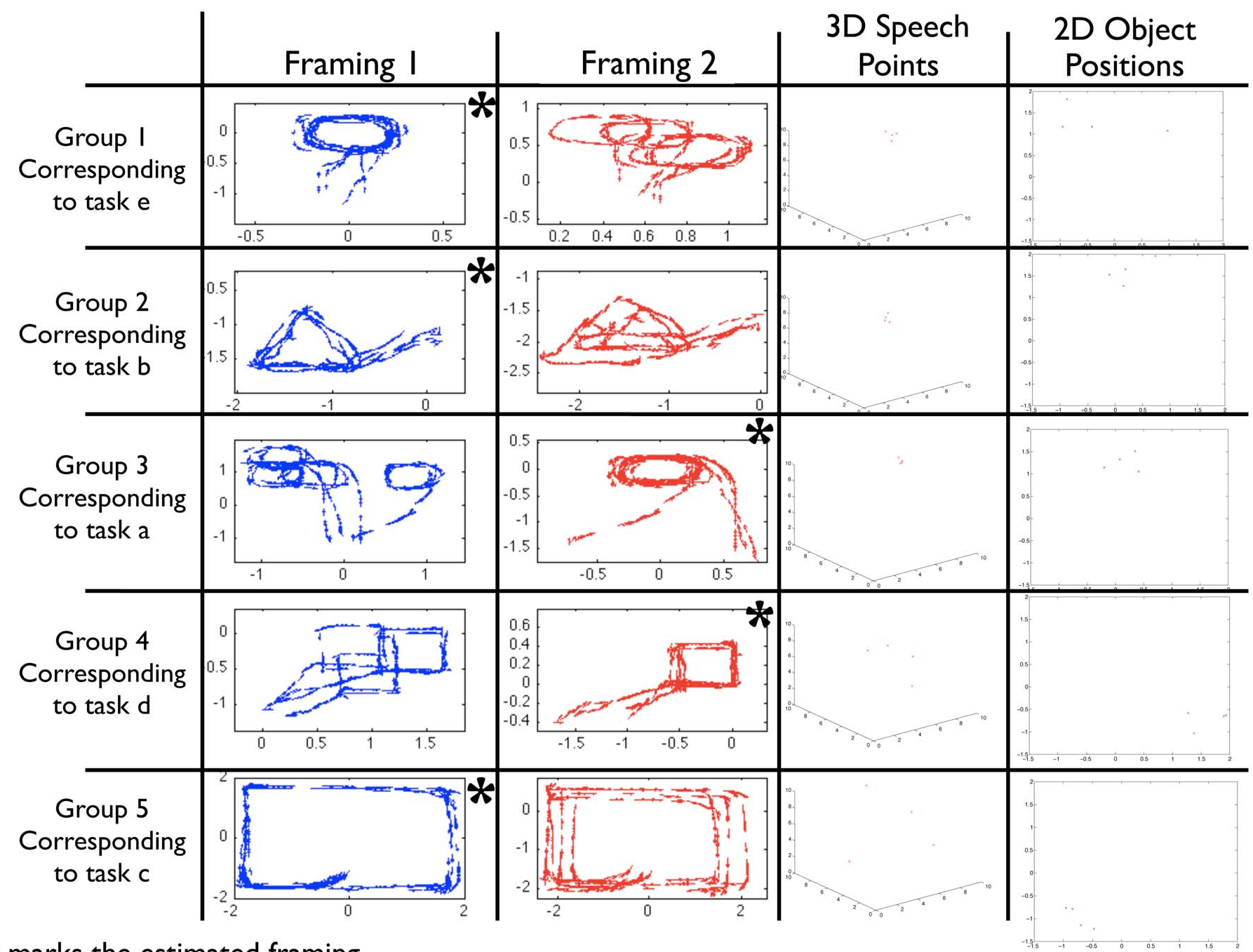 Figure 2: Successful clustering of trajectories across different tasks and their corresponding trigger contexts.
Critical Insight: Language as an Exaptation
The most striking takeaway is the Evolutionary Hypothesis. The authors suggest that language acquisition might not require a dedicated, "special" brain module. Instead, it might be an exaptation—a repurposed use—of a general-purpose imitation system that evolved to learn complex sensorimotor skills.
If a robot can learn that a sound wave triggers an action using the same math it uses to learn that a nearby obstacle requires a detour, then perhaps the "language gap" in AI is smaller than we think.
Limitations & Future Work
- Scalability: While the MFCC projection worked for 5-7 tasks, scaling to a full human vocabulary remains a challenge.
- Conflict Resolution: The current model struggles if two triggers (e.g., a word and a position) conflict.
- Segmentation: The model assumes demonstrations are already pre-cut. Future work must address how to segment a continuous stream of human behavior.
Conclusion
This work pushes us toward a more "holistic" AI. Rather than programming a "Natural Language Processing" module and a "Motion Planning" module separately, we should strive for unified architectures where communication emerges naturally from the need to coordinate action.