
Inside the Bursty Botnet: How 500,000 Bots Evaded Detection via "Hit-and-Run" Tactics
Full Cycle Analysis of a Large-Scale Botnet Attack on Twitter
This paper presents a forensic "Full Cycle Analysis" of the Bursty botnet, one of the largest Twitter botnets discovered with over 500,000 accounts. It uncovers a massive phishing infrastructure that generated 2.8 million spam tweets and targeted 1.3 million users using sophisticated URL redirection tactics.
TL;DR
Researchers from UCL have deconstructed the Bursty Botnet, a massive 500,000-account infrastructure on Twitter that successfully targeted over 1.3 million users. By utilizing a "Hit-and-Run" strategy—where bots tweet immediately upon registration and then go silent—the botnet bypassed state-of-the-art detection tools like Botometer. The study reveals a sophisticated multi-layer phishing network controlled by a single botmaster.
Problem & Motivation: The Failure of Generic Classifiers
Most social bot research focuses on detection rather than forensic analysis. However, detection frameworks often rely on the assumption that bots are high-activity "chatterboxes." The Bursty Botnet flips this script:
- Brief Activity Window: Bots only tweet within the first hour of registration (80% within the first 2 minutes).
- Minimal Profile Data: No profile pictures, no followers, and no long-term history.
- The Detection Lag: While URL blacklists take days to update, botnet victims click links within hours.
The authors argue that this "scarcity of data" per account is exactly what allows the botnet to remain invisible to automated systems.
Methodology: Tracing the Puppet Strings
The researchers analyzed 2.8 million tweets and nearly 3 million unique URLs. They identified a sophisticated redirection hierarchy designed to bypass filters.
1. The Redirection Network
The botnet didn't just post spam links; it used a three-tier obfuscation strategy:
- Public Shorteners: TinyURL and Bit.ly.
- Open Redirects: Exploiting
google.com/url?sa=t...to leverage Google's reputation. - Sacrificial Lambs: A middle layer of domains (e.g.,
ggew.info) that could be easily swapped if blacklisted.
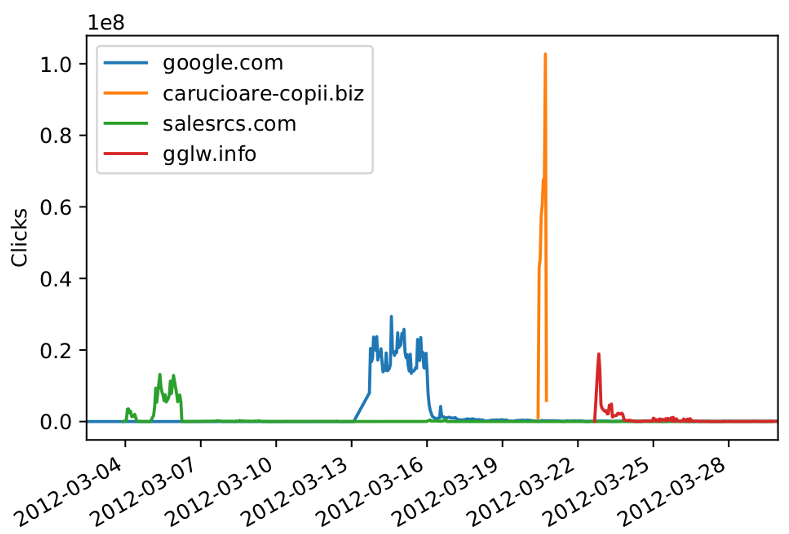 Figure 6: The complex network of redirects and landing pages reconstructed via forensics.
2. Hunting the Botmaster
By digging into WHOIS records and underground forums like blackhatworld.com, the authors identified "Alexandru F.," a threat actor selling proxy services and CAPTCHA solvers. This links the botnet's existence to a broader commercial ecosystem of cybercrime.
Experiments: Why State-of-the-Art Failed
The authors tested 1,000 Bursty bots against Botometer. The results were startling:
- Language Bias: Without English language features, the classifier actually rated real humans as more likely to be bots than the actual bots (AUC 0.30).
- Overlapping Distributions: As shown in the histograms below, the "bot scores" for malicious accounts and random users were nearly indistinguishable in a real-world scenario.
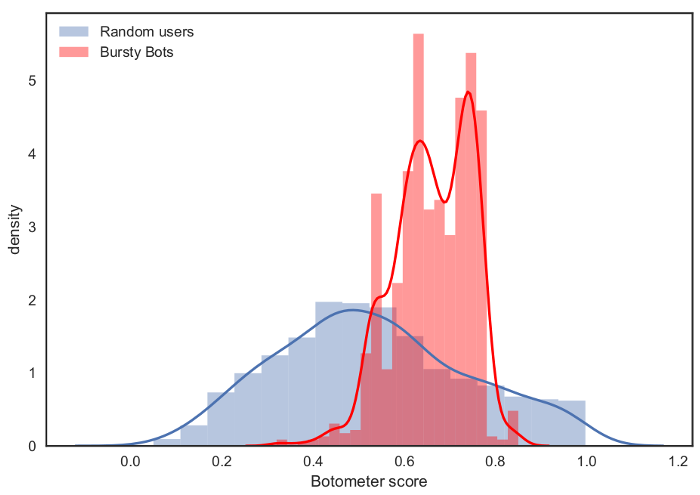 Figure 7: The overlapping distributions of Botometer scores show the inability of supervised models to isolate these specific bots.
The Hit-and-Run Pattern
The attack follows a specific lifecycle that exploits the "speed gap" in security:
- Preparation: Bulk registration of domains and acquisition of IP pools.
- Execution: Mass "bursts" of tweets following user registration.
- Harvesting: Victims click within 48 hours.
- Abandonment: By the time blacklists (Google Safe Browsing, etc.) flag the domains, the campaign is already over.
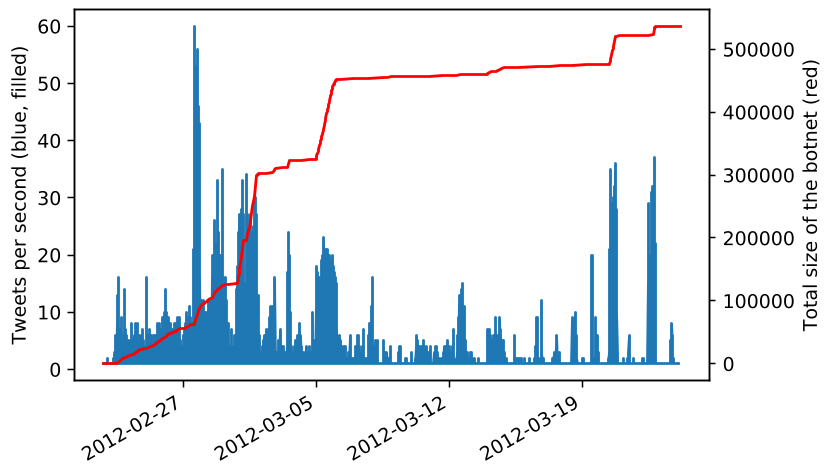 Figure 1: The temporal spikes illustrate the "bursty" nature of the botnet's registration and tweeting activities.
Critical Insight & Conclusion
The Bursty Botnet demonstrates that a "low-tech" approach—simple accounts with simple tweets—can be more effective than complex "AI-driven" social bots if they exploit temporal vulnerabilities.
Key Takeaways:
- Account-level vs. Network-level: Detecting individual bots is a losing battle. We must detect "lockstep" behaviors across a network.
- The Need for Speed: Real-time response is the only way to counter "hit-and-run" attacks.
- Forensic Value: Without individual botnet analysis, these massive operations remain "dark matter" in the social media ecosystem, existing but undetected by our most sophisticated instruments.