
Decoding the 2020 U.S. Election: How AI Maps Policy, Character, and Public Emotion
Functional Analysis of the 2020 U.S. Elections on Twitter and Facebook using Machine Learning
This study presents a machine learning framework to analyze the 2020 U.S. Presidential Election discourse on Facebook and Twitter using Functional Theory. By classifying candidate posts into Policy or Character themes and analyzing millions of public comments, the researchers provide a scalable approach to understanding digital political participation.
TL;DR
Researchers have developed a machine learning model capable of categorizing political social media posts as "Policy-oriented" or "Character-oriented" with nearly human-level accuracy. Analyzing over 6 million comments from the 2020 U.S. Election, the study reveals a stark contrast in supporter psychology: while Policy posts drive analytical thinking, Character-driven discourse—particularly surrounding Donald Trump—triggers significantly higher levels of anger and linguistic patterns associated with deception.
The Scalability Gap in Political Science
For decades, "Functional Theory" has been the gold standard for analyzing how political candidates separate themselves from opponents. By acclaiming (praising oneself), attacking (criticizing opponents), or defending (responding to attacks), candidates focus on either Policy (deeds, goals, plans) or Character (leadership, values, personality).
However, until now, this analysis required human experts to read every tweet and post—a task impossible in the era of Big Data. The core motivation of this research is to bridge this gap by automating functional analysis, allowing us to see not just how much people are talking, but how the nature of a candidate's message changes the collective psyche of the electorate.
Methodology: From Word Vectors to Psychological Indices
The researchers collected a massive dataset involving Donald Trump, Bernie Sanders, and Joe Biden, totaling ~4,800 posts and over 6 million comments.
1. The Classification Engine
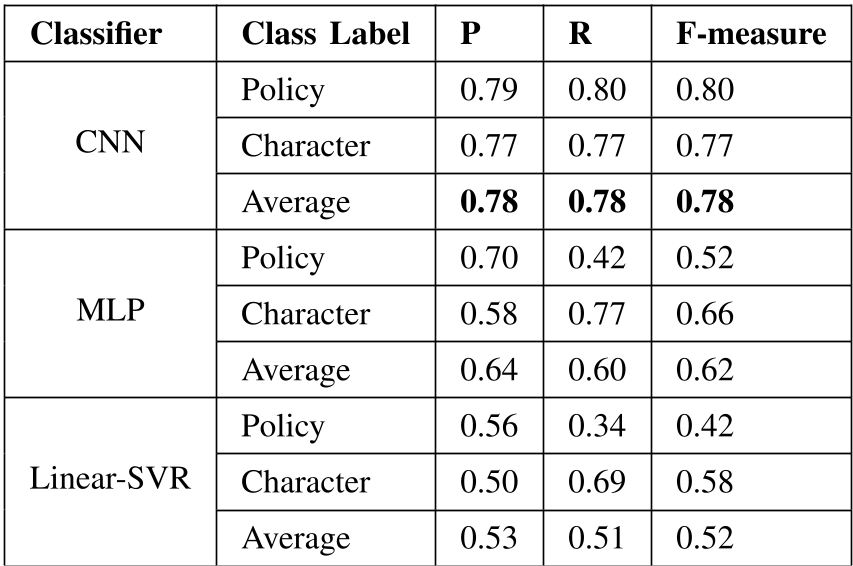
The authors compared several architectures, including Multinomial Naive Bayes and Multi-layer Perceptrons (MLP). However, the Convolutional Neural Network (CNN) using Word2Vec embeddings emerged as the victor. By treating text as a spatial arrangement of semantic vectors, the CNN was able to capture the nuances of campaign rhetoric.
2. Commentator Analysis (LIWC)
Once the posts were categorized, the team used LIWC (Linguistic Inquiry and Word Count) to analyze the public's response. This tool doesn't just look at "happy" or "sad"; it measures dimensions like:
- Analytical Thinking: Logical, hierarchical writing.
- Clout: Confidence and social hierarchy.
- Authenticity: Honesty vs. deceptive/distanced language.
Key Findings: The Psychology of the Follower
The data suggests that the type of post a candidate shares acts as a psychological trigger for their followers.
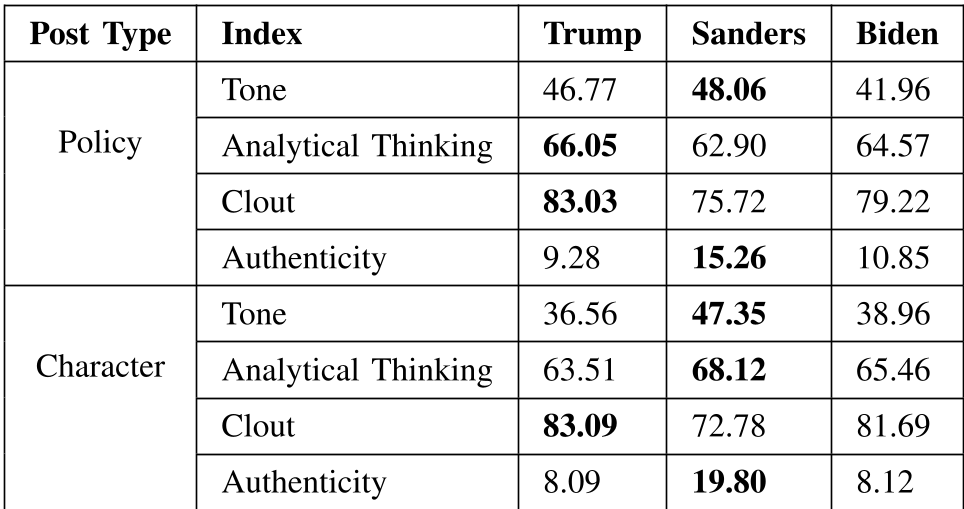
- The Trump Effect: Trump’s commentators showed significantly higher levels of Anger (nearly double compared to others on Character posts) and Clout. However, they scored the lowest on Authenticity, which the authors suggest points toward more "deceptive" or less honest writing styles.
- The Sanders Effect: Sanders' supporters wrote with the highest levels of Authenticity, suggesting a more "honest" and "personal" connection to the campaign's messaging.
- Policy vs. Character: Policy posts generally led to higher "Analytical Thinking" scores across the board, proving that substantive discourse actually encourages more logical public engagement.
Critical Insight & Future Outlook
The most impressive feat of this paper is the 78% F-measure achieved by the CNN for Policy/Character detection. In the world of noisy social media text, this is remarkably close to the 80% agreement found between human experts.
Takeaway: We are entering an era where AI can provide a "real-time pulse" of the democratic process. By understanding the linguistic cues that trigger anger or logical thought, campaign strategists—and more importantly, the public—can better understand how digital rhetoric shapes our political reality.
Limitations: The study notes difficulty in classifying "Mixed/Other" posts (scoring only 22% F-measure). Future work utilizing Large Language Models (LLMs) like GPT-4 or Llama-3 could likely resolve these technical ambiguities by understanding broader context and sarcasm, which simple Word2Vec models may miss.