
SocialFusion: Bridging the Gap Between Sensing and Social Context
Fusing mobile, sensor, and social data to fully enable context-aware computing
SocialFusion is a pioneering system designed to achieve Mark Weiser's vision of ubiquitous computing by fusing mobile connectivity, fixed sensor networks, and social media data. It introduces a multi-stage architecture to provide context-aware recommendations for both individuals and groups, notably achieving a proof-of-concept in personalized environmental adaptation (SocialFlicks).
TL;DR
SocialFusion is one of the earliest comprehensive frameworks designed to merge Mobile (Location), Sensing (Environment), and Social (Preferences) data streams. By moving beyond simple proximity-based systems, it enables "Minority Report"-style interactions—such as jukeboxes or public screens that automatically adapt their content based on the collective tastes of the groups standing near them—all while maintaining privacy through a unique logic-based K-anonymity mechanism.
Problem: The Context Gap
In the early 2010s, "context-aware" computing was fragmented. Your phone knew where you were (GPS), but not what you liked. Facebook knew your favorite bands, but not that you were currently standing in a coffee shop. Sensor networks knew the room's temperature but had no idea who was in the room.
The authors identify that tastes and relationships are the missing links in ubiquitous computing. Previous SOTA works like CenceMe focused on activity recognition, and Serendipity focused on social links, but none fused the three pillars (Social + Mobile + Sensor) into a unified recommendation engine for both individuals and groups.
Methodology: The Fusion Architecture
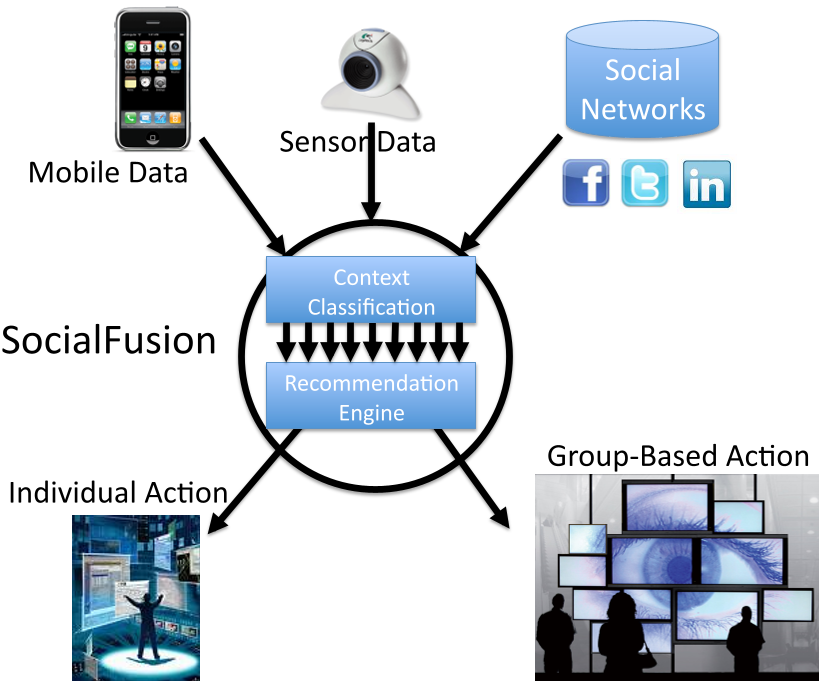
The SocialFusion system operates through a structured pipeline:
- Collection & Management: Aggregating data from diverse APIs (Facebook REST, Netflix, mobile sensors).
- Fusion (Classifier Bank): Moving from raw data to "meaningful context" (e.g., determining if a user is "in distress" or if a collection of individuals constitutes a "friend group").
- Recommendation Engine: Using data mining to generate actions (e.g., a "majority vote" for a movie choice).
The Group-Aware Insight
Unlike standard recommenders that treat groups as a single "virtual user," SocialFusion explores Social Satisfaction Metrics. It recognizes that group decisions are influenced by leaders, pairwise similarities, and social hierarchies, moving away from simple averaging toward weighted influence models.
Security: Privacy through Logic Minimization
One of the most profound technical contributions is the Selective Withholding approach to K-anonymity. The authors argue that traditional K-anonymity (which often blurs or "fuzzifies" data) ruins the accuracy needed for specialized recommendations.
Instead, they model the relationship between data and users as a directed graph and apply Boolean logic minimization (specifically the ESPRESSO algorithm). By selectively withholding specific pieces of data (e.g., masking a name while keeping the "class" and "major"), they ensure that a public recommendation doesn't inadvertently reveal a user's identity—ensuring the released data maps to at least people.

Experiments & SocialFlicks
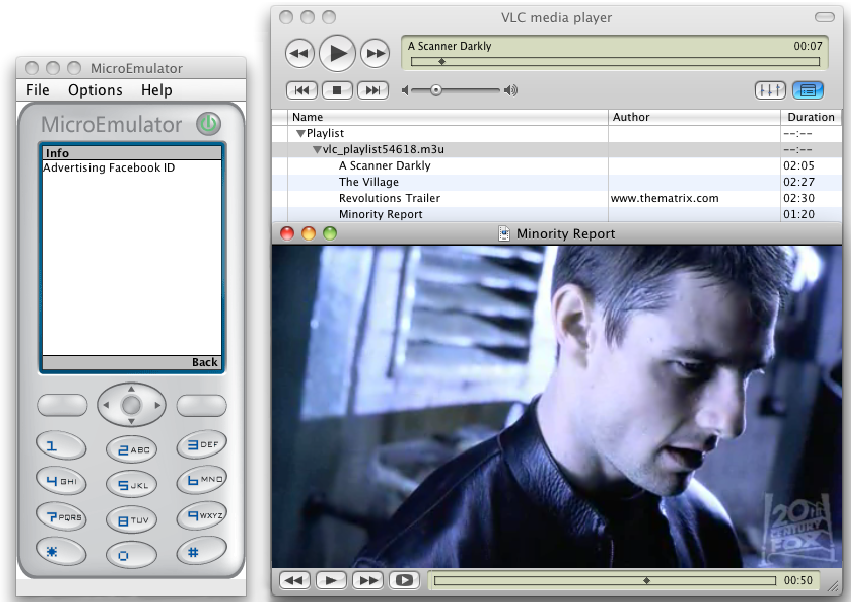
To prove the concept, the team built SocialFlicks. In this scenario:
- A "Stationary Component" (SC) monitors for Bluetooth signals.
- Once a user is detected, it fetches their "Favorite Movies" from Facebook.
- It then queries Netflix for similar titles.
- The Result: A public screen that dynamically generates a movie trailer playlist tailored to the specific group of people currently in the room.
Critical Analysis & Future Outlook
Value Add: SocialFusion correctly predicted the "Identity Aggregator" problem—the fact that we use different handles across the web—and proposed a centralized identity mapping to manage cross-platform context.
Limitations:
- Dependency on APIs: The system relied heavily on open APIs (Facebook, Netflix, etc.) which have since become significantly more restricted.
- Bluetooth Range: Using Bluetooth Class 2 limits interactions to 10 meters, which might be too coarse for "smart seat" or "micro-context" applications.
Conclusion: This paper remains a foundational study on how Social Graphs are not just for social networking—they are a critical data layer for the physical world. For researchers today, SocialFusion’s logic-based privacy approach provides a compelling alternative to more computationally heavy differential privacy methods for real-time mobile environments.