
RAN: Unmasking Spammers via Textual Decomposition and Weak Social Dynamics
Fusion-based Spammer Detection Method by Embedding Review Texts and Weak Social Relations
The paper introduces Relation Attention Network (RAN), a comprehensive framework for spammer detection that fuses deep textual semantics with dynamic user interaction graphs. By leveraging a co-attention and orthogonal decomposition mechanism alongside "weak social relations," the model achieves state-of-the-art performance on Mobile01 and Yelp datasets, significantly improving F1 scores by up to 6.73%.
TL;DR
Spammers have become adept at gaming the system, either by manipulating follower counts or by blending their text with legitimate reviews. The Relation Attention Network (RAN) provides a two-pronged solution: it decomposes review texts to isolate unique spamming patterns and replaces easily-forged "strong" social links with "weak" behavioral relations. The result? A new SOTA on Yelp and Mobile01 benchmarks with F1 improvements up to 6.7%.
Beyond Concatenation: The Problem with Traditional Text Processing
Most prior works treat a user’s history as a monolithic block of text. This "bag-of-reviews" approach creates a semantic mess, blurring the lines between a user's consistent intent and the specific topics of individual reviews.
More critically, current models rely on the "Strong Social Relation" hypothesis—the idea that spammers follow other spammers. However, modern bot-herders often use "polite following" tricks to link with innocent users or use disposable accounts that have no social links at all. This makes traditional graph-based detection easy to circumvent.
Methodology: The RAN Framework
The RAN model treats spammer detection as a fusion of Intra-user Textual Analysis and Inter-user Behavioral Dynamics.
1. Refined Review Embedding
Instead of simple concatenation, RAN uses:
- Co-Attention Module: Learns the "soft" similarities between reviews (e.g., similar phrasing across different products).
- Orthogonal Decomposition: This is the "secret sauce." It splits a review representation into two vectors: one parallel to the user embedding (capturing consistent user traits) and one orthogonal (capturing specific review information).
2. Mining "Weak" Social Relations
The authors argue that while you can't trust who a user follows, you can trust what they do. They construct a graph based on "Weak Relations"—dynamic interactions like posting about the same topic or using the same hashtags.
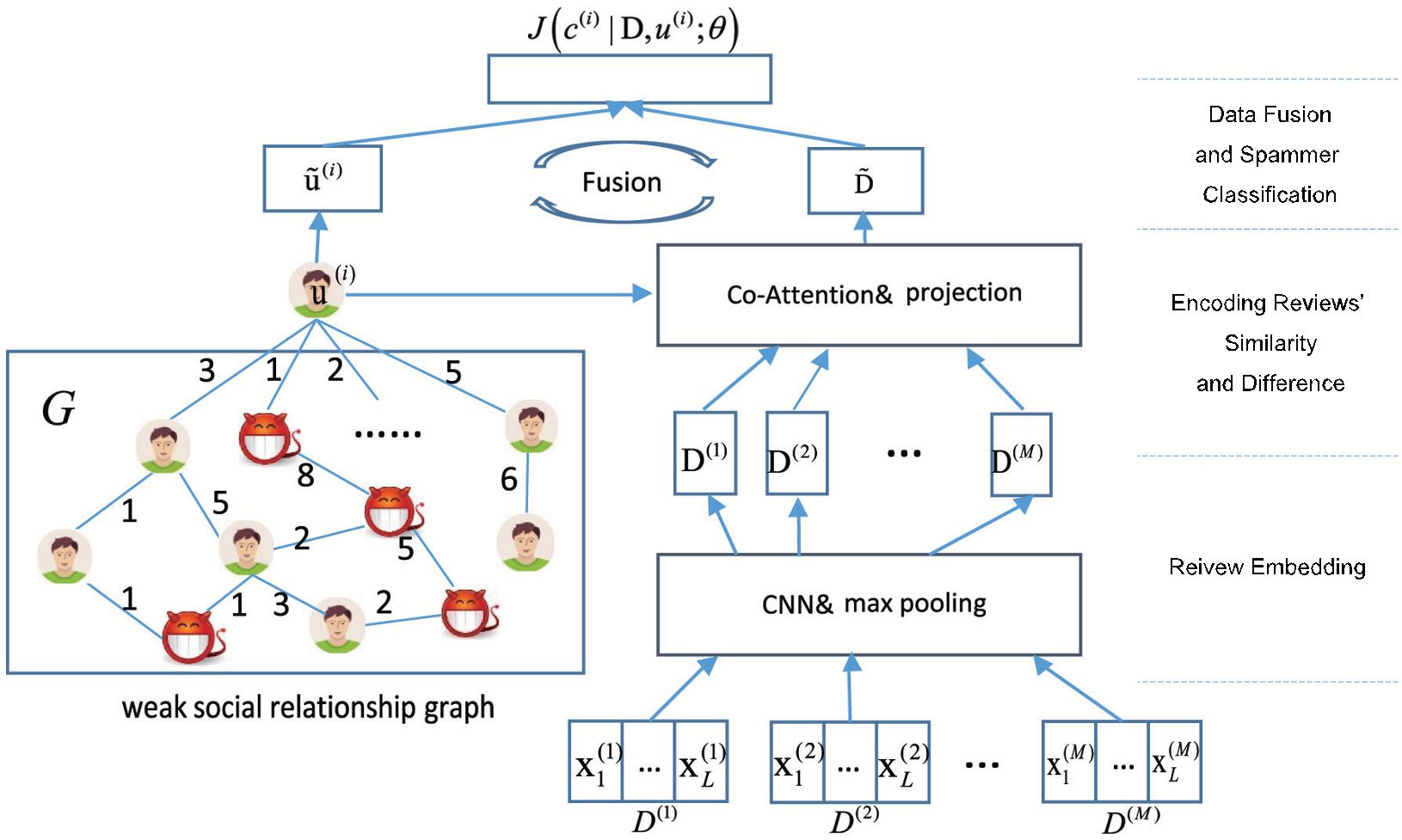 Fig 1: The RAN architecture showcasing the dual-path processing of texts and relations.
To make this graph robust, they use a weight function based on Liebig’s Law of the Minimum: the closeness of two users is determined by the minimum intensity of their shared interactions, filtering out coincidental overlaps.
Experiments & Results
The model was tested against heavyweights like GCN, GraphSAGE, and specialized spam detectors like SSDMV.
- Performance Leap: On the Yelp dataset, RAN achieved near-perfect precision (97.13%).
- The Power of Relations: The Ablation study (Table IV) reveals that removing the Weak Relationship Embedding (-WRE) causes a massive drop in Recall. This suggests that while text helps identify how spammers write, the behavioral graph is what helps find them in the first place.
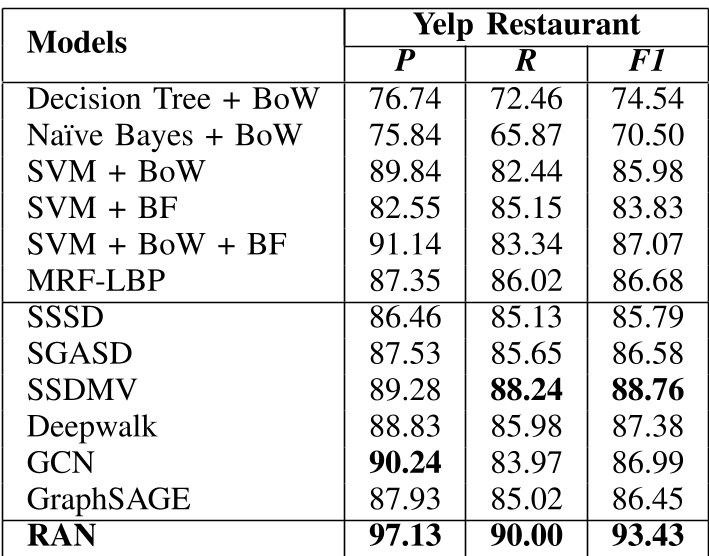 Fig 2: Comparison of RAN against baselines on the Yelp Restaurant dataset.
Critical Insight: Why it Works
The brilliance of RAN lies in its Inductive Bias. By forcing the model to decompose embeddings (Orthogonal Decomposition), the authors prevent the user representation from being "poisoned" by the noise of a single outlier review. Simultaneously, the transition from "Strong" to "Weak" relations recognizes a fundamental shift in social media security: explicit metadata is a liability; implicit behavior is the only source of truth.
Conclusion & Future Outlook
RAN proves that spammer detection is no longer just about sentiment analysis; it’s about relational forensics. The move toward "weak relations" opens the door for detecting sophisticated "coordinated inauthentic behavior" (CIB) that traditional tools miss.
Future Work: The authors aim to explore the synergy between strong and weak relations. In an era where AI-generated spam is rising, integrating these structural insights with LLM-based detection could be the next frontier.