
From Posts to Progress: Decoding Emotional Trajectories in Mental Health Forums
Future Generation Computer Systems
The paper introduces a modeling framework to predict shifts in a user's emotional tone during interactions within Reddit mental health communities. By employing DistilBERT embeddings and Gated Recurrent Units (GRUs), the authors quantify how social support influences a user's emotional state, achieving significantly lower error rates than traditional baselines.
TL;DR
Researchers have developed a deep learning framework to predict how users' emotional states change after receiving support on Reddit. Using a combination of DistilBERT and RNNs with a specialized Weighted L1 Loss, the study proves that online interactions significantly improve user sentiment and that these improvements are predictable.
Background: Beyond Detection
Traditionally, AI in mental health has asked: "Does this user have depression?" This paper shifts the focus to: "How is this user reacting to support right now?" By treating the "Emotional Tone" (EmT) as a proxy for mental state, the authors analyze the impact of communities like r/Anxiety and r/SuicideWatch.
The Problem: The "Average Prediction" Trap
Human emotions are volatile. Standard Machine Learning models suffer from "regression to the mean"—they play it safe by predicting a neutral response to avoid large errors. To capture the "highs" of recovery and the "lows" of crisis, the researchers had to rethink how models learn from rare, extreme emotional expressions.
Methodology: The Architecture of Empathy
The authors treat a Reddit thread as a chronological sequence. Each message is processed through a three-stage pipeline:
- Textual Embedding: Using DistilBERT to capture the semantic nuance of the words.
- Feature Engineering: Concatenating the VADER sentiment score and a flag indicating if the author is the "Original Poster" (OP).
- Sequence Modeling: A Gated Recurrent Unit (GRU) RNN ingests these features to predict the tone of the final comment in the thread.
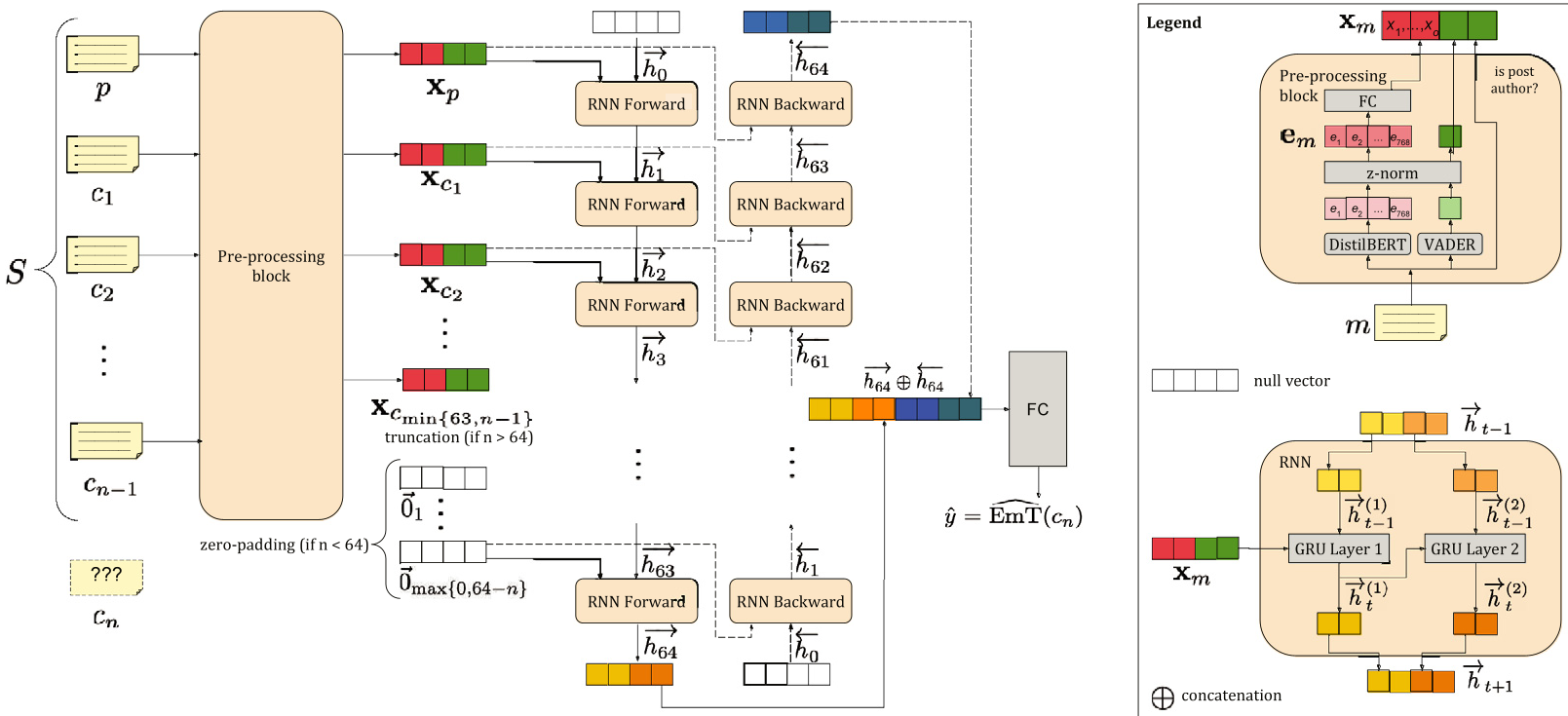 Figure 1: The RNN-based pipeline processing chronological interactions to forecast emotional outcomes.
The secret sauce is the Weighted L1 Loss. By binning the data and penalizing errors more heavily on extreme values (very positive or very negative), the model is forced to learn the characteristics of significant emotional shifts rather than just the "average" vibe.
Experimental Results: Proving the Pivot
The data characterization (Figure 3 in the paper) reveals a powerful truth: authors of negative posts often write "rosier" comments after engaging with the community.
Comparing the model against XGBoost and simple heuristics like Mean (predicting the average tone of previous comments), the proposed RNN outperformed all:
- Anxiety: 22% improvement over Mean baseline.
- Depression: 22.8% improvement.
- SuicideWatch: 14.7% improvement.
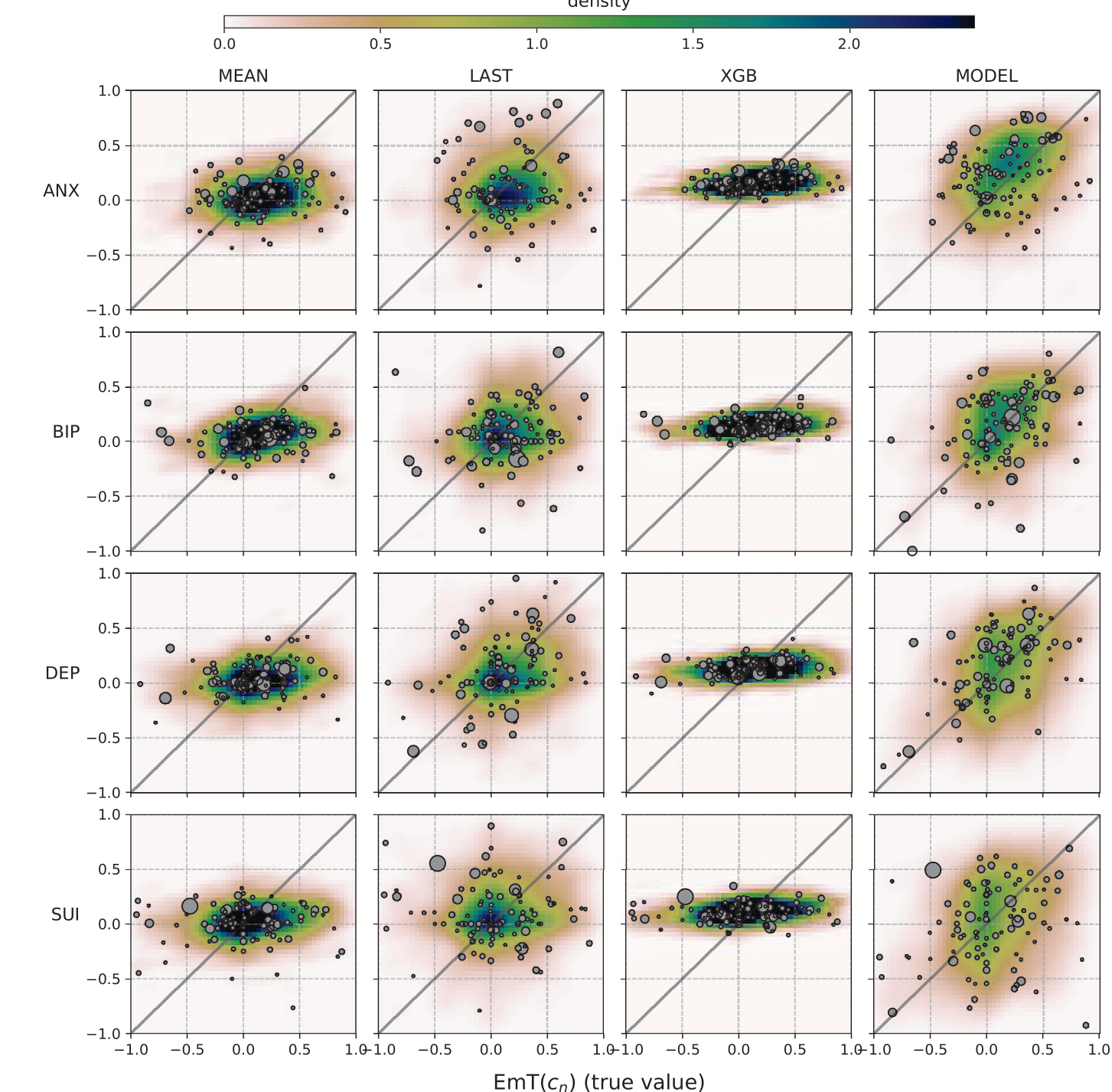 Figure 2: Joint distribution of true vs. predicted values. Note how the "Model" (bottom right) aligns most closely with the diagonal, especially for extreme emotional values.
Qualitative Insights
The paper highlights a thread where a user struggling with depression received encouraging words ("You matter... stay strong"). The OP responded with a significant positive shift (), which the model predicted with high accuracy (). This demonstrates that the GRU isn't just crunching numbers; it's capturing the mechanics of social support.
Critical Insight & Future Outlook
This work moves us closer to AI-assisted clinical care. Imagine a browser extension that helps a peer-supporter rephrase their comment in real-time to maximize the positive emotional impact on a struggling user.
Limitations:
- Anonymity: We cannot track if these "rosy" comments translate to long-term clinical recovery.
- Sarcasm/Complexity: Sentiment tools like VADER can still be fooled by "etiquette" (e.g., saying "Thank you" while still feeling devastated).
Future Work: The authors suggest moving toward Attention-based Transformers and Graph Neural Networks to better interpret which specific comment in a massive thread triggered the emotional turnaround.
Conclusion
This research confirms that online communities are not just shouting into the void—they are active environments for emotional healing. By modeling the "trajectory" of a conversation, we can better design digital spaces that foster resilience and provide timely support to those in need.