
Smart e-Health Gateway: Bringing Fog Computing Intelligence to Healthcare IoT
Future Generation Computer Systems
2016-01-20
Summary
Problem
Method
Results
Takeaways
Abstract
This paper proposes a "Smart e-Health Gateway" architecture leveraging Fog Computing to bridge the gap between resource-constrained medical IoT sensors and the Cloud. By shifting intelligence to the network edge, it achieves real-time data processing, enhanced energy efficiency, and seamless patient mobility in smart hospital and home-care environments.
## TL;DR
While Cloud Computing has revolutionized data storage, it is often too slow and "far away" for life-critical healthcare. This paper introduces a **Smart e-Health Gateway** that utilizes **Fog Computing** to process medical data right at the edge of the network. The result? A **55% reduction in sensor energy consumption**, a **74% drop in cloud traffic**, and response times that are **5x faster** than traditional cloud-only systems.
## The Latency Crisis in Digital Health
The "Hospital-to-Home" transition is the next frontier of medicine. However, moving patient monitoring from a bedside monitor to a wearable sensor creates a massive technical bottleneck.
1. **Energy Scarcity**: Wearables cannot afford the battery drain of sending raw, high-frequency signals (like ECG) to the cloud.
2. **The "Speed of Light" Problem**: In an emergency (e.g., a cardiac arrest), a 200ms round-trip delay to a distant data center can be the difference between life and death.
3. **Reliability Gap**: If the home Wi-Fi drops, a "dumb" gateway stops monitoring, leaving the patient at risk.
The authors argue that the gateway shouldn't just be an "Internet translator"; it must be a **Smart Hub** capable of thinking for itself.
## Methodology: The Anatomy of UT-GATE
The core of the paper is the **UT-GATE**, a prototype developed using Pandaboard and TI CC2538 modules. It sits in the "Fog Layer"—spatially close to the patient but computationally powerful compared to the sensor.
### 1. Local Intelligent Processing
Instead of treating the gateway as a transparent pipe, UT-GATE performs:
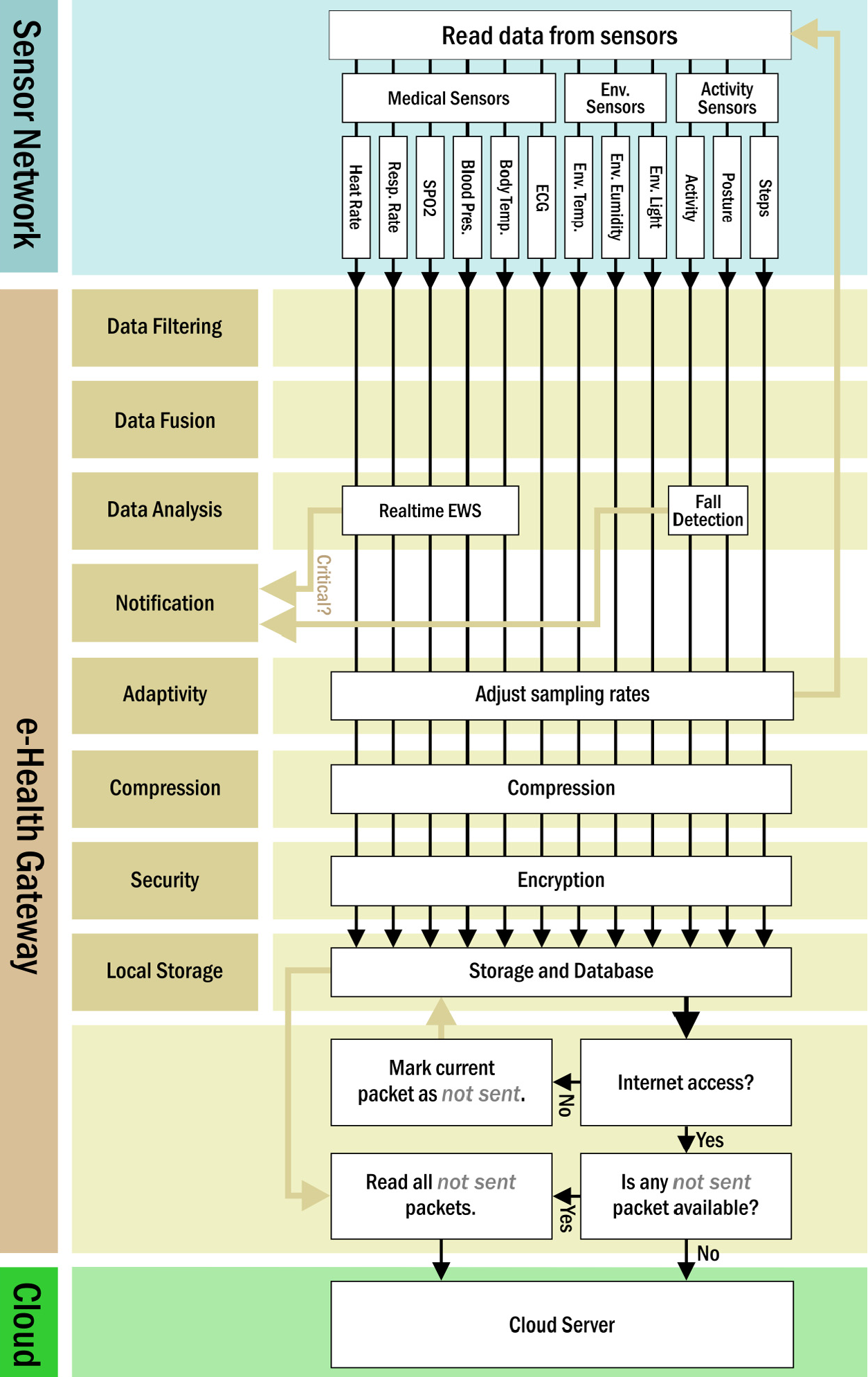
* **Data Fusion**: Correlating data from different sensors (e.g., Heart Rate + Motion) to filter out "false positives" caused by movement.
* **Wavelet Transformation**: Using Daubechies 4 wavelets to extract R-peaks from ECG signals locally, sending only the heart rate and anomalous features to the cloud instead of the whole raw wave.

### 2. Mobility and Interoperability
One of the biggest hurdles in hospitals is "Handover." Patients move between rooms, losing connection to one base station and finding another. The proposed Fog layer manages this geo-distributed network, ensuring that a patient's medical profile "follows" them as they move from Gateway A to Gateway B.
## Experimental Results: Fog vs. Cloud
The researchers rigorously tested their "Fog-assisted" model against a standard cloud setup. The results were striking:
* **Energy Efficiency**: By offloading the Signal Processing (SP) from the Arduino-based sensor to the UT-GATE, the sensor's power consumption dropped by over **50%**.
* **Bandwidth Optimization**: The system achieved a **74.1% data reduction**. Instead of clogging the network with raw data, the gateway sends "Knowledge."
* **Real-time Response**: For a "Sense-to-Actuate" loop, the Fog approach achieved **21ms latency**, compared to **161ms** for the Cloud.

## Medical Case Study: The Early Warning Score (EWS)
To prove the practical value, the team implemented an **Early Warning Score (EWS)** system. EWS is a clinical tool used to predict patient deterioration based on six vital signs (BP, Heart Rate, SpO2, etc.).
In their setup, the UT-GATE:
1. Automatically calculates the EWS score every second.
2. **Dynamically adjusts sampling rates**: If the score rises (indicating danger), the gateway commands sensors to sample faster. If the patient is stable, it lowers the rate to save power.
3. Provides local visualization even if the hospital's main Internet goes down.
## Critical Analysis & Conclusion
The shift to Fog Computing is an essential evolution for IoT. The UT-GATE proves that by adding a layer of "Edge Intelligence," we solve the three most critical problems of remote medicine: **Reliability, Speed, and Longevity.**
**Future Outlook**: While the paper focuses on rules-based EWS, the next logical step is deploying **Deep Learning** models directly on these gateways (Edge AI). As the healthcare industry moves toward 24/7 "Hospital at Home" models, architectures like the one proposed here will become the standard skeleton of modern medical infrastructure.
**Takeaway**: We must stop treating gateways as simple routers and start treating them as the "Local Brain" of the healthcare ecosystem.