
Extreme Events Management: Leveraging Multimedia Social Networks and Bio-Inspired AI
Future Generation Computer Systems
This paper introduces an integrated Multimedia Big Data system for managed extreme events, combining incremental clustering-based event detection with a bio-inspired Influence Maximization (IM) algorithm. The core methodology, centered on an "action-reaction" paradigm and multimedia similarity, aims to optimize alert diffusion through Online Multimedia Social Networks (MuSN).
TL;DR
In the wake of a disaster, every second counts. This paper presents a sophisticated framework that treats Multimedia Social Networks (MuSN) as a distributed sensor grid. By analyzing the "Action-Reaction" patterns of users sharing images and videos, the system detects extreme events (like wildfires) and identifies the most influential accounts to broadcast emergency alerts. It replaces static social graphs with a dynamic, multimedia-aware influence model powered by a modified Artificial Bee Colony (ABC) algorithm.
The "Blind Spot" in Modern Emergency Response
Current emergency management often treats social media as a secondary text-feed. However, as the authors note, "an image is worth a thousand words." When the Vesuvio volcano area caught fire in 2017, the first alerts weren't official reports; they were a flood of photos and videos from locals.
The technical bottleneck lies in two areas:
- Variety & Velocity: Detecting an event within the "Big Data" noise of millions of posts.
- Dynamic Influence: Traditional metrics like follower counts are vanity metrics. True influence during a crisis is determined by how quickly one's post triggers reactions (likes, shares, or similar photo uploads) from others in the same geographic area.
Methodology: From "Action-Reaction" to Influence Graphs
The paper's core innovation is the Reaction Operator. Unlike traditional influence models that assume influence is a static probability, this model looks at logs to see if User A's post consistently triggers a response from User B within a specific time window ().
The Two-Stage Pipeline
- Event Detection: The system uses a sliding window to monitor features like hashtag co-occurrence, spatial distribution, and—crucially—image similarity. If a cluster of similar images emerges from a specific location, an event is flagged.
- Influence Maximization (IM): Once an event is detected, the system builds an Influence Graph. It then deploys a modified ABC Algorithm to find the "Employer Bees"—the top-k users who can maximize the spread of an official alert.
 Figure 1: The proposed system architecture integrating stream processing and batch computation for influence estimation.
Bio-Inspired Alert Diffusion: The ABC Algorithm
Why bees? The Artificial Bee Colony algorithm is exceptionally good at global searching without getting stuck in local optima—a common problem in complex social graphs.
- Employer Bees: Represent the current top-k influential users.
- Scout Bees: Explore neighboring nodes in the graph to see if a more "profitable" (influential) user exists.
- Waggle Dance: A metaphor for the influence spread. If a scout finds a better seed user, it "recruits" the colony to that node.
Experimental Validation: The Vesuvio Case Study
The researchers tested their system on data from the 2017 Vesuvio fires. By including multimedia similarity (tracking when users post similar pictures of the fire), the system identified influence paths that textual analysis missed entirely.
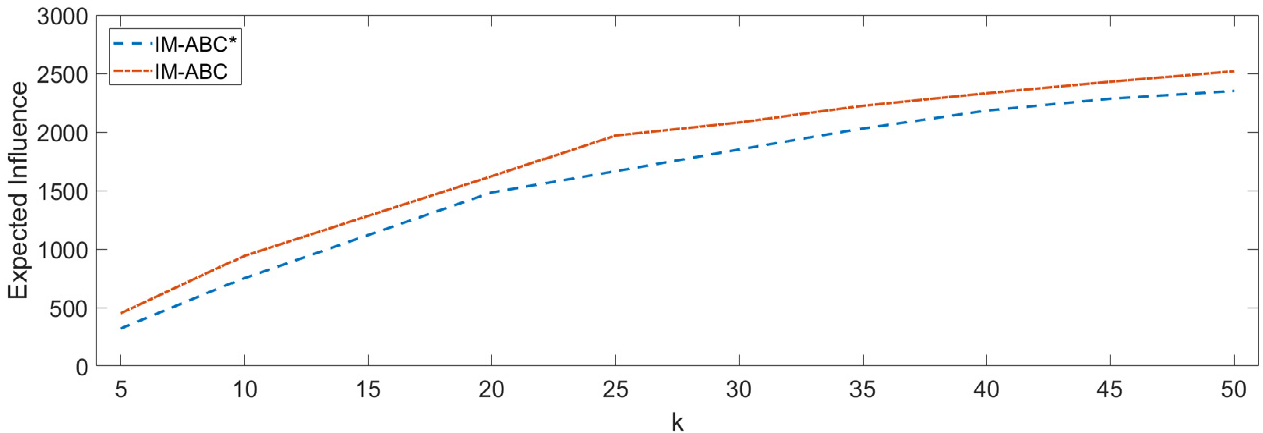 Figure 2: The estimated influence spread. Note that models considering multimedia similarity (IM-ABC) consistently outperform those that don't.
Key findings included:
- Efficiency: The
IM-ABC*model (with multimedia) actually reduced graph complexity by filtering for high-relevance interaction edges, resulting in faster computation. - Effectiveness: Alert reach was significantly higher when seeds were chosen based on their ability to trigger visual reactions.
Critical Insight & Conclusion
This work shifts the paradigm from Social Media Monitoring (listening) to Social Media Orchestration (directing). By grounding Influence Maximization in the physical reality of multimedia content, the authors provide a blueprint for next-generation "Social Sensor" systems.
Limitations: The reliance on Twitter's API (which has changed significantly since 2018) and the potential for "influence manipulation" by bots remain challenges. However, the integration of visual similarity remains a gold standard for verifying "ground zero" authenticity in extreme event management.