
Designing for Interaction: A Utility-Based Approach to Social Network Activation
Toward Future Network Systems Boosting Interactions between People in Social Networks
The paper introduces a micro-economics-based utility model to analyze information forwarding in social networks. It proposes a "link-based" incentive scheme where rewards are granted only if the receiver reacts to shared content, significantly outperforming traditional node-based rewarding in activating social interactions.
TL;DR
Information distribution is easy; meaningful interaction is hard. This paper demonstrates that by shifting incentive rewards from the sender to the receiver's reaction, we can reduce communication latency by nearly 40% and foster more deliberate, high-quality social exchanges.
The "Unidirectional" Trap in Modern Networks
While digital networks have achieved near-zero marginal costs for data distribution, they have inadvertently encouraged "unidirectional" communication. When sending information is cheap and rewards are tied simply to the act of "sharing," the market becomes flooded with low-value content. The authors argue that for a society to stay "activated," we need systems that treat communication as a bidirectional utility exchange, similar to real-world face-to-face interactions.
Methodology: The Micro-Economics of a "Forward"
The researchers modeled the behavior of users using two core utility equations. A user forwards content only when the sum of their intrinsic motivation (), external rewards (), and potential feedback () outweighs the costs of forwarding () and commenting ().
The Core Mechanism: Link-Based Incentives
The defining contribution of this work is the comparison between two reward rules:
- Node-based (Compared): Forwarder gets 600 units just for sending.
- Link-based (Proposed): Forwarder gets 600 units only if the receiver answers the content's question.
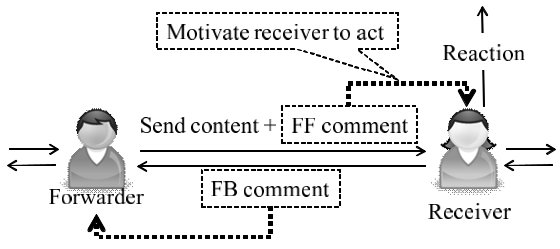 Figure 1: The interaction loop between Forwarders and Receivers involving Feed-Forward (FF) and Feed-Back (FB) dynamics.
This subtle shift forces the forwarder to care about the receiver's experience. To secure the reward, the forwarder spends effort () creating a personalized recommendation (FF comment), which in turn increases the receiver’s utility (), making them more likely to react.
Experimental Insights
The study involved 114 participants across four real-world communities. The results were categorized by "hopcounts" (how many steps the info traveled) and "reaction time."
SOTA Comparison: Speed and Quality
The data showed that the Link-based method significantly accelerated the social network.
- Reaction Speed: Under the proposed method, users reacted within 15 minutes on average, compared to 24 minutes in the baseline.
- Trust & Proximity: The impact was most pronounced in "A-level" relationships (frequent contacts), where reaction times were 5x faster than conventional methods.
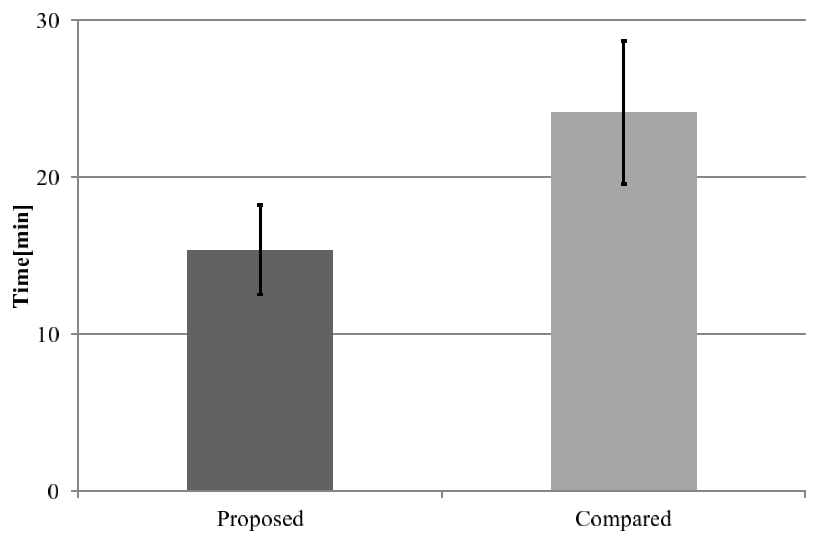 Figure 2: The link-based method (Proposed) shows a consistently faster reaction curve compared to the node-based method.
Selective Behavior via MCA
Using Multiple Correspondence Analysis (MCA), the authors discovered that users aren't just spamming. They perform strategic selectivity. "Forwarder type (1)" users—those who act quickly—are highly correlated with positive attitudes toward receiving comments. Users also tend to identify and target friends who are likely to contribute to the chain, effectively acting as "social routers."
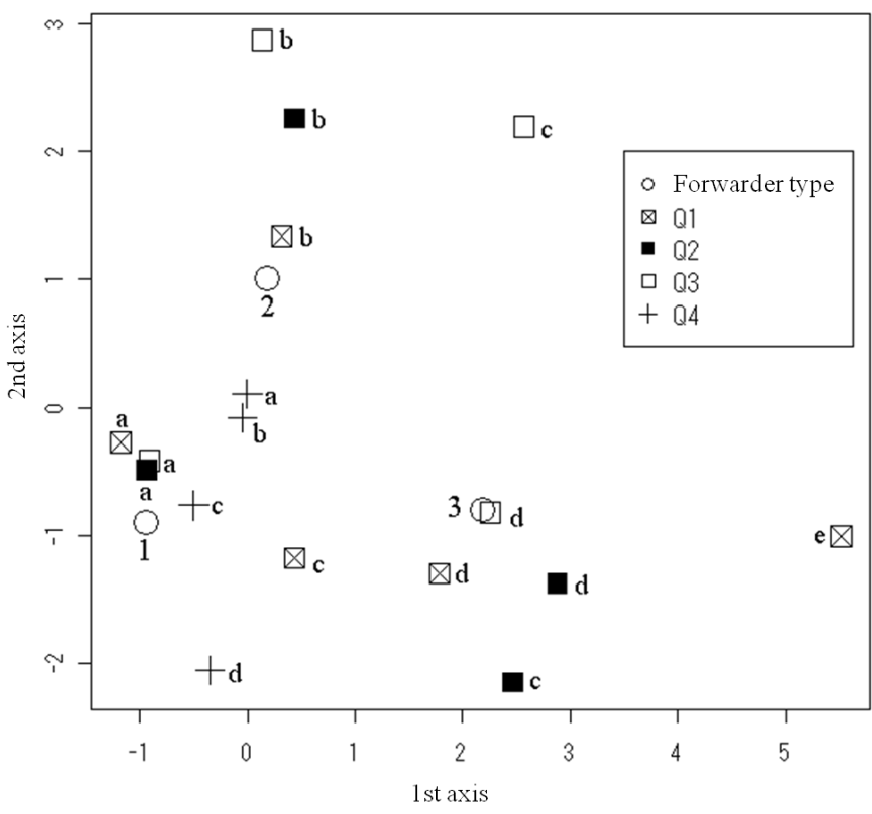 Figure 3: MCA visualization showing the correlation between user types and their psychological traits.
The Takeaway: Toward "High-Friction" Quality
Counterintuitively, the study suggests that adding a bit of "cost" to the forwarder (rewarding only successful interactions) improves the overall efficiency of the network. By incentivizing the quality of the link rather than the volume of the node, we can build network systems that truly boost human interaction rather than just moving bits.
Future Outlook: As we move toward decentralized social protocols, these utility-based incentive designs will be crucial in mitigating "noise" without resorting to centralized censorship.