
Bridging Logic and Learning: Hybrid Fuzzy Decision Trees and Knowledge-Based Networks
Fuzzy decision tree, linguistic rules and fuzzy knowledge-based network: generation and evaluation
This paper presents a hybrid framework that integrates Fuzzy Decision Trees (FDT) with Fuzzy Knowledge-Based Networks. It introduces a quantile-based discretization method for continuous attributes and a novel "T-measure" to evaluate decision tree efficiency by balancing compactness and performance.
TL;DR
This research bridges the gap between the interpretability of decision trees and the learning power of neural networks. By introducing a quantile-based discretization and a "T-measure" for tree efficiency, the authors create a system that extracts precise linguistic rules from data and uses them to "initialize" a neural network. This results in faster training, smaller architectures, and superior handling of overlapping data classes.
Background & Motivation: The Interpretable AI Dilemma
In the landscape of pattern recognition, we often choose between two extremes:
- Decision Trees (ID3/C4.5): Highly interpretable but fragile with continuous data and poor at handling overlapping class boundaries.
- Neural Networks: Powerful and robust but operate as "black boxes" with architectures often determined by trial and error.
The authors argue that Soft Computing (Fuzzy Logic) is the "glue" that can bind these two. The goal is to create a system that can handle the imprecision of real-world data (like vowel sounds or medical biopsies) while remaining scientifically transparent.
Methodology: The Three Pillars of Fuzzy Integration
1. Linguistic Discretization via Quantiles
Instead of arbitrary thresholds, the paper proposes using quantiles () to divide continuous features into Low, Medium, and High linguistic sets. This statistical approach minimizes the influence of outliers and noise, which typically plague standard discretization.
2. The T-Measure: A New Metric for Tree Goodness
The paper introduces a critical evaluation metric, the T-measure, which penalizes tree depth and unresolved nodes: Where is the number of attributes and is depth. A value closer to 1 signifies a compact, efficient tree that generalizes well.
3. Mapping Rules to Neurons
The most innovative part of the methodology is the mapping of extracted rules into a Multilayer Perceptron (MLP).
- Architecture: Each rule becomes a hidden node.
- Weight Encoding: Unlike previous works, these models (Model I, II, III) weights the connections based on sample frequency and the depth/importance of the attribute in the original tree.
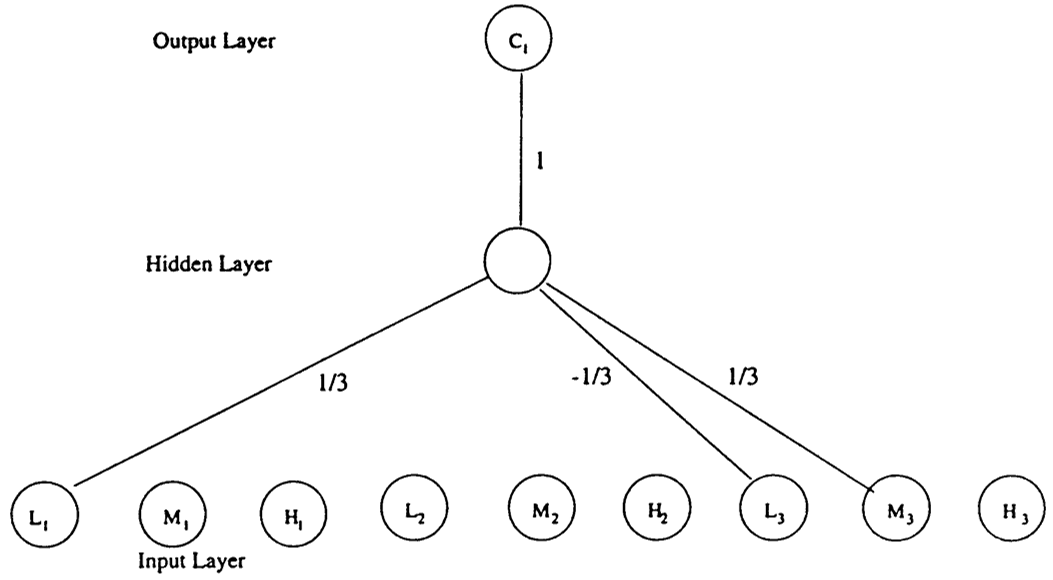 Fig 1: Weight encoding representing how linguistic rules are mapped into neural links.
Experimental Proof: SOTA Results
The system was tested on the Vowel, Wisconsin Breast Cancer, and Balance Scale datasets.
- Fuzzy vs. Classical: Fuzzy entropy measures consistently outperformed classical Shannon entropy in both recognition scores and tree compactness.
- Knowledge-Based vs. Blind MLP: The networks initialized with fuzzy rules (Knowledge-Based) reached higher accuracy faster than "empty" networks.
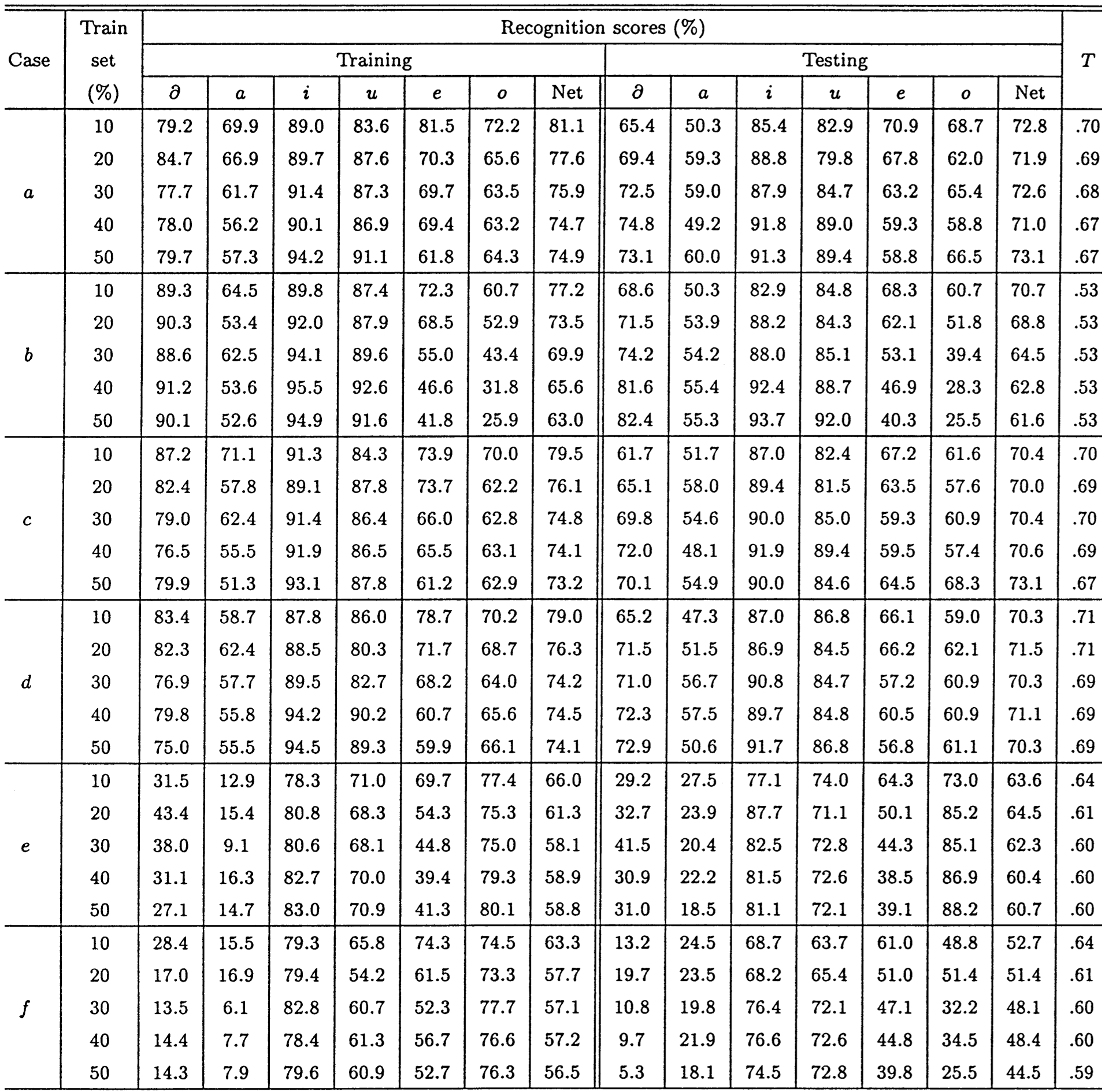 Table 1: Comparative performance across different fuzzy entropy cases (Case a-f).
Critical Insight & Conclusion
The true value of this work lies in Inductive Bias. By using a fuzzy decision tree to seed a neural network, we are providing the model with a "head start" based on linguistic logic.
Takeaways for Practitioners:
- Pruning Matters: Case 'a' (pruned) often generalizes better than Case 'b' (unpruned) even if training accuracy is lower.
- Quantiles over Means: For discretization, quantiles are more robust than simple means in noisy environments.
- Efficiency: The T-measure is a sophisticated way to optimize models for deployment on edge devices where storage and time are limited.
While the paper focuses on MLPs, the underlying philosophy—extracting symbolic knowledge to guide connectionist learning—remains a cornerstone for the next generation of Neuro-Symbolic AI.