
FDNNSA: Decoding the Human Heart Through Fuzzy Logic and Sparse Autoencoders
A Fuzzy Deep Neural Network with Sparse Autoencoder for Emotional Intention Understanding in Human-Robot Interaction
The paper introduces FDNNSA, a Fuzzy Deep Neural Network with Sparse Autoencoder designed for emotional intention understanding in human-robot interaction. It integrates Fuzzy C-means (FCM) for data clustering and a stacked sparse autoencoder to achieve human-like sparsity and high-level feature extraction, ultimately outperforming baselines on benchmark datasets like CK+ and CASIA.
TL;DR
Understanding human emotion is one thing; understanding emotional intention—what a person actually wants based on their feelings—is quite another. This paper presents FDNNSA, a hybrid model that combines Fuzzy C-means (FCM) clustering with Sparse Autoencoders (SAE) to help robots understand social cues. By fusing facial features with identity data (age, gender, region), the model achieves state-of-the-art accuracy in predicting human needs in real-time.
Perspective: From Expression to Intention
Most AI systems treat emotion recognition as a classification task: "Is this person happy or sad?" However, in Human-Robot Interaction (HRI), a robot needs to know the consequence of that emotion. If a customer at a bar looks "sad," do they want a strong whisky or a non-alcoholic drink?
The authors argue that intention is deeply influenced by uncertainty and demographics. A young student from Northern China might have different beverage intentions when "surprised" compared to an older professional from a different region.
Methodology: The Three Pillars of FDNNSA
The proposed architecture is built on three innovative stages:
1. Dynamic Feature Tracking (Candide3 Model)
Instead of simple 2D CNNs, the authors use the Candide3 3D face model. This allows the system to track Action Units (AUs) in real-time, capturing the physical mechanics of facial expressions even as a person moves.
2. Fuzzy C-means (FCM) Pre-processing
To handle the "vagueness" of human identity and its impact on emotion, FCM clusters the dataset. This step is critical because it reduces the dimensionality of the subsequent neural network, allowing the model to focus on specific demographic "clusters" rather than trying to find a one-size-fits-all solution.
3. Sparse Autoencoder (DNNSA)
The core of the "deep" part is the Sparse Autoencoder. By introducing a sparsity parameter () and a penalty term based on KL divergence, the model mimics the human brain’s neural mechanism—where only a fraction of neurons fire at once. This prevents overfitting and extracts the most salient statistical features of the emotion-intention mapping.
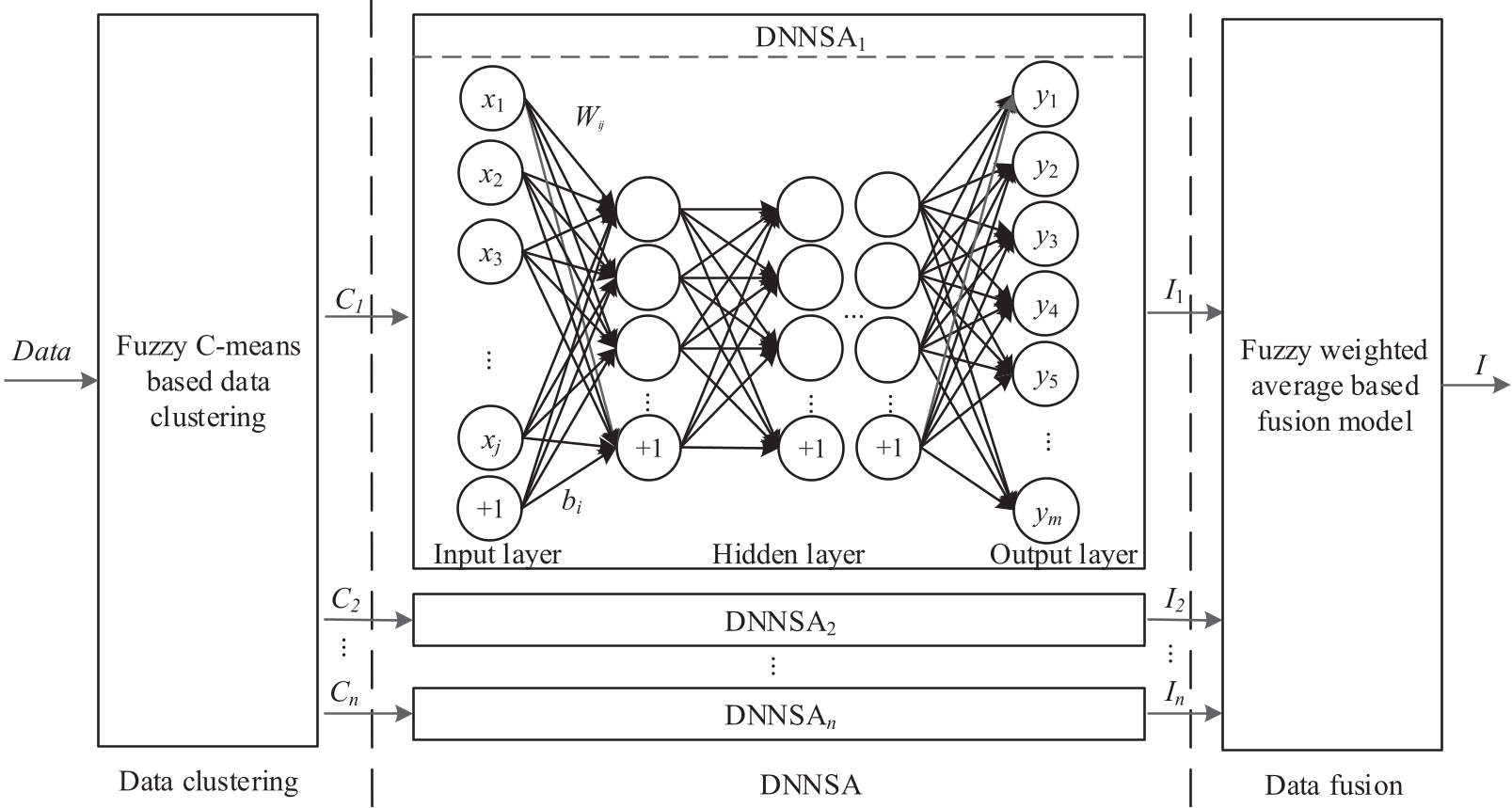 Above: The hierarchy of emotional intention understanding combining identity and AU data.
Experimental Results: SOTA Performance
The FDNNSA was tested against baseline algorithms like Softmax Regression (SR) and standard DNNs across multiple databases:
- CK+ (Facial): 81.31% Accuracy.
- CASIA (Speech): 82.08% Accuracy.
- Real-world ("Drinking at the Bar"): The model achieved ~80% accuracy in predicting drink choices.
One of the most impressive feats is the inference speed. On the CK+ dataset, the test time per image was roughly 0.0088 seconds, comfortably meeting the requirements for fluid, real-time human-robot conversation.
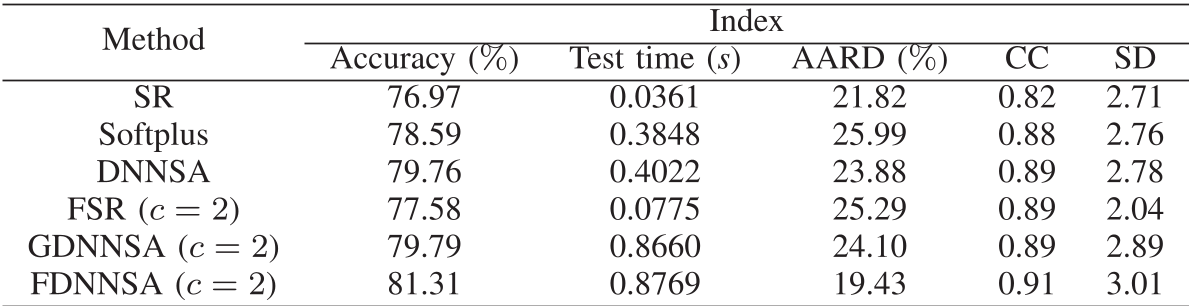 Comparison showing FDNNSA outperforming SR, DNNSA, and other variants.
Deep Insight: Why Sparsity Matters
The "Sparse" in Sparse Autoencoder isn't just a technical detail—it's the secret sauce. By forcing the network to represent information using a limited number of active neurons, the model learns a compressed, high-level representation of the intention. This makes the model robust to noise (like lighting changes or microphone hiss) and ensures it captures the "essence" of the emotional state rather than just memorizing pixels.
Conclusion and Future Outlook
The FDNNSA represents a significant leap toward "Socially Intelligent" robots. By moving past simple classification and into the realm of Intention Understanding using Fuzzy sets, the authors have bridged a gap between raw computer vision and cognitive science.
Limitations: The study currently focuses on a limited "Bar" scenario. Future iterations will likely need to explore more complex multi-modal fusion, combining visual, auditory, and perhaps even physiological data (like heart rate) to further refine the robot's "intuition."
Takeaway for Researchers
If you are working on HRI, don't ignore demographic metadata. This paper proves that "Fuzzifying" identity information like age and region provides the necessary context for Deep Learning models to make accurate social predictions.