
Reimagining Product Line Strategy: Optimal Multi-Platform Design via Fuzzy Logic
10478_A Fuzzy Goal Programming Approach for Optimal Product Family Design of Mobile Phones and Multiple-Platform Architecture.
This paper presents a Fuzzy Goal Programming (FGP) framework specifically designed for the concurrent optimization of product family design and multiple-platform architecture. By integrating conjoint analysis for utility estimation with meta-heuristic search algorithms (GA, SA, TS), the study achieves a balance between maximizing consumer utility and minimizing complex production costs in mobile phone manufacturing.
TL;DR
In the fight for market share, manufacturers face a paradox: consumers want bespoke variety, but factories need mass-produced efficiency. This paper provides a mathematical bridge using Fuzzy Goal Programming (FGP) to optimize both mobile phone design and the production platforms they are built on. The result? A proven blueprint to shift from rigid single-platform thinking to a dynamic multiple-platform architecture that slashes costs while maximizing customer utility.
Background: Beyond the Single Platform
In the 1980s, Sony used a platform strategy to launch over 250 Walkman variants. Today, the complexity of mobile phones has made a "one size fits all" platform a liability rather than an asset. While a single platform reduces initial development time, it often forces "over-design" or "under-performance" on specific variants.
The authors argue that the real competitive edge lies in finding the Pareto-optimal number of platforms—where the cost of setting up a new line is offset by the assembly efficiencies of more specialized component sharing.
Problem & Motivation: The Conflict of Utility and Expense
The research addresses two fundamental pain points:
- Incommensurate Goals: How do you add "utility points" (a measure of customer love) to "dollars" (a measure of production pain)? Usually, they can't be summed up.
- Uncertainty/Fuzziness: Decision-makers rarely say "I want exactly 50,000, but I can tolerate a bit more if utility is high." Traditional math fails here; Fuzzy Logic thrives.
Methodology: Decoding the Hybrid Architecture
The researchers developed a two-pronged mathematical model.
1. Conjoint Analysis for Utility
By surveying 100 sophisticated users, they used conjoint analysis to assign "part-worth utility" to 10 mobile phone attributes (Camera, RAM, CPU, etc.). This allows the model to calculate the total "utility score" of any theoretical product family.
2. The Fuzzy Goal Programming (FGP) Optimizer
The core innovation is the FGP model. It defines "Membership Functions" () for goals. If a goal is met, . If it's completely missed beyond a tolerance, . The optimizer tries to maximize the weighted sum of these satisfaction levels.
3. Solving the NP-Hard Puzzle
Since there are over 270,000 possible design combinations, the paper tests three Random Search Optimization Techniques (RSOTs):
- Genetic Algorithm (GA): Mimics evolution to "breed" better designs.
- Simulated Annealing (SA): Mimics the cooling of metals to find global minima.
- Tabu Search (TS): Uses local search with a "memory" to avoid cycles.
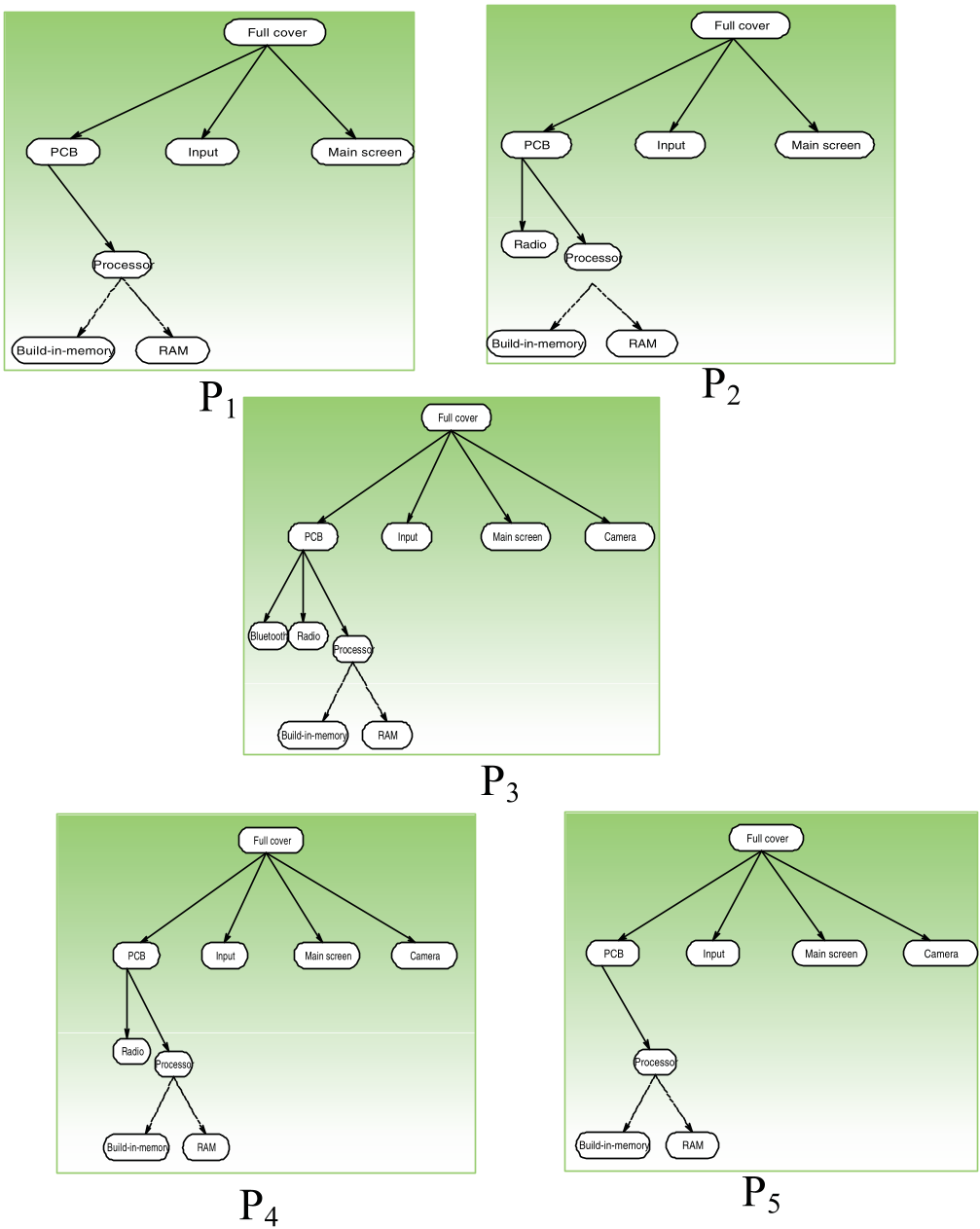 Fig 2: Example of a product platform acting as a "base" for multiple variants.
Experiments & Results: The Power of "Multiple"
The authors pitted a single-platform strategy against a multiple-platform one using a mobile phone case study.
Key Findings:
- Setup Cost Sensitivity: When setup costs are high (100), the system naturally gravitates toward 3 platforms.
- Algorithm Performance: The Genetic Algorithm (GA) consistently outperformed SA and TS in terms of both the final objective value and the speed of convergence to a near-optimal solution.
- The Single Platform Fallacy: The data shows that sticking to one platform regardless of demand leads to significantly higher "manual addition/removal" costs for components, which are much more expensive than mass assembly.
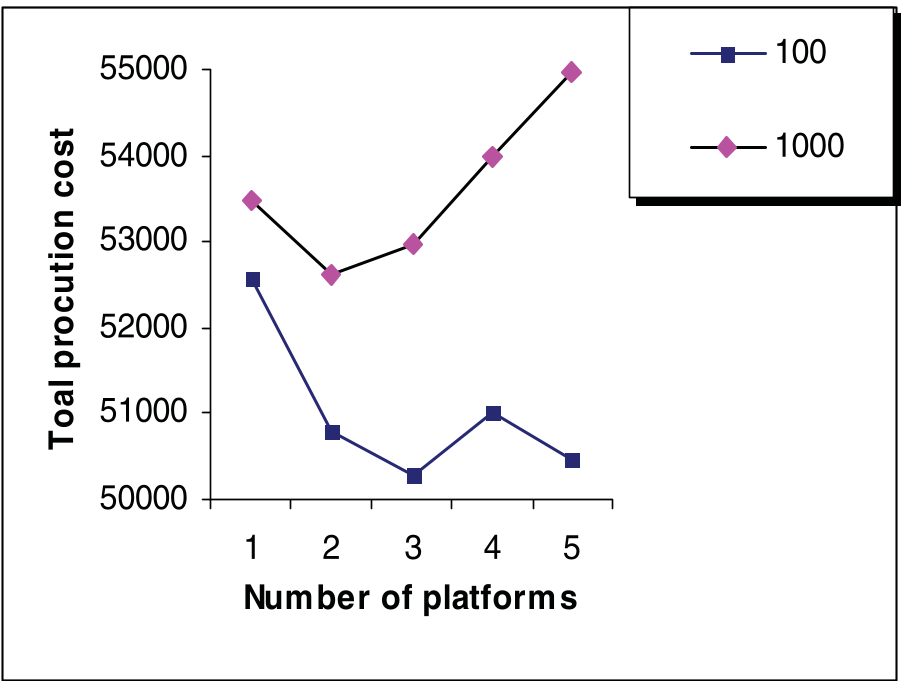 Fig 4: Graph illustrating how total production costs vary depending on the number of platforms and setup costs.
Critical Insight: Why This Matters
The value of this paper isn't just in the mobile phone example—it's in the validation of multiple platforms as a cost-saving measure via a rigorous fuzzy logic framework.
- Takeaway: Manufacturers shouldn't fear the "complexity" of multiple platforms if their setup costs are optimized.
- Limitations: The model assumes a static Part Assembly Sequence (PAR matrix). In high-tech assembly, these sequences can be fluid, which would add even more "fuzziness" to the model.
- Future Vision: Integrating this FGP model with real-time sales data (as suggested in Section VII) could lead to "Self-Optimizing Production Lines" that adjust platform architectures based on live consumer trends.
Conclusion
By moving from "mass production" to "mass customization" through multiple platforms, companies can finally satisfy the diverse needs of the modern consumer without going bankrupt. Satish Tyagi and colleagues have provided the mathematical heavy lifting to make this transition a calculated reality.