
Causal Association Mining: Using Fuzzy RPD Models to Revolutionize Drug Safety Surveillance
10477_A fuzzy recognition-primed decision model-based causal association mining algorithm for detecting adverse drug reactions in postmarketing surveillance
This paper introduces a novel causal association mining algorithm for detecting Adverse Drug Reactions (ADRs) using a "causal-leverage" interestingness measure. Integrated with a Fuzzy Recognition-Primed Decision (RPD) model, the method successfully identified hyperkalemia as a top 1% risk for the drug Enalapril within a real-world database of 16,206 patients.
TL;DR
Postmarketing drug surveillance is currently a "waiting game" that relies on voluntary reports, often missing 90% of adverse drug reactions (ADRs). This paper presents a sophisticated data mining algorithm that uses Fuzzy Logic and a Recognition-Primed Decision (RPD) model to proactively identify causal links between drugs and adverse events in electronic health records, successfully ranking high-risk associations like Enalapril-induced hyperkalemia in the top 1% of thousands of candidates.
The "Lurking Danger" in Postmarketing Surveillance
When a drug hits the market, it has only been tested on a few thousand people. Rare but fatal ADRs often only emerge after millions of exposures. The current gold standard, the FDA's MedWatch, is passive: it requires a doctor to notice a pattern and manually report it.
From a data science perspective, mining these ADRs from hospital databases is a "needle in a haystack" problem. Traditional association rule mining (Support/Confidence) fails because:
- Infrequency: Serious ADRs are rare; setting low thresholds causes a "combinatorial explosion" of false positives.
- Confounding Factors: Many symptoms (like cough) are both ADRs and common illnesses, making frequency-based signals noisy.
- Binary Limitations: Existing models treat an ADR as "happened" or "didn't happen," ignoring the nuances of timing and recovery.
Methodology: The Fusion of Fuzzy Logic and Expert Intuition
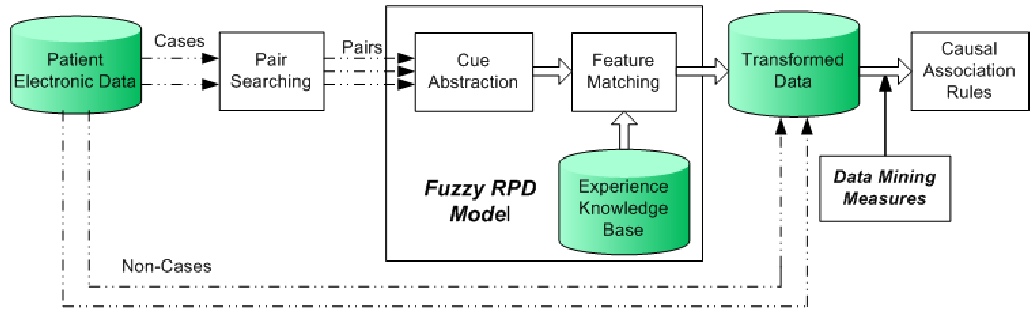
The researchers' breakthrough is the Causal-Leverage measure. Instead of just counting co-occurrences, the algorithm "reasons" like a clinical expert using a Fuzzy RPD Model.
1. The Fuzzy RPD Architecture
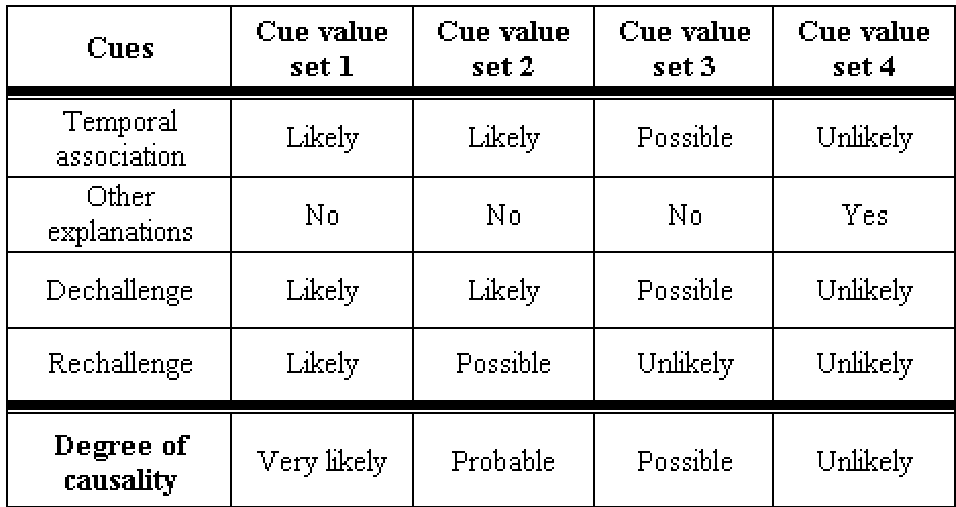
The model mimics how experienced doctors make rapid decisions based on patterns. It evaluates four qualitative cues:
- Temporal Association: How soon after taking the drug did the event occur? (Fuzzy values: Short, Medium, Long).
- Dechallenge: Did the symptom stop when the drug was stopped? (Inferred via pharmacy records of drug switching).
- Rechallenge: Did the symptom return if the drug was restarted?
- Other Explanations: Could a concurrent disease explain the event?
2. From Logic to Math: Causal-Leverage
Standard leverage measures the "excess" probability of two events happening together compared to independence. The authors redefine this by replacing binary counts with Weighted Causality Scores () derived from fuzzy inference.
Where is the membership degree of causality (Very Likely to Unlikely) and is the clinical weight.
Experimental Results: Proving the Concept
The team tested their algorithm on 16,206 patient records from the Detroit VA Medical Center. They focused on Enalapril (an ACE inhibitor).
- The Baseline Problem: There were 3,954 potential ADR codes in the database.
- The Success: Their algorithm ranked Hyperkalemia (excess potassium, a known serious ADR for Enalapril) at #33.
- The Comparison: Traditional frequency-based measures ranked common, irrelevant symptoms (like general pain or fever) much higher, burying the "true" signal in noise.
Critical Insight: Why This Matters
The Genius of this approach lies in its Inductive Bias. By encoding medical knowledge (like the "rechallenge" principle) into the mining measure itself, the algorithm requires fewer data points to "signal" a danger than a purely statistical model would. This effectively solves the "Cold Start" problem in drug safety—detecting risks before thousands of people are harmed.
Limitations & Future Work
While powerful, the model currently struggles with the "Other Explanations" cue, as modeling every possible disease interaction is computationally heavy. Future iterations could benefit from Knowledge Graphs to automate the exclusion of confounding underlying diseases.
Conclusion
This work demonstrates that "Smart Data" beats "Big Data." By augmenting raw health records with fuzzy expert systems, we can move from reactive reporting to proactive, causal discovery, turning hospital databases into early-warning systems for global health.