
G2G: Crowdsourcing the Cellular Landscape for Proximity-Aware Socializing
G2G: location-aware mobile social networking with applications in recommender systems and gaming
G2G is a location-aware mobile social networking platform that enables proximity-based interactions like friend discovery, chatting, and localized notes without requiring GPS or specialized hardware. It uses a novel GSM cell-correlation mechanism combined with user-defined "hotspots" to determine proximity via the existing cellular infrastructure.
TL;DR
Before the era of ubiquitous high-speed GPS and ubiquitous smartphones, the G2G (GetTogether) platform proposed a clever workaround for mobile social networking. By leveraging the existing GSM cellular infrastructure and a crowdsourced mapping of "cell neighborhoods," G2G enabled friend discovery, localized "sticky notes," and location-based gaming without needing an open sky or power-hungry GPS sensors.
Contextual Positioning
Published in 2008, G2G sits at the transition point between the manual "check-in" era of DodgeBall and the automatic "always-on" tracking of modern social apps. While competitors like Live Contacts! were restricted to rare GPS-enabled handsets, G2G focused on the Symbian OS and J2ME ecosystems, prioritizing accessibility and indoor reliability over raw geographic precision.
The Core Problem: The Binary Trap of Cell IDs
The fundamental challenge in 2008 was that a GSM Cell ID is a "dumb" identifier. Without a provider's internal database, you don't know where a tower is.
- The Proximity Gap: Two friends could be 50 meters apart but connected to different towers (Cell A and Cell B). A naive system would think they are far apart.
- The Hand-off Noise: Mobile phones frequently bounce between towers. This creates "flickering" locations that confuse social proximity.
The Insight: Crowdsourcing the "Cell Graph"
The authors' "Aha!" moment was realizing that users can map the network for the system.
1. Hotspots and Correlation
When a user marks a "Hotspot" (e.g., "My Office"), the G2G client doesn't just record one Cell ID. It records every Cell ID the phone sees during the user's stay. If the phone sees Cell A and Cell B at the same hotspot, the system now knows Cell A and Cell B are neighbors.
2. Neighbor-of-a-Neighbor Search
By building this graph of overlapping cells, G2G can perform a "k-hop" search. If Bob is at Cell A, and Alice is at Cell C, and the system knows that Cell B overlaps with both, it can accurately alert them that they are "nearby."
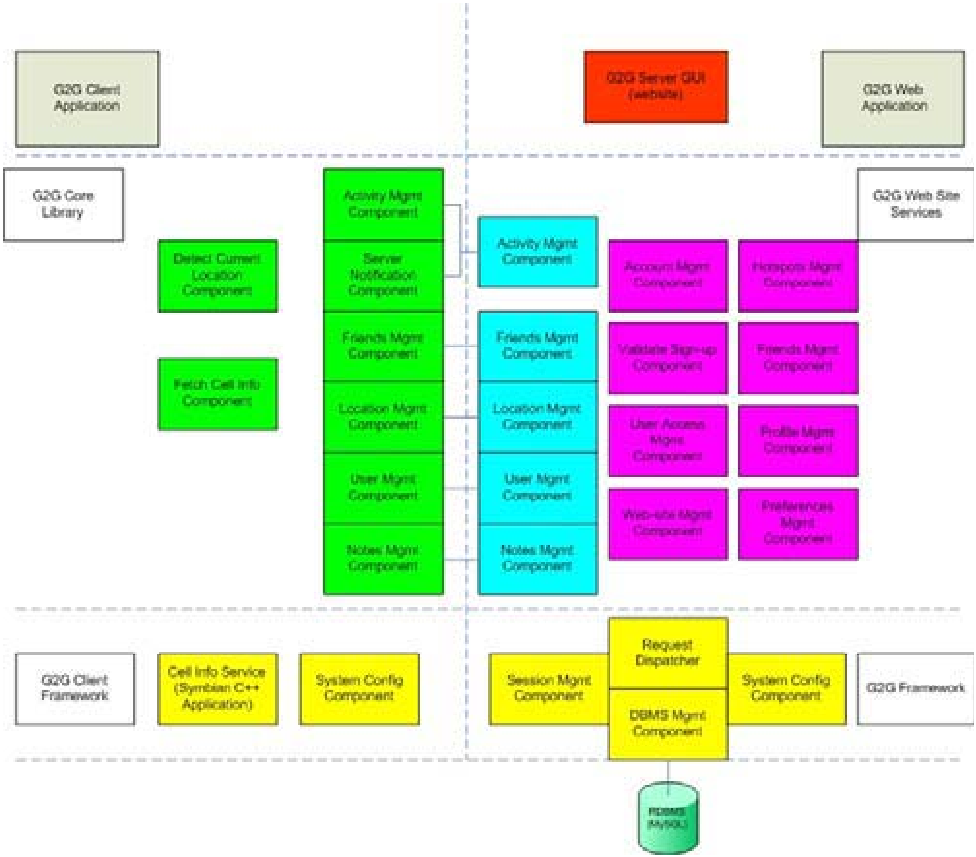 The G2G architecture leverages a Symbian C++ back-end to bypass J2ME's sandbox limitations and access low-level GSM data.
Revolutionary Applications (for 2008)
G2G wasn't just about finding friends; it pioneered several features we now take for granted:
- Location-Aware Notes: Digital "sticky notes" that only appear when a friend enters a specific area. This created a primitive but effective recommendation system (e.g., "Try the pasta here" visible only at the restaurant).
- Treasure-Hunt Gaming: Using notes as clues to lead players from one physical location to another.
- Privacy Controls: The "Invisibility" toggle, a precursor to modern "Ghost Modes."
Performance and Accuracy
The authors validated the system in Athens. The results proved that in dense urban environments, logical proximity (being in the same or adjacent cell) correlates almost perfectly with social proximity.
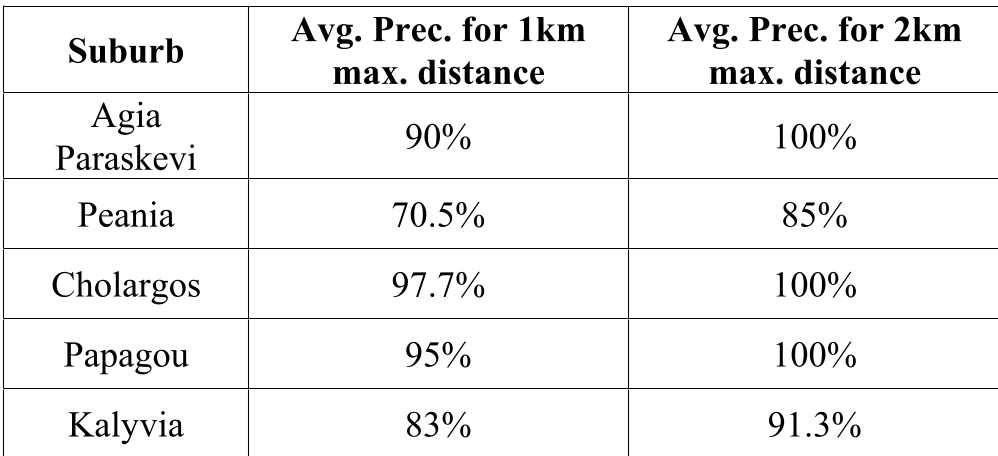 Table 1: Performance metrics across different suburbs. Urban areas like Cholargos reached near-perfect precision.
The paper also provides a rigorous mathematical proof for "worst-case" precision using numerical integration in MATLAB, showing that even when users are on the fringes of adjacent cells, the system remains reliable (Precision > 0.71).
The Takeaway: Architecture Matters More Than Sensors
The legacy of G2G is its resourceful engineering. Instead of waiting for better hardware (GPS), the authors used graph theory and user behavior to turn a "dumb" network into a "smart" social sensor. It serves as a classic case study in how to build SOTA features on top of legacy infrastructure by understanding the underlying physics and logic of the network.
Limitations
- Cross-Provider Issues: Since different carriers use different towers, the system initially only worked within one provider. The authors proposed a manual "handshake" to correlate cells across different networks.
- Battery Management: Even without GPS, the constant "heartbeat" polling of cell data presented a challenge for early mobile batteries.
Editor's Note: G2G was a visionary precursor to the location-aware world we live in, proving that metadata—when correlated correctly—is as powerful as raw coordinate data.