
Gait as Personality: Decoding the Biomechanics of Extroversion in Virtual Agents
The Effect of Gait Parameters on the Perception of Animated Agents’ Personality
This study investigates the influence of specific gait parameters on the perception of an animated pedagogical agent's personality, specifically "Extraversion." Utilizing a 3D stylized agent, the researchers identified that four key walking attributes—stride length, walk beat (speed), beltline tilt, and upper body twist—significantly modulate how audiences perceive an agent's extroverted nature.
TL;DR
Can the way a virtual teacher walks change how much students trust or engage with them? This study reveals that "Extraversion" in animated agents isn't just a vibe—it's a calculated result of stride length, speed, and pelvis tilt. By manipulating 6 specific gait parameters, researchers found that expansive, fast movements are the "secret sauce" for projecting a confident, extroverted persona.
Background: Why Personality Matters in Digital Learning
In the realm of Animated Pedagogical Agents (APAs), personality is more than aesthetic; it is an instructional tool. An extroverted agent is often perceived as more charismatic and energetic, which correlates with higher student motivation. However, animators often struggle with the how: exactly how many degrees of upper body twist or how many frames per step are required to signal "outgoing" rather than "anxious"?
The "Anatomy" of a Walk: Methodology
The researchers moved beyond simple "fast vs. slow" descriptions. They isolated six biomechanical variables:
- Stride Length: Distance covered per step.
- Walk Beat: The timing/speed (frames per step).
- Beltline Tilt: Pelvis rotation along the Z-axis (weight shifting).
- Upper Body Twist: Counter-rotation between the pelvis and shoulders.
- Body Lean: Forward or backward inclination.
- Foot Angle: Inward/outward rotation of the heel.
Using a Fractional Factorial Design, they generated 18 unique walk cycles, ensuring they didn't have to animate every possible combination (which would have been 729 clips!) while still maintaining statistical integrity.
 Figure 1: The rigged agent showing the control points for pelvis and spine rotation used to iterate gait variations.
Key Insights: What Makes an Extrovert?
The results from 79 participants provided a clear hierarchy of sensory cues:
1. The Power of the Stride and Speed
The most "extraversion-positive" traits were large stride length and high walking speed. If an agent takes long, fast steps, the audience almost universally tags them as extroverted. Conversely, a slow walk isn't just perceived as "low extraversion"—it often causes the audience to perceive the agent as Neurotic or "worrying."
2. The Subtle Swag: Beltline Tilt
A more pronounced tilt in the beltline (reflecting a confident weight shift) contributes positively to the extroversion score. It adds a "fluidity" that participants associated with an active, assertive personality.
3. The Non-Factors: Lean and Foot Angle
Surprisingly, whether the agent leaned forward or pointed their toes outward had no statistically significant impact on extraversion. This suggests that while these traits might affect "attractiveness" or "realism," they are not primary signals for core personality traits in the Big Five model.
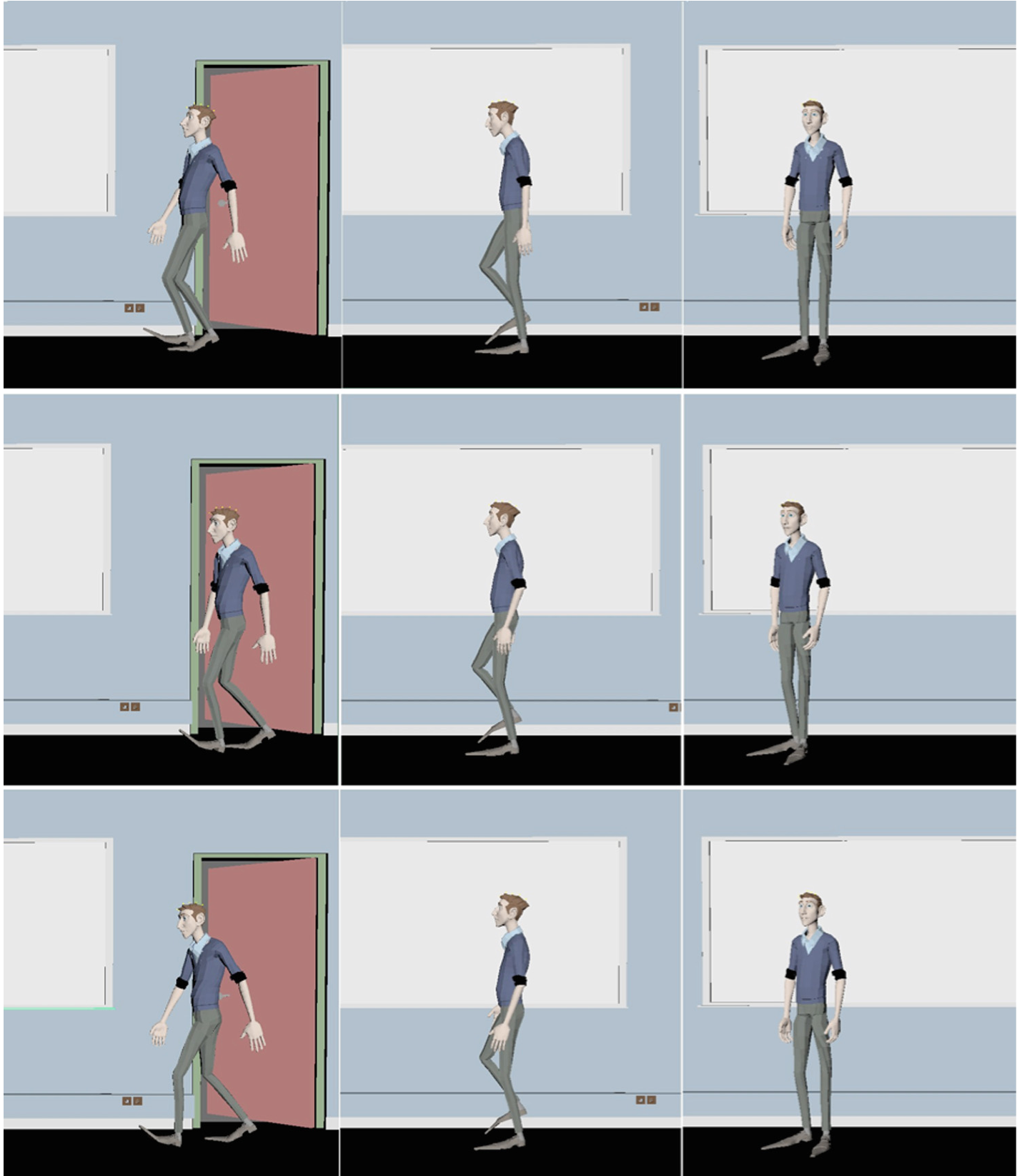 Figure 2: Comparison of different walk levels—Low (000000), Neutral (111111), and High (222222).
Experimental Results Table
The ANOVA test results underline the dominance of the first few parameters:
| Parameter | Significance (p-value) | Perception Impact |
|---|---|---|
| Stride Length | 2.71e-09 | High |
| Walk Beat (Speed) | < 2e-16 | High |
| Beltline Tilt | 0.0393 | Moderate |
| Body Twist | 0.0158 | Moderate |
| Body Lean | 0.1069 | Negligible |
Critical Analysis & Conclusion
This paper provides a rare "bridge" between the subjective art of animation and the objective data of psychology.
Takeaway for Designers: If you want to build a "teacher" bot that feels energetic and approachable:
- Increase the Stride: Make the steps 20% longer than "natural."
- Decrease Frame Count: Aim for a faster cadence (e.g., 16 frames/step vs. 24).
- Focus on the Core: Don't sweat the foot angle; focus on the pelvis and shoulder rotations (Upper Body Twist).
Limitations: The study used a single, young, white male avatar. Personality perception is heavily filtered through the lens of social bias; future work must determine if a female or elderly avatar requires different gait modifications to achieve the same "extrovert" rating.
Future Outlook
As we move toward a world of AI-driven metaverses, the ability to procedurally generate reliable non-verbal cues is essential. This research sets the foundation for "Personality-Driven Procedural Animation," where an AI can dial up an agent's confidence level just by tweaking its walk cycle in real-time.