
Unmasking the Algorithmic Gold-Miners: Social Network Analysis of MMORPG Bots
Analysis of Game Bot's Behavioral Characteristics in Social Interaction Networks of MMORPG
This paper presents a social network analysis of game bots in the MMORPG "Aion," leveraging large-scale log data provided by NCSoft. By comparing six distinct interaction networks (Friend, Whisper, Party, Trade, Mail, and Shop), the authors identify unique behavioral patterns that distinguish automated bots from human players, primarily driven by gold-farming and real-money trading motives.
TL;DR
By analyzing 88 days of live server data from the MMORPG Aion, researchers from Korea University have successfully mapped the "social DNA" of game bots. Unlike humans who interact for leisure, bots form highly reciprocal, mission-critical networks focused exclusively on resource consolidation and distribution, leaving a distinct mathematical footprint in Trade and Party interactions.
Problem & Motivation: The Economic Threat of Automation
In the ecosystem of a Massively Multiplayer Online Role-Playing Game (MMORPG), game bots are more than just a nuisance; they are an existential threat to the game's economy. These automated programs perform repetitive tasks to accumulate in-game wealth, which is often sold for real-world currency—a process known as Real Money Trading (RMT).
The authors argue that individual behavior analysis (like tracking movement) is increasingly insufficient. Instead, they look at the Social Interaction Network. Since bots belong to organized "gold-farming" studios, they must interact to move assets. The core insight is that while bots try to mimic player movement, their social structures are purely utilitarian and lack the chaotic diversity of human relationships.
Methodology: Mapping Six Dimensions of Interaction
The study utilizes data from NCSoft, analyzing nearly 100,000 characters. To ground their findings, they used the official "banned account list" as the ground truth for bot identities.
They constructed six distinct networks:
- Friend: Adding players to a list.
- Whisper: Private messaging.
- Party: Temporary groups for combat.
- Trade: Direct exchange of items/money.
- Mail: Asynchronous communication.
- Shop: Transactions via user-defined private stalls.

Key Insights from the Network Data
1. Functional Specialization
The most striking finding is the absence of behavior. In the Bot-Bot group, interaction in the Mail and Shop networks was virtually non-existent (as seen in Table 1). Humans use private shops to browse and socialize, whereas bots prefer direct Trade for speed and efficiency.
2. High Reciprocity in "The Business"
In social network analysis, Reciprocity indicates the fraction of mutual connections.
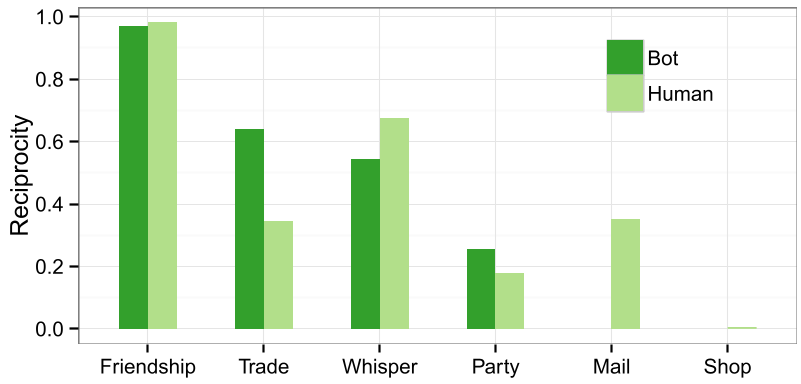 As shown in Figure 2, bots exhibit significantly higher reciprocity in Trade and Party networks. This reflects the "Business" nature of bots: they form parties to farm more efficiently and trade gold to "mule" accounts for storage.
3. Degree Distribution Anomalies
The Mail network provided a unique anomaly. While 90% of bots sent very few mails, a tiny subset (9 "spam" bots) sent over 10,000 mails each with no attachments—clearly identifying them as advertisement bots for illegal gold-selling websites.
Deep Insight & Conclusion
The value of this research lies in its transition from Individual-based Detection to Group-based Detection. By viewing the game as a multi-relational graph, the authors prove that bots are "socially specialized." They don't just act differently; they connected differently.
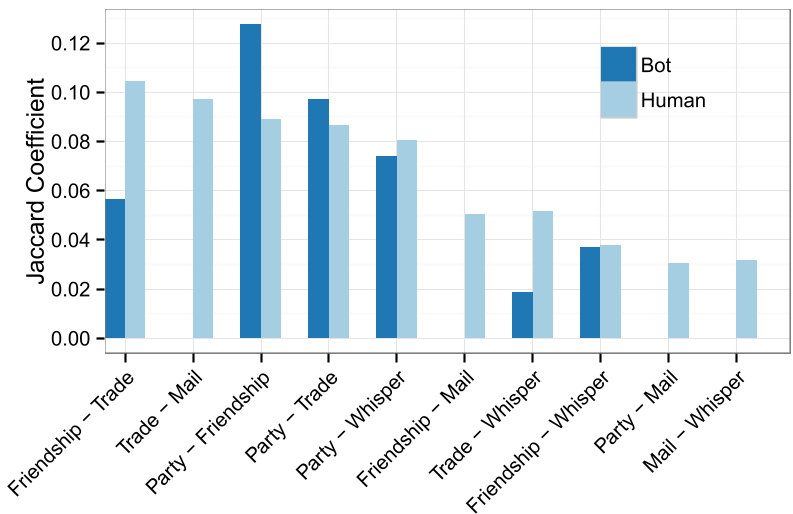
Takeaway: Future bot detection should focus on Triad Motifs (patterns of three-way interactions) and Pearson correlation across different networks (e.g., does a large Friend list correlate with high Trade volume?).
Limitations: Sophisticated bots may eventually begin to "spoof" human social behavior (like opening fake shops) to blend in. However, the overhead of making a bot "socially human" might reduce the profitability of gold farming, which is in itself a win for game security professionals.