
Battle for the Feed: A Game-Theoretic Deep Dive into Competitive Viral Marketing
A Game-Theoretic Analysis of a Competitive Diffusion Process over Social Networks
This paper presents a game-theoretic analysis of competitive diffusion processes in social networks using the Linear Threshold Model (LTM). It defines a simultaneous non-cooperative game where firms compete to maximize product adoption, identifying critical structural conditions for Pure Nash Equilibria (PNE) and establishing that deciding PNE existence is co-NP-hard.
TL;DR
When multiple companies launch products simultaneously on a social network, who wins? This paper analyzes this "Competitive Diffusion" through a game-theoretic lens. It moves beyond simple optimization to prove that finding a stable equilibrium (Pure Nash Equilibrium) is computationally "hard" (co-NP-hard), and that competition can often lead to "market failure" where social welfare is drastically reduced.
Background Positioning
In the landscape of social network theory, we've moved from Influence Maximization (how to spread one thing) to Competitive Diffusion (how to win against others). While previous researchers looked at sequential moves (Stackelberg games), this work tackles the much more volatile simultaneous game, where strategies collide in real-time.
Problem & Motivation: The Chaos of Competition
Existing models often assumed that the underlying graph structure (like diameter) was the key to stability. However, the authors argue that this is insufficient. The core difficulty lies in "collisions":
- Time Collisions: A competitor reaches a node one step earlier.
- Tie-Breaking: Two products reach a node at the exact same time—who does the customer pick?
- Structural Inhibition: Competitors block the path to your "natural" audience.
The authors discovered that even in a simple 3-node line graph, companies can get stuck in an endless loop of shifting strategies, meaning a stable "best" set of seed nodes often doesn't exist.
Methodology: The Mechanics of the Spread
The authors utilize the Linear Threshold Model (LTM), where a node adopts a product only if a certain percentage of its neighbors have.
Key Innovation: Structural Factors
Instead of looking at the graph diameter, they define:
- Diffusion Depth (D): How many "hops" the influence travels.
- Ideal Spread (): The maximum territory you'd win if you were the only player.
- Diffusion Collision Factor (DC): A quantification of how much one player's strategy inherently damages another's potential.
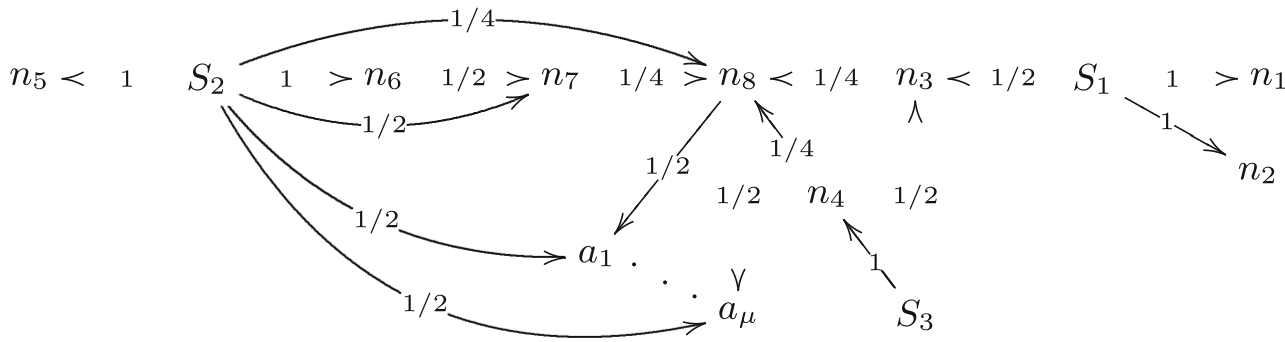 Figure 1: A network demonstrating how player 2 can out-compete player 1 even if player 1 has higher "quality" or reputation.
Experiments & Results: Stability vs. Complexity
The findings are a mix of mathematical elegance and grim reality for network stabilizers:
- Complexity: Determining if a network even has a stable equilibrium is co-NP-hard. You essentially have to check every possible combination of seed nodes.
- The Price of Anarchy (PoA): In competitive environments with more than one hop of diffusion (), the efficiency of the network drops significantly. Companies might focus so much on fighting each other that they leave the majority of the network "white" (uninfected).
- Quality Doesn't Guarantee Victory: In a 3stplayer game, the "superior" product (determined by tie-breaking reputation) can actually end up with the lowest market share due to how other players position their seeds.
Note: Table 1 in the paper illustrates a simple case where no PNE exists, leading to a cycle of strategy shifts.
Critical Analysis & Conclusion
Takeaway
The paper shifts the focus from graph global metrics to local interaction dynamics. It provides a rigorous proof that competition in social networks is inherently unstable.
Limitations
The model is primarily deterministic. In the real world, "word-of-mouth" is often stochastic (probabilistic). While the authors mention their results hold for some general schemes, the specific bounds on the Price of Anarchy are heavily tied to the LTM's deterministic nature.
Future Outlook
This work opens the door for Merge and Acquisition (M&A) Analysis in social networks. As shown in Theorem 7, a top-tier firm might actually benefit from "absorbing" a smaller competitor to simplify the game from a 3-player chaos to a 2-player manageable competition.
Author's Note: This research suggests that for viral marketing managers, the "optimal" strategy may be less about finding the most influential people and more about finding the most defensible people.