
Cross-Media Logic: How Yelp Ratings Drive the Groupon "Gamble"
Game-Theoretic Cross Social Media Analytic: How Yelp Ratings Affect Deal Selection on Groupon?
This paper proposes a data-driven game-theoretic framework to analyze deal selection on Groupon by integrating external social media signals from Yelp. The authors utilize a "Dynamic Chinese Restaurant Game" (D-CRG) extension to model how rational customers navigate network externalities and social learning to maximize utility.
TL;DR
Buying a Groupon is more than a bargain—it's a high-stakes decision involving social learning and "network externalities." This paper introduces a sophisticated game-theoretic framework that proves customers don't just pick the highest rating; they rationally predict how a deal's popularity might actually ruin the service quality.
Problem & Motivation: The "Groupon Effect"
When you buy a discounted meal on Groupon, you face a dual uncertainty: Is the restaurant actually good? And if everyone else buys the deal, will the kitchen be too overwhelmed to serve me well?
Prior research often treated social learning as a vacuum—assuming you just follow the crowd. However, the authors identify a critical nuance:
- Negative Externality: For a 5-star restaurant, too many Groupon sales lead to over-crowding and service degradation.
- Positive Externality: For a 3-star vendor, higher sales might actually signal a baseline of reliability or "safety in numbers."
Existing models like the Dynamic Chinese Restaurant Game (D-CRG) were too rigid, assuming a fixed set of "tables" (deals). This paper breaks that mold by accounting for the fact that Groupon deals appear and disappear hourly.
Methodology: The Rationality of the Crowd
The authors propose a Multi-Dimensional Markov Decision Process (M-MDP). The "State" of the system isn't just a list of deals; it's a combination of:
- Available Deal Set: What's currently on sale.
- Grouping State: How many people have already bought each deal.
- Belief State: The current collective estimation of quality based on Yelp reviews.
Architecture of Decision Making
The core of the paper lies in how it handles Bayesian Updates. As new Yelp reviews arrive stochastically, rational customers update their "belief" using Gaussian distributions. They then use a Value-Iteration Algorithm to calculate their "Expected Utility," which factors in the probability of a deal going offline and the predicted behavior of future buyers.
 Fig 1: The cross-social media decision-making process involving Yelp feedback and Groupon actions.
Experiments & Results: Are We Actually Rational?
The authors tracked 6,509 deals over 19 months in Washington D.C. They found that customer behavior aligns most closely with a Fully-Rational Nash Equilibrium strategy.
Key Findings:
- Price vs. Rating: Customers were surprisingly sensitive to price (the "Minimum Price" strategy was the strongest naive baseline), but as the number of choices increased, they shifted their focus to Yelp ratings.
- Performance Boost: The proposed framework outperformed "Myopic" strategies (choosing for immediate gratification) by a significant margin in both individual utility and overall Social Welfare.
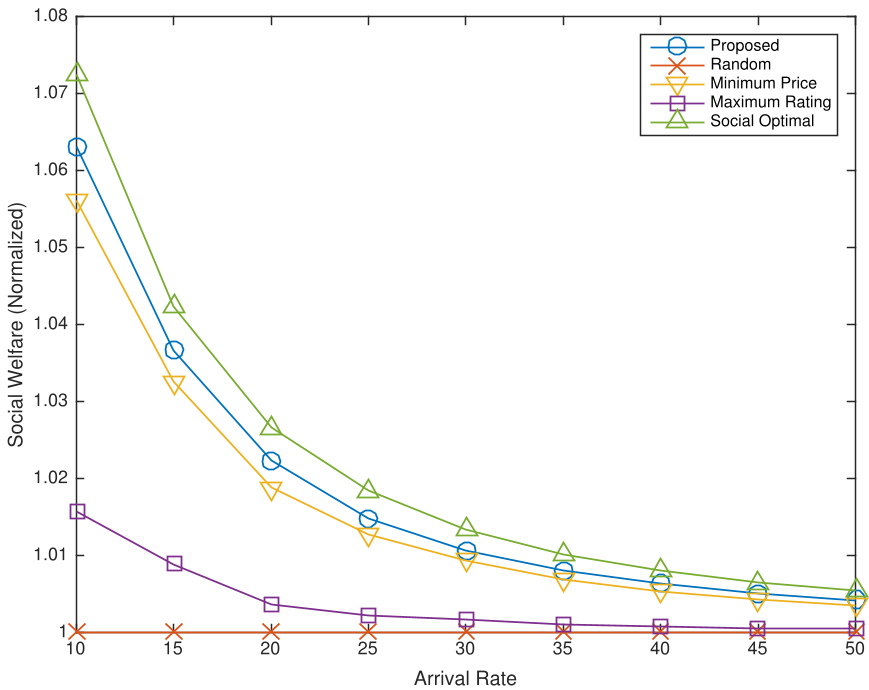 Fig 7: Impact of review accuracy on social welfare—the proposed strategy (Red) consistently nears the Social Optimal (Black).
Critical Insight & Conclusion
The study proves that consumers are "System 2" thinkers when it comes to daily deals. They aren't just following a digital herd; they are performing a subconscious game-theoretic calculation.
Limitations: The model currently struggles when a vendor has zero Yelp presence, a common "cold-start" problem in e-commerce.
The Takeaway: For platforms like Groupon, the future isn't just about showing the "Best Seller" badge. It's about providing decision assistance tools that help users balance quality, price, and the inevitable "crowding" that comes with a viral deal.