
The Strategic Social: A Game-Theoretical View of Information Diffusion
A Game Theoretical Approach to Broadcast Information Diffusion in Social Networks
The paper introduces a game-theoretical model for broadcast information diffusion in star-shaped social networks, focusing on "friendcasts" (one sender, multiple receivers). It utilizes a multi-player non-zero-sum game to determine optimal strategies for information forwarding and feedback based on psychological traits.
TL;DR
Information in social networks doesn't just "spread"—it is strategically pushed and pulled. This paper models social media interactions (friendcasts) as a multi-player game where users balance Knowledge, Reputation, and Popularity. By simulating "Experts" vs. "Trolls," the authors reveal how different social motivations drastically alter how fast a network learns—or misleads itself.
Problem & Motivation: Beyond Passive Nodes
Most early research on information diffusion viewed social networks through the lens of physics or epidemiology—treat information like a virus and the network like a petri dish. However, humans are not passive hosts. We decide whether to share a post or leave a comment based on how it makes us look.
The authors argue that previous models lacked:
- Broadcast Realism: Moving beyond 1-to-1 communication to 1-to-N "friendcasts."
- Psychological Depth: Incorporating "Trust," "Belief," and "Forgetfulness."
- Strategic Intent: Modeling the decision to provide feedback as a Nash Equilibrium problem.
Methodology: The Utility of Personality
At the heart of the paper is the Utility Function (), which defines why an actor does anything in the network:
Where:
- (Knowledge): Qualitative and quantitative belief in assertions.
- (Reputation): How much other actors trust you.
- (Popularity): Your social impact and dominance.
The Knowledge Model
Assertions are not binary (True/False). They are tuples of Knowledge Quantity () and Belief (). The model even accounts for "forgetfulness" (), where knowledge decays over time unless reinforced.
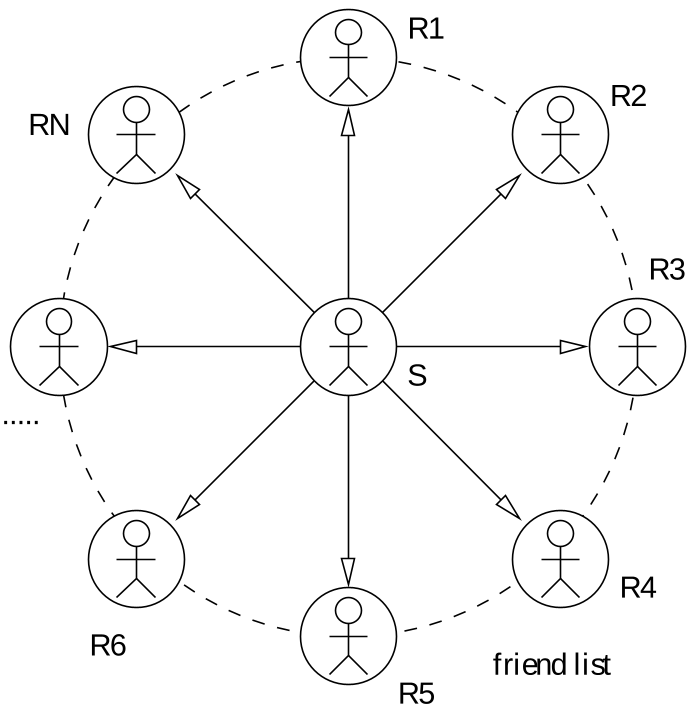 Figure 1: The star-shaped "Friendcast" topology used in the game.
The Game Matrix
When a sender () has information, they play a game with receivers ().
- Sender's moves: {Send, Not Send}
- Receivers' moves: {Feedback, No Feedback} The optimal move is calculated as a Nash Equilibrium. If feedback improves the sender's reputation, they are more likely to share; if the receiver thinks the sender is a "troll," trust drops, and diffusion halts.
Experiments: Experts vs. Trolls
The authors simulated two distinct network types:
- Experts: Driven by reputation and knowledge ( high).
- Trolls: Driven purely by popularity ( high).
Key Findings:
- Trolls learn faster?: Paradoxically, "Troll" networks reached a "total knowledge" state faster. Because they prioritize popularity over accuracy, they share everything immediately.
- The Quality Gap: In "Expert" networks, convergence is slower because actors are skeptical. They hold assertions until trust is verified.
- The "Mediocrity" Dip: In Troll networks, smart actors temporarily appear "stupider" as they absorb unverified assertions from the masses before the collective knowledge eventually stabilizes.
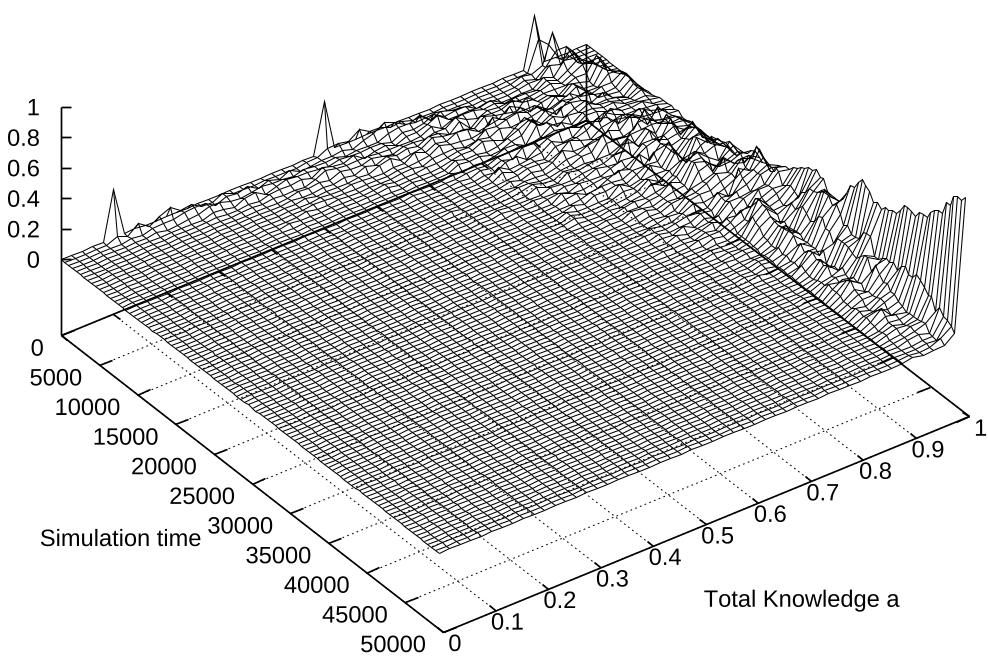 Figure 2: Knowledge diffusion in "Expert" networks—note the slow, cautious convergence.
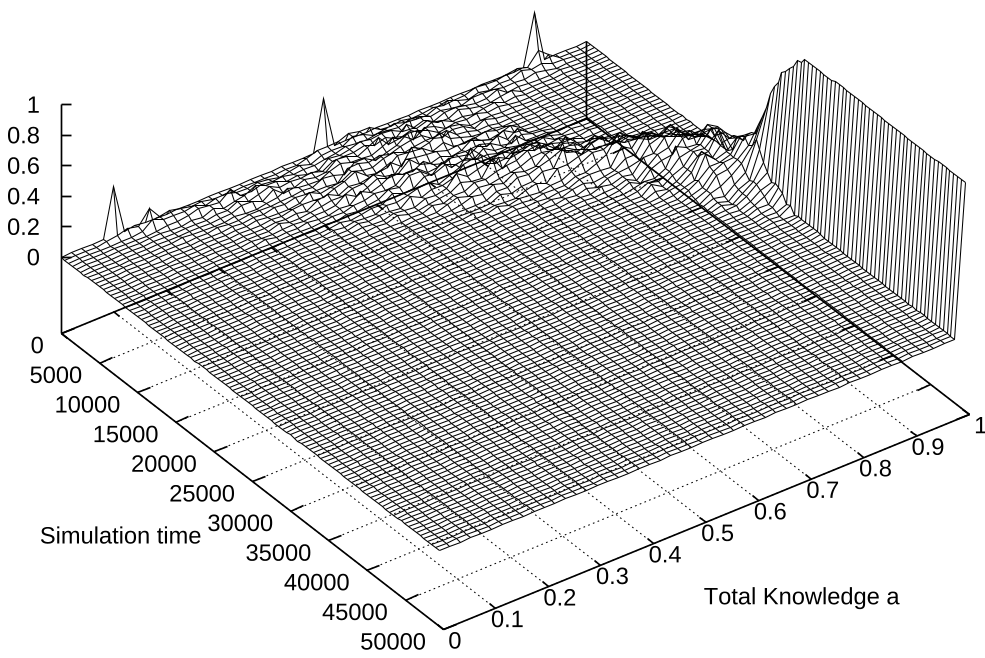 Figure 3: Knowledge diffusion in "Troll" networks—rapid spread but with a "learning dip."
Critical Insight & Conclusion
The paper’s most profound takeaway is that trust is the friction of the social web. In a high-trust, high-reputation network, information moves slowly but accurately. In low-reputation "troll" environments, information moves like wildfire because the cost of being "wrong" is outweighed by the gain of being "seen."
Limitations: The model assumes a fixed "friend list" during the game and lacks a mechanism for actors to change their personality (e.g., an expert becoming a troll to gain followers).
Future Outlook: This framework provides a precursor to modern algorithmic feed analysis. As we move into an AI-driven era, modeling how "AI agents" act as senders/receivers in these strategic games will be vital for combating misinformation.