
Strategic Security in MSNs: A Game-Theoretic Approach to Managing Malice
Analysis of strategic security through game theory for mobile social networks
This paper presents a Strategic Security Analysis for Mobile Social Networks (MSNs) using a Bayesian Game framework. It models interactions between a legitimate server and a client of unknown intent (benign or malicious) and identifies Bayesian Nash Equilibria (BNE) to determine optimal defense and engagement strategies.
TL;DR
In the volatile environment of Mobile Social Networks (MSNs), identifying a malicious node is rarely a binary certainty. This paper utilizes Bayesian Game Theory to model the uncertainty of node intentions, providing a mathematical framework for when a server should transmit data, stay inactive, or invest in costly surveillance. The results suggest that the objective isn't always to "ban" malicious nodes, but to create a strategic environment where attackers find it more "profitable" to simply ignore communications rather than disrupt them.
The Motivation: The "Cost of Suspicion"
In a machine-to-machine MSN, a server (legitimate node) faces a dilemma. If it treats every client as benign, it risks catastrophic service disruption or data theft. However, if it treats every client as a potential attacker, it must implement constant Surveillance, which consumes energy, increases latency, and degrades the Quality of Service (QoS) for everyone.
The authors argue that prior work simplified this too much. Real attackers are strategic; they don't always attack. They might "Forward" or "Ignore" to stay under the radar. By expanding the action space, this paper captures the "cat-and-mouse" reality of network security.
Methodology: Modeling Uncertainty via Bayesian Games
The interaction is modeled as a two-player game with Incomplete Information.
- Player 1 (Server): Actions include Nothing (inactive), Packet (transmit/relay), and Surveillance (detect attacks).
- Player 2 (Client): Has a "Type" (Benign or Malicious). Actions include Forward, Ignore, or Damage.
The server doesn't know the client's type but knows the prior probability (probability of being malicious). The authors solve for the Bayesian Nash Equilibria (BNE) by splitting the analysis into three regimes based on .
1. The Architecture of Deception
The game is characterized by the payoff matrix below, which factors in the "cost" of being attacked vs. the "cost" of surveillance.
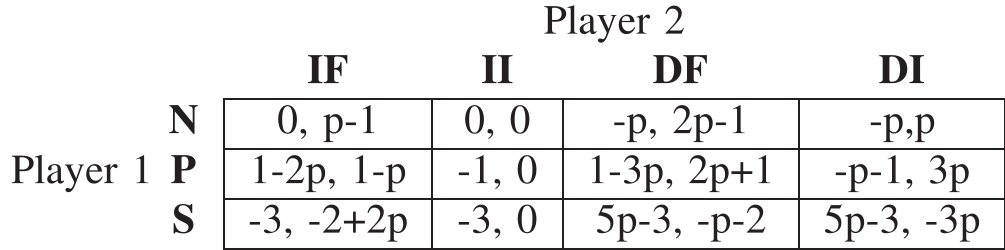 Table III: The Bayesian Payoff Matrix for Server vs. Unknown Client
Core Experimental Insights
The paper evaluates the players' payoffs against the probability of malice ().
The Regime (Likely Benign)
When the network is generally trustworthy (), the server has an incentive to take risks. Surveillance is often a "dominated strategy" (too expensive relative to the risk). In this regime, pure strategy equilibria like (Packet, Forward) exist, maximizing network throughput.
The Regime (Likely Malicious)
Once the probability of malice crosses a threshold, "Packet Transmission" becomes a dominated strategy. The server identifies that the risk of "Damage" outweighs the benefit of communication. Here, the game shifts to a Mixed BNE, where the server randomizes between "Nothing" and "Surveillance" to keep the malicious client in check.
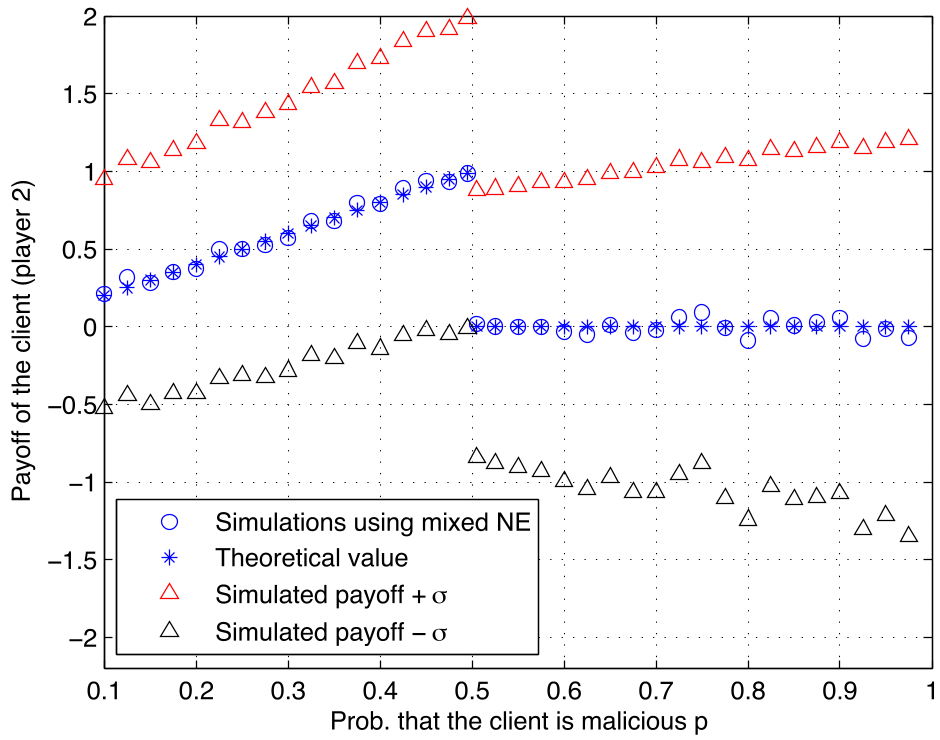 Fig 2: As p increases, the client's payoff eventually drops to zero in mixed strategies as the server becomes more defensive.
Critical Analysis: Tolerance over Elimination
One of the most profound takeaways is the "Tolerance of Malicious Nodes." The authors demonstrate that in certain conditions, a server can reach an equilibrium where it survives despite the presence of attackers. By strategically choosing the "Surveillance" probability, the server forces a malicious client to play the "Ignore" action instead of "Damage," as the punishment for being caught "Damaging" (modeled as a low payoff) is too high.
Limitations & Future Work
The current model is a Static Game. In real-world MSNs, interactions are repeated. A strategic attacker might cooperate for 100 turns to lower the server's estimate, only to strike on the 101st turn. The authors acknowledge this and suggest that Dynamic Bayesian Games (where is updated via Bayesian inference after every turn) are the next logical step.
Conclusion
This paper shifts the MSN security paradigm from "Identify and Block" to "Analyze and Incentivize." By using Game Theory to find the BNE, network operators can design systems that are robust not because they are impervious to attack, but because they make attacking an "irrational" choice for the adversary.