
Scaling Collective Intelligence: Leveraging Social Networks for Sentiment Crowdsourcing
Games with a purpose for social networking platforms
The paper introduces a cross-platform application framework for "Games with a Purpose" (GWAP) integrated into social networking sites like Facebook. It features the "Sentiment Quiz," a gamified crowdsourcing tool used to build multilingual sentiment dictionaries and evaluate NLP algorithms for media analysis.
TL;DR
This research presents a framework for deploying "Games with a Purpose" (GWAP) directly within social networking environments. By integrating a "Sentiment Quiz" into Facebook, the authors successfully mobilized over 1,000 users to label 30,000+ data points, effectively solving the "Cold Start" problem for sentiment analysis while studying the psychological biases of media consumption.
Problem & Motivation: The Annotation Bottleneck
Modern Natural Language Processing (NLP) is only as good as the data it’s fed. In 2009, as today, creating high-quality sentiment dictionaries and evaluation sets required expensive human experts. Computers struggle with nuance, sarcasm, and context—tasks that are trivial for humans but laborious.
The authors identified two major roadblocks in prior GWAP attempts:
- User Acquisition: Building a standalone game website is hard; getting people to visit it is harder.
- Validation: How do you ensure "players" aren't just clicking buttons randomly to earn points?
Their insight was simple but powerful: Go where the people already are. By building on Facebook, they could use existing friendships to drive "viral" growth and use social accountability to improve data quality.
Methodology: The Framework Architecture
The core of the work is a platform-agnostic framework that acts as a wrapper for social APIs.
1. The Multi-Platform Wrapper
The system maps a user’s Facebook or Google ID to a "Meta ID," allowing a player to start a task on one site and finish on another without losing progress.
2. Task vs. Game Logic
The framework separates Gaming Rules (points, high scores, levels) from Task Rules (validation logic). A data point is only considered "solved" in the database once it reaches a consensus—typically ten different players agreeing on the sentiment of a sentence.
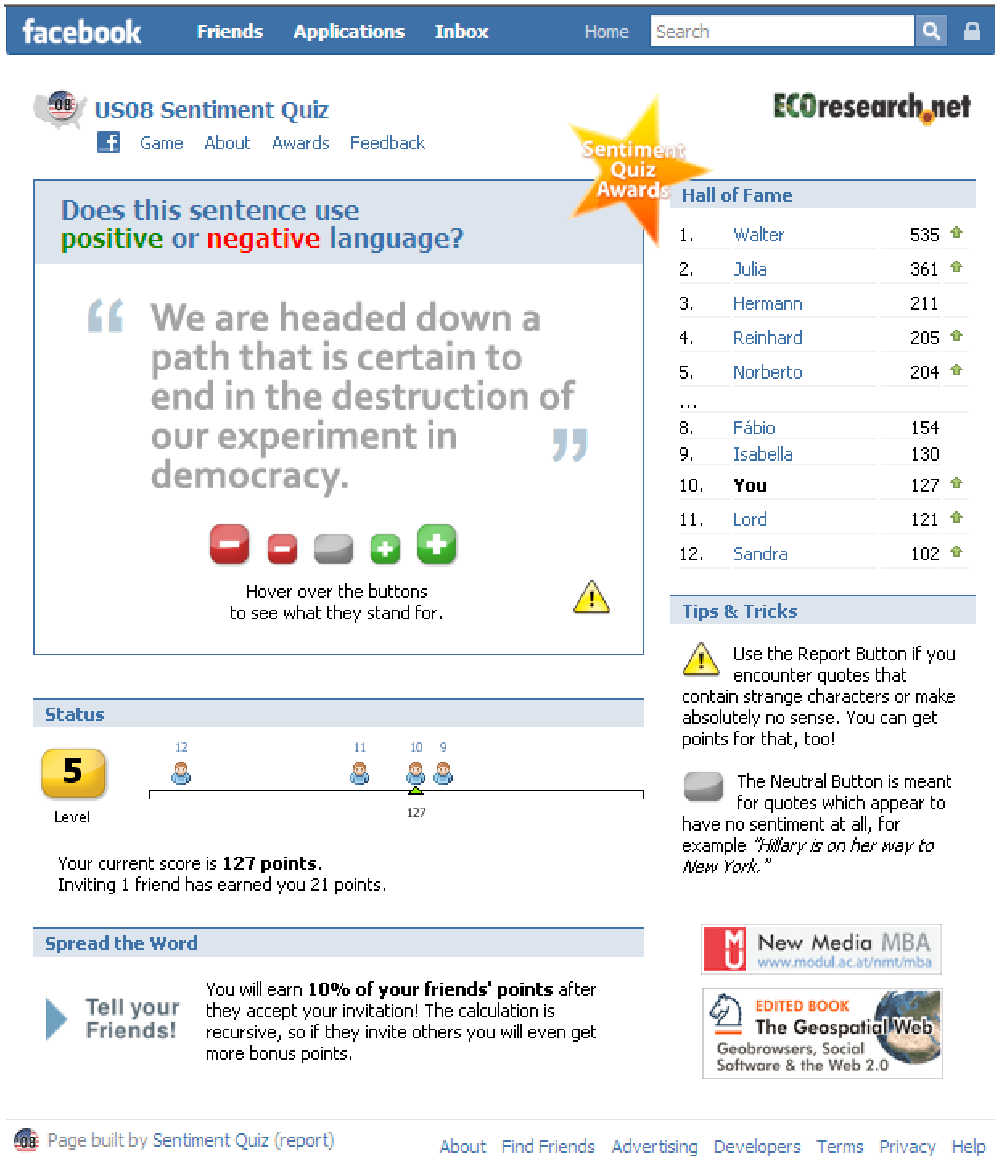 Figure 1: The US08 Sentiment Quiz interface, showing the gamified 5-point sentiment scale applied to political quotes.
Experiments & Results: The Power of the Crowd
The "Sentiment Quiz" was deployed during the 2008 US Presidential Election. The results were staggering for the era:
- Scale: 30,000+ quotes annotated by 1,000+ users.
- Incentives: By awarding points for "matches" with other players and 10% referral bonuses, users were motivated to grow the network themselves.
- Scientific Insight: Beyond just labeling data, the authors analyzed the "Hostile Media Effect"—finding that a user's political orientation significantly changed how they perceived the "neutrality" of a news sentence.
To manage this complex web of interactions, the authors utilized "Rhizome Visualization" to track information diffusion and user activity in real-time.
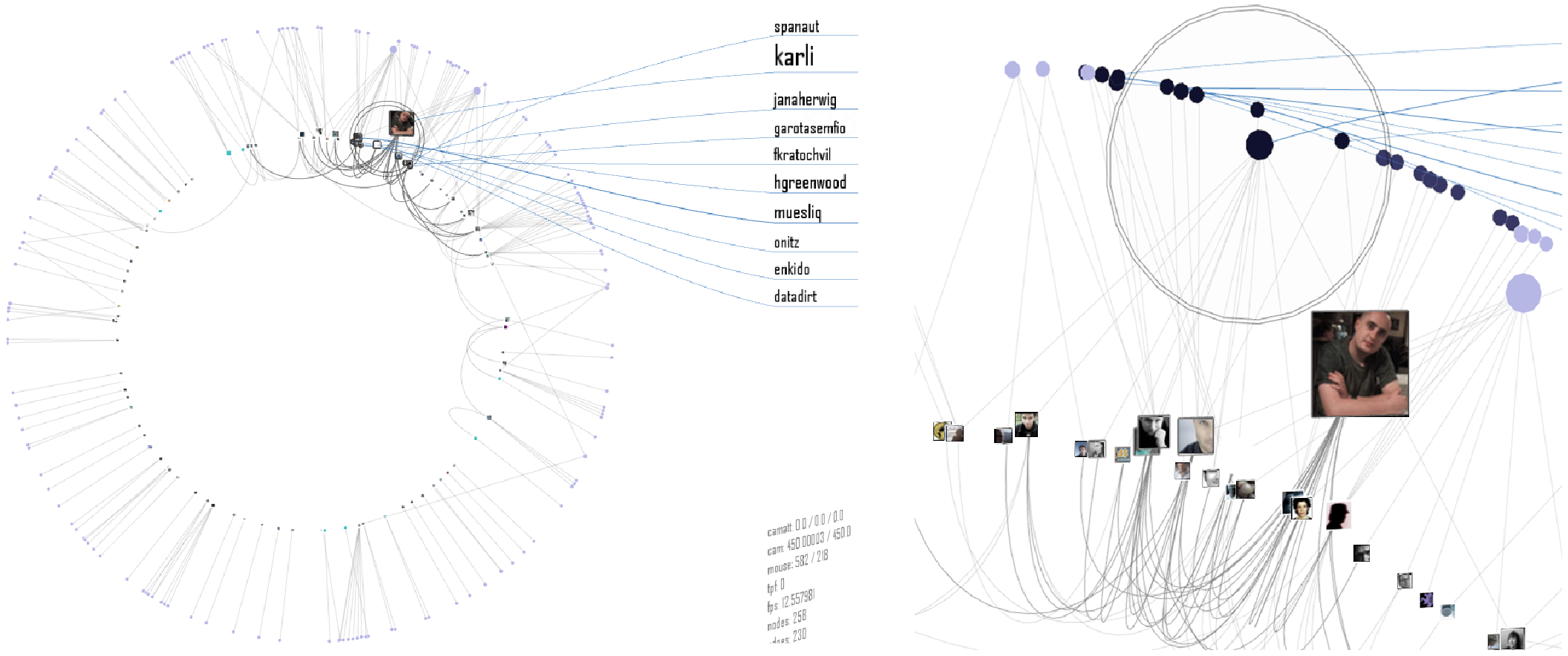 Figure 2: Real-time Rhizome visualization of conversations, used to track social network analysis and engagement.
Critical Analysis & Future Outlook
Takeaway
The framework proves that Social Network Integration is the ultimate multiplier for collective intelligence. It moves crowdsourcing away from "work" and into "social play."
Limitations
While innovative, the reliance on social APIs makes the framework vulnerable to platform policy changes (as seen in later years with Facebook's API restrictions). Furthermore, the "Meta ID" system faces increasing privacy challenges in the modern GDPR era.
Future Prospect
In the age of Large Language Models (LLMs), the principles here are being reborn as RLHF (Reinforcement Learning from Human Feedback). The "Sentiment Quiz" of 2009 is the direct ancestor of today's systems that ask users to rank AI responses—showing that the "Wisdom of the Crowds" remains the gold standard for teaching machines how to understand human emotion.