
The Gendered Exit: Why Bloggers Switch Services
10841_Understanding the role of gender in bloggers' switching behavior.
This study investigates the post-adoption "switching behavior" of bloggers using a research model based on marketing and IS literature. It identifies satisfaction, sunk costs, and attractive alternatives as primary drivers of the Intention to Switch (INT), specifically highlighting gender as a critical moderator of these relationships.
TL;DR
In the hyper-competitive landscape of social networking, keeping a user is harder than acquiring one. This seminal study investigates the "switching behavior" of bloggers, revealing that why we leave a platform is deeply tied to our gender. While women are driven primarily by satisfaction (or lack thereof), men are more easily lured away by attractive alternatives.
Executive Summary
In the mid-2000s, the blogosphere exploded, turning platforms like Xanga and MSN Spaces into digital hubs. However, as the market matured, "post-adoption" behavior—specifically the intention to switch—became a critical business metric. This paper moves beyond simple adoption metrics to explore the psychological and sociological drivers of platform migration. It positions itself as a bridge between Marketing (Switching Costs) and Information Systems (Continuance Models), with a unique lens on Social Role Theory.
Problem & Motivation: The Friction of Leaving
Why do we stay on a platform we don't like? Often, it is because of Sunk Costs—the time, effort, and emotional labor we’ve invested. The authors noticed that while many studies looked at how people start blogging, few looked at why they stop or move. They hypothesized that the "switch" isn't just a functional choice but is moderated by socio-cultural factors, specifically how men and women are socialized to value digital tools.
Methodology: The Sunk Cost vs. Satisfaction Framework
The researchers proposed a model centered on three pillars:
- Satisfaction (SAT): The internal emotional state regarding current usage.
- Sunk Costs (SC): The perceived "waste" of effort if one leaves (posts, friends, layouts).
- Attractive Alternatives (AA): The "pull" of a shiny new platform with better features.
They utilized Social Role Theory (SRT) to predict gender differences:
- Women (Communal): Expected to prioritize interpersonal and emotional satisfaction.
- Men (Agentic): Expected to be more instrumental and task-oriented, focusing on utility and "better" tools.
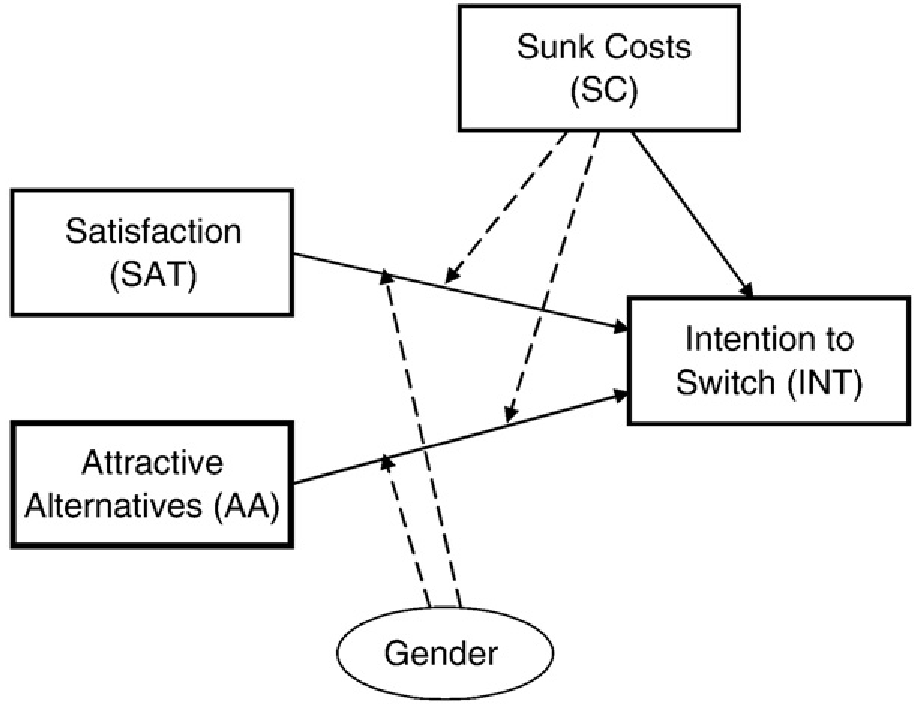 Figure 1: The Research Model illustrating the paths from Satisfaction, Sunk Costs, and Attractive Alternatives to Switching Intention, moderated by Gender.
Experimental Insights & Results
The team surveyed 299 bloggers in Hong Kong and analyzed the data via Partial Least Squares (PLS).
Key Findings:
- Direct Effects: As expected, high satisfaction and high sunk costs keep users anchored. High alternative attractiveness pulls them away.
- The Gender Divide:
- Female Bloggers: The link between satisfaction and switching was significantly stronger. If a woman is unhappy with the experience, she is much more likely to leave, regardless of the alternatives.
- Male Bloggers: The allure of "Attractive Alternatives" played a more dominant role. Men are more likely to switch just because a better tool exists, even if they aren't necessarily "dissatisfied" with their current one.
- The Sunk Cost Surprise: Interestingly, sunk costs did not act as a moderator. Unlike monetary investments in business, "digital" sunk costs (like old blog posts) didn't significantly stop users from leaving if they were sufficiently unhappy or saw a much better option.
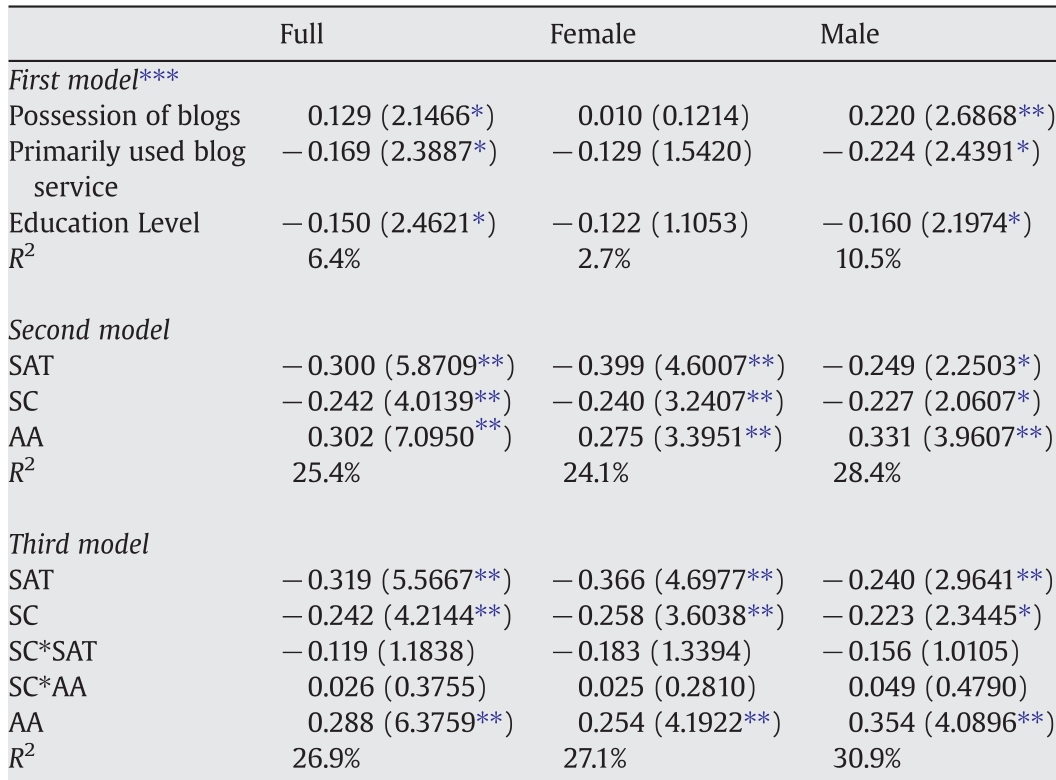 Table 4: Regression results showing path coefficients for Full, Female, and Male subgroups.
Critical Analysis & Conclusion
Takeaway
The study proves that "one size fits all" retention strategies are destined to fail. Platforms targeting a female demographic should invest heavily in UX, emotional engagement, and community stability. Platforms targeting men must stay on the "bleeding edge" of features and innovative utility to prevent them from being lured away by competitors.
Limitations & Evolution
The study’s context (Hong Kong, 2009) reflects an era of early social computing. Today, the "Sunk Cost" of a blog is even lower due to "Export" tools and cross-platform API integrations. Furthermore, the binary exploration of gender, while grounded in the Social Role Theory of the time, provides a foundation that future research should expand into more nuanced identity frameworks.
Future Outlook
As we move into the era of Decentralized Social Media (Web3), the concept of "Sunk Costs" may disappear entirely since users "own" their data. In such a world, Satisfaction will become the only tether keeping a community together.