
Digital Skin, Real Intelligence: How VR Body-Swapping Neutralizes Stereotype Threat
The Effect of Gender Body-Swap Illusions on Working Memory and Stereotype Threat
This study investigates the "Proteus Effect" in virtual reality, specifically whether a male body-swap illusion can buffer female participants against "stereotype threat" in STEM-related cognitive tasks. Utilizing an immersive VE and working memory metrics (Saccade and N-back tests), researchers demonstrated that embodying a male avatar successfully induces "stereotype lift," neutralizing performance decrements typically caused by gender stereotypes.
TL;DR
Can changing your virtual gender make you better at math? This paper proves that in Virtual Reality, it can. Researchers found that when female participants "body-swapped" into male avatars, they were protected from the performance-crushing effects of gender stereotypes. By measuring working memory, the study highlights VR's potential as a powerful tool to bridge the gender gap in STEM.
Background: The Weight of a Stereotype
"Stereotype Threat" is a well-documented psychological phenomenon where individuals underperform simply because they are afraid of confirming a negative stereotype about their group (e.g., "women aren't good at math"). This isn't just a "feeling"—it has a physical manifestation in the brain, specifically by consuming Working Memory, the cognitive "RAM" we need for complex problem-solving.
The authors of this study hypothesized that the Proteus Effect—the tendency for people to take on the characteristics of their virtual avatars—could be used as a shield. If a woman perceives herself as a male in a virtual space, would she still feel the "threat" aimed at her real-world identity?
The Experiment: Mirroring a New Identity
The researchers recruited 64 female participants and placed them in a high-stakes virtual classroom. Using HTC Vive headsets, participants looked into a virtual mirror to see either a female or male avatar that moved in perfect sync with their real bodies.

The researchers then "triggered" the stereotype threat by telling some participants that the upcoming test would measure gender differences in math ability. Others were told the test was gender-neutral.
Measuring the "RAM" of the Brain
To measure working memory, they used two specialized tests:
- Anti-Saccade Test: Measures the ability to inhibit the instinct to look at a flashing cue.
- N-Back Test: Measures the ability to keep a sequence of locations in mind.
Critical Insight: Stereotype Lift vs. Cognitive Load
The results revealed a fascinating duality in how our brains handle virtual identities.
1. The Shield Effect (Stereotype Lift)
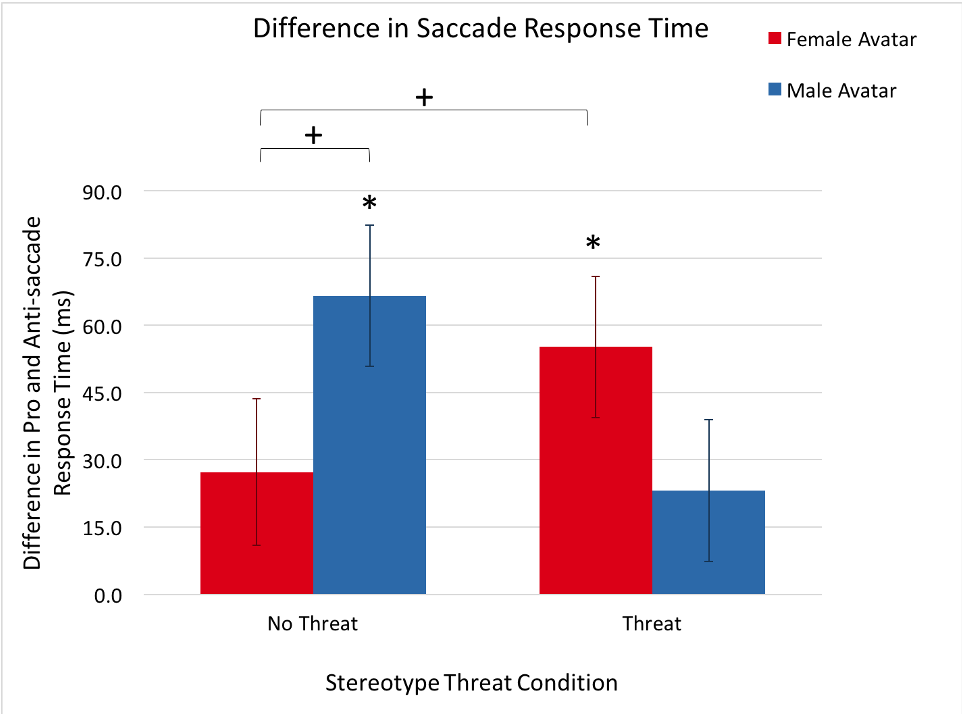
When the "threat" was active, women in female avatars performed significantly worse—their working memory was clogged by the stress of the stereotype. However, women in male avatars performed just as well as the control group. This is "Stereotype Lift": the male identity acted as a cognitive buffer, allowing the participants to access their full mental capacity.
2. The Cost of Change
Surprisingly, in the absence of a threat, being in a male avatar actually hurt performance (MNT condition). The brain seemingly had to work harder to "manage" the mismatched identity when there was no external reason to lean into it.
Why This Matters: Beyond the Headset
This study moves VR from the realm of "gaming" into "social engineering." If a 3-minute embodiment phase can change how a woman's brain processes a high-stress technical task, the implications for online education and remote workspaces are massive.
Limitations & Future Work
The study noted low "Everyday Embodiment" scores, likely because participants only saw their virtual arms most of the time. The authors suggest that full-body tracking and longer "habituation" times might make the effect even stronger. Furthermore, we must ask: what happens if we switch identities daily? Does "code-switching" our digital bodies lead to psychological exhaustion?
Conclusion
The "glass ceiling" in tech may be partly psychological, reinforced by societal cues. This paper demonstrates that by changing the "skin" we wear in digital spaces, we can temporarily shatter that ceiling, providing a glimpse of a future where VR helps level the playing field for everyone, regardless of real-world identity.