
IDP: Re-engineering Local Patterns for High-Efficiency Gender Classification
Gender Classification Using Interlaced Derivative Patterns
The paper introduces Interlaced Derivative Patterns (IDP), a high-order local feature descriptor for automated gender classification. By encoding directional derivative variations instead of simple pixel intensity comparisons, IDP achieves a 91.2% recognition rate on the FRGC ver.2.0 database, significantly outperforming Local Binary Patterns (LBP) and Local Derivative Patterns (LDP).
TL;DR
Researchers have developed Interlaced Derivative Patterns (IDP), a novel facial descriptor that bridges the gap between the speed of Local Binary Patterns (LBP) and the precision of high-order Local Derivative Patterns (LDP). IDP achieves a 91.2% accuracy on the FRGC database, operating 4.2x faster than LDP while reducing the error rate of LBP by nearly 30%.
Background: Beyond Simple Pixel Gradients
Gender classification is a cornerstone of Human-Computer Interaction (HCI) and security. For years, the Local Binary Pattern (LBP) was the gold standard due to its simplicity. However, LBP only captures first-order relationships—essentially whether a neighbor is brighter or darker than the center.
The Local Derivative Pattern (LDP) later emerged, capturing higher-order "gradients of gradients" to find subtle skin textures. But LDP had a major flaw: it was computationally "fat," generating 32-bit codes per pixel that slowed down real-time systems and introduced noise through redundancy.
Methodology: The Logic of "Interlacing"
The core insight of IDP is Directional Relevance. Instead of comparing every neighbor to the center across all four directions (0°, 45°, 90°, 135°), IDP assigns each neighbor a specific directional responsibility.
How it Works:
- Directional Channels: For an -order IDP, the system creates four -order derivative channels.
- Specific Thresholding: For each pixel in a neighborhood, IDP identifies the spatial direction from the center to that neighbor.
- Selective Encoding: It then thresholds that specific neighbor against the center only in that corresponding directional channel.
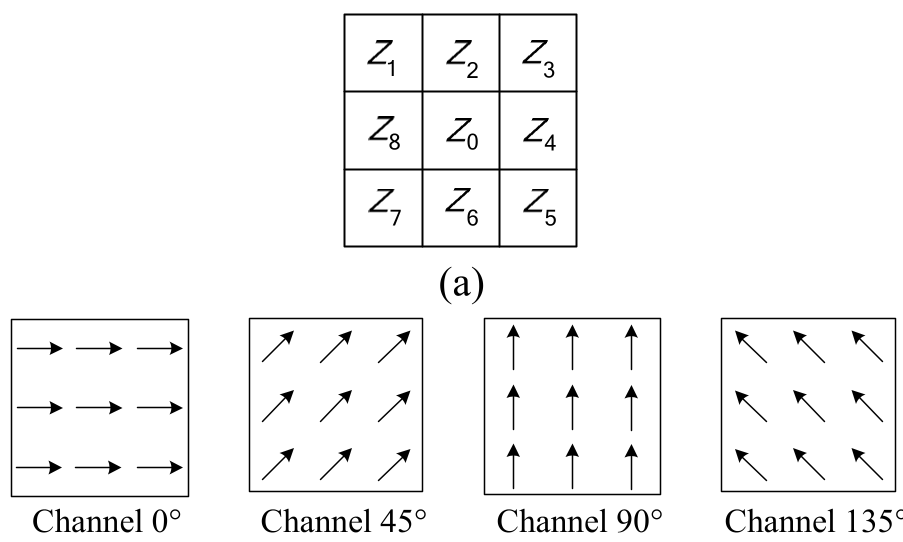 Figure 1: The IDP encoding mechanism showing how specific neighbors are mapped to directional derivative channels.
This selective process compresses the feature representation from 32 bits back down to 8 bits, the same size as LBP, while retaining the discriminatory power of high-order derivatives.
Experimental Results: Speed Meets Accuracy
The researchers tested IDP on the FRGC ver.2.0 database, featuring 457 individuals. The results confirm that IDP successfully eliminates the "High-Order Tax" (the performance cost usually associated with complex features).
Key Comparisons:
- Accuracy: IDP reached 91.2%, surpassing both LBP (87.5%) and the best-performing LDP (90.4%).
- Efficiency: IDP generated codes in 0.4 seconds, identical to the "fast" LBP, whereas LDP required 2.1 seconds.
- Robustness: By using spatial histograms (dividing the face into regions), the method remains robust against minor pose variations.
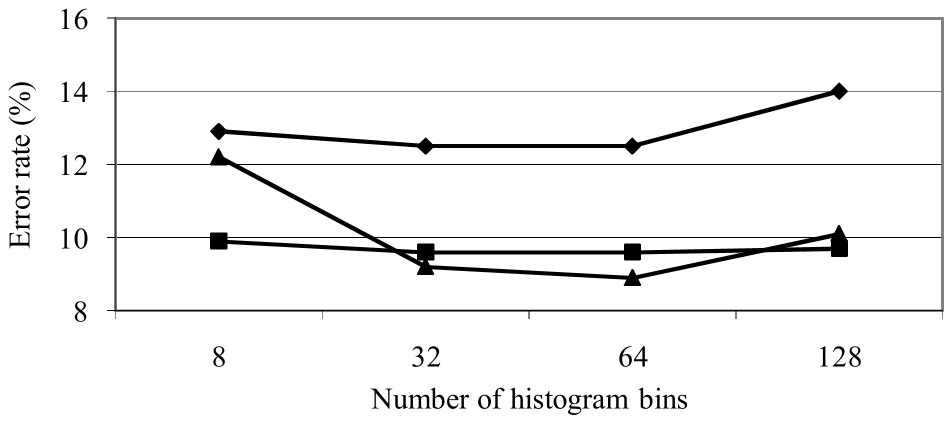 Figure 2: Error rate curves comparing IDP, LDP, and LBP across various histogram bin configurations.
Critical Insight & Conclusion
Why does IDP work better than the theoretically more comprehensive LDP? The answer lies in Signal-to-Noise Ratio (SNR).
In high-order derivative modeling, every extra bit of information risks capturing incidental noise (like lighting artifacts or sensor grain). IDP acts as a structural regularizer—by forcing the model to look at neighbors only in their natural directional alignment, it filters out "cross-directional" noise.
Takeaway: IDP proves that in computer vision, "more data" is not always better. Precise, directionally-aware feature selection can outperform exhaustive feature extraction in both speed and accuracy. This approach provides a blueprint for optimizing other local descriptors in tasks like facial expression recognition or iris scanning.