
Beyond Identity: Decoding Gender from the Binary Iris Code
9593_Gender Classification From the Same Iris Code Used for Recognition.
This paper presents the first approach to classify gender directly from the binary iris codes used in standard identity recognition systems. By utilizing Mutual Information-based feature selection (W-CMIM), the authors achieved a gender prediction accuracy of 89% through the fusion of left and right iris features.
TL;DR
Researchers have successfully demonstrated that the same 4,800-bit binary "iris code" used to unlock your smartphone or pass through border control contains enough latent information to predict your gender with 89% accuracy. By moving away from raw image analysis to direct bitstream mining, this work bridges the gap between identity recognition and soft biometrics.
Background: The Hidden Signals in Your Iris
Most commercial iris recognition systems today are built on the foundations laid by John Daugman: converting iris textures into a compact binary representation. While these codes are designed to be unique for identity matching, this paper asks a provocative question: Does the code also carry demographic markers?
The authors identify a critical flaw in previous research: Optimistic Bias. Most prior works used training and testing sets containing images of the same people, inflating results. This study enforces a person-disjoint protocol, ensuring the model learns general biological patterns rather than memorizing individual eyes.
Why Mutual Information Matters
The iris code is high-dimensional (4,800 bits). Feeding all these bits into a classifier introduces "gender-irrelevant" noise. To solve this, the authors utilize Mutual Information (MI) to filter the signal from the noise.
The Methodology: W-CMIM
The core innovation is Weighted Conditional Mutual Information Maximization (W-CMIM). Unlike traditional methods that look at bits in isolation, W-CMIM:
- Evaluates Groups: It identifies how bits work together to provide predictive power.
- Reduces Redundancy: It discards bits that provide the same information as already selected ones.
- Applies Weights: It uses a k-Nearest Neighbors (k-NN) approach to prioritize bits that consistently distinguish between male and female samples in a manifold space.
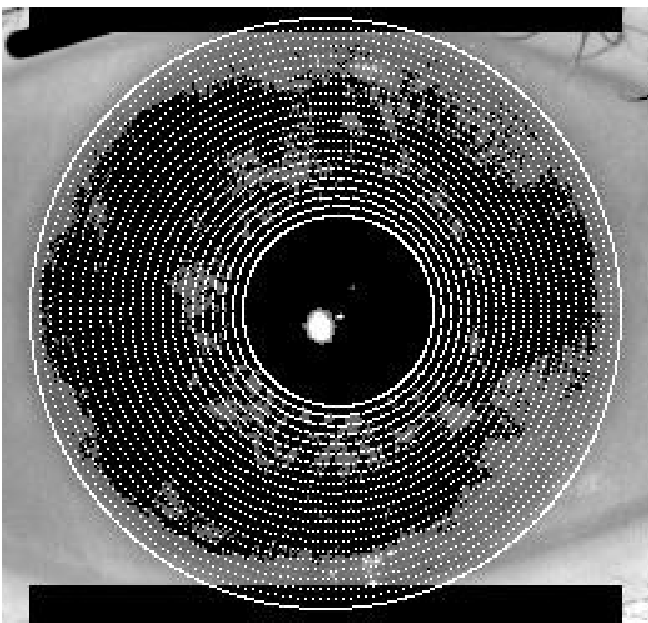 Figure: The pipeline from iris acquisition to feature selection and classification.
Spatial Insights: Where is the Gender?
One of the paper's most fascinating findings is the distribution of gender information. By testing 20 individual concentric bands of the iris separately, the authors discovered that:
- Information is global: Every single band performed better than random chance (>50%).
- Inner Stability: Bands 1-10 (closer to the pupil) generally provide higher accuracy (up to 68% for a single band) compared to the outer bands.
- Fusion is Key: Combining features from both the left and right eyes provides a significant +5% boost in accuracy, reaching 89%.
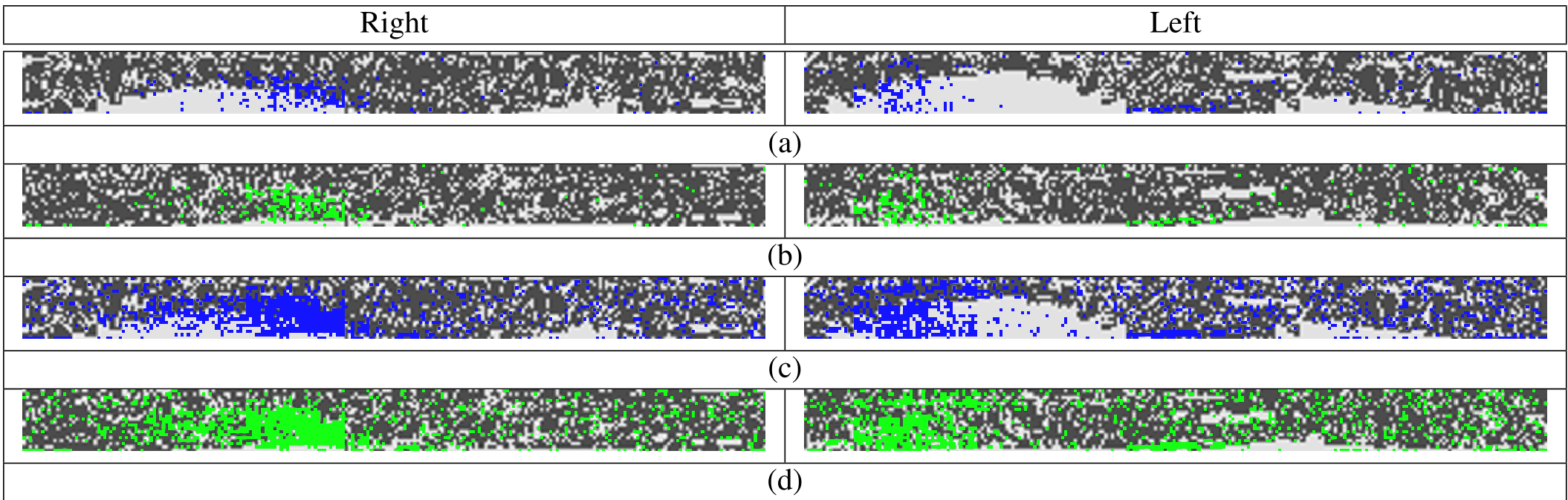 Figure: Visualization of selected features (bits) across male and female iris codes. Notice the distributed nature of the relevant points.
Experimental Performance
The results prove that "the whole is not always better than the sum of its parts." Using the entire iris code resulted in lower performance (~77%) due to overfitting on noise. The W-CMIM selected subset boosted this to over 85% for single eyes.
| Method | Left Eye Accuracy | Right Eye Accuracy | Fusion (Best Features) |
|---|---|---|---|
| Whole Iris Code | 77.33% | 74.66% | 72.66% |
| W-CMIM (Proposed) | 85.33% | 84.33% | 89.00% |
Impact of Real-world Noise
The validation on the UND_V dataset revealed that the "Achilles' heel" of iris-based gender classification is mascara. Thick eyelashes treated with mascara often confuse segmentation algorithms, leading to 57-66% error rates in those specific subsets.
Critical Analysis & Future Outlook
This work highights a significant opportunity for the biometrics industry. By extracting gender directly from the iris code:
- Search Efficiency: Large-scale databases (like India's UIDAI) could theoretically halve search times by pre-filtering by gender.
- Hardware Compatibility: No new cameras or sensors are required; it is a purely software-based upgrade to existing pipelines.
Limitations: The study notes that while high accuracy is achieved, the "biological "why" remains somewhat abstract. Why does a specific gabor filter response at a specific iris coordinate correlate with gender? Answering this will require further intersectional research between ophthalmology and computer vision.
Conclusion: This paper sets a new SOTA for person-disjoint gender classification and proves that our iris codes are much more "talkative" than we previously imagined.