
Decoding the Digital Fingerprint: Gender Classification via Authorial Style in Microblogs
Gender classification of microblog text based on authorial style
This paper introduces a robust gender classification approach for microblog text (Twitter) utilizing authorial style features such as function words and Part-of-Speech (POS) n-grams. By employing Naïve Bayes and Maximum Entropy classifiers, the study achieves a SOTA accuracy of approximately 71%, significantly outperforming commercial benchmarks like Gender Genie.
TL;DR
In the chaotic realm of Twitter, where slang and brevity rule, identifying an author's gender is notoriously difficult. This research shifts the focus from topic keywords to authorial style, using "invisible" features like function words and POS n-grams. The result? A 71% classification accuracy that beats industry-standard software by 7% or more.
Background: The Limits of Content
Why is gender classification on Twitter harder than on a standard blog?
- Length Constraints: 140 characters offer very little semantic "meat."
- Noise: Informal language, emoticons, and creative misspellings (e.g., "Goooooood") break traditional NLP pipelines.
- Topic Dependency: Most classifiers look for keywords (e.g., "sports" vs. "makeup"). However, a woman tweeting about football or a man tweeting about cooking would confuse these systems.
The authors argue that true gender identity lies not in what we discuss, but in our unconscious syntactic habits.
Methodology: The Power of the "Innocuous"
The core innovation lies in the feature set. Instead of looking at "Content Words" (nouns/verbs with specific meaning), the system targets:
- Function Words: High-frequency words like "the," "though," "might," and "never." These are used unconsciously and are independent of the topic.
- POS n-grams: Sequences of grammar tags (e.g., Noun-Verb-Adjective). This captures the skeleton of a sentence.
The System Pipeline
The researchers utilized a structured workflow to transform raw tweets into a gender-predictive model:
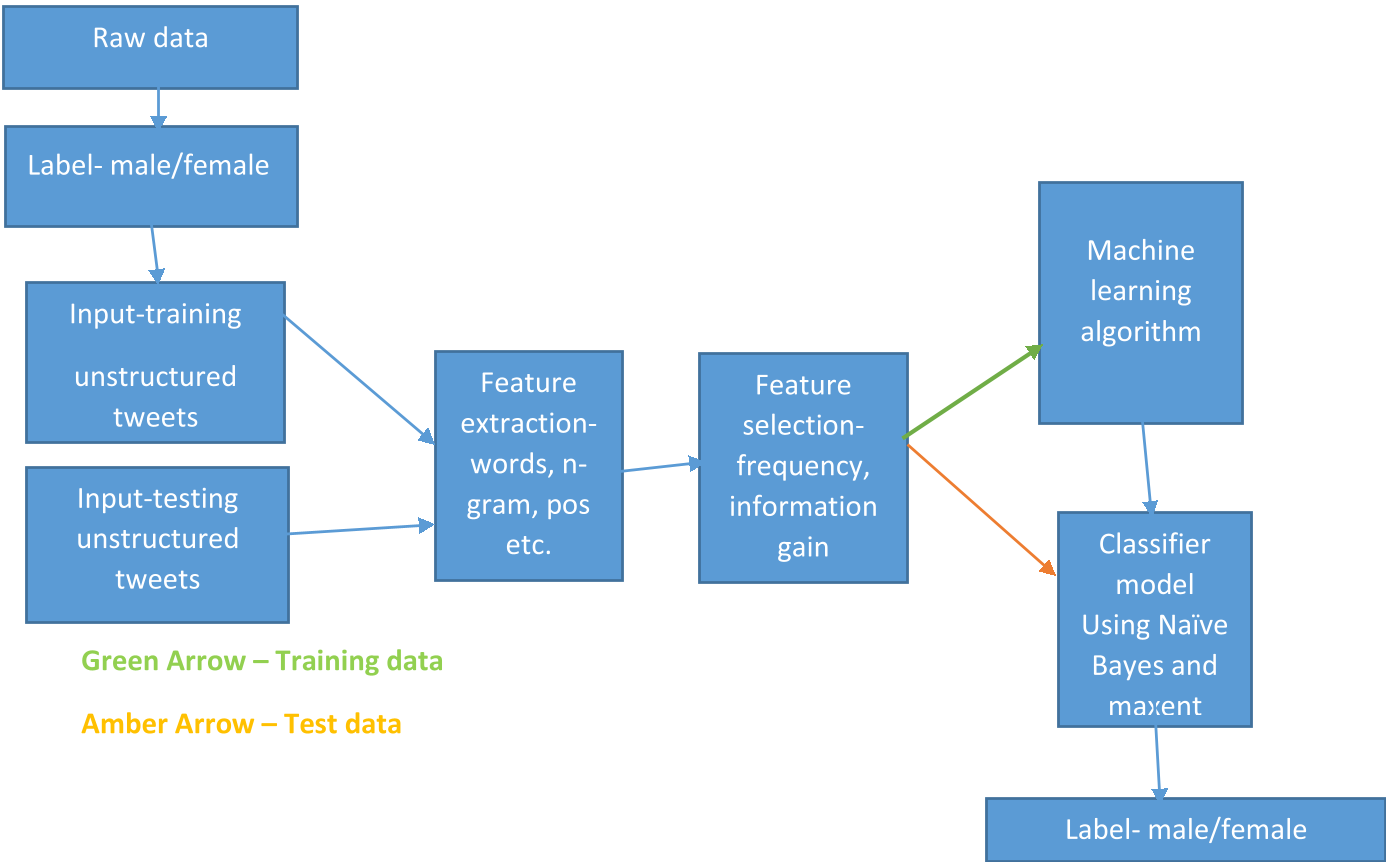
They tested two primary mathematical frameworks:
- Naïve Bayes (Generative): Assumes features are independent; efficient and surprisingly effective for text.
- Maximum Entropy (Discriminative): Does not assume independence, selecting the "most uniform" distribution that fits the training data.
Why it Works: The Hidden Differentiators
The study reveals fascinating linguistic patterns that distinguish gender in the digital space:
1. Function Word Usage
| Word | Gender | Likelihood Ratio |
|---|---|---|
| Never | Male | 5.7 : 1.0 |
| Today | Female | 3.9 : 1.0 |
| Though | Male | 3.8 : 1.0 |
Women appear more affirmative and "present" (using words like "today"), while men in the dataset utilized negations and conditional function words ("never", "though") more frequently.
2. Syntactic "Templates" (POS n-grams)
The most striking finding was in the POS n-grams. For instance, certain plural noun genitives (NNS-$-TL) were 11.9 times more likely to appear in tweets by females.
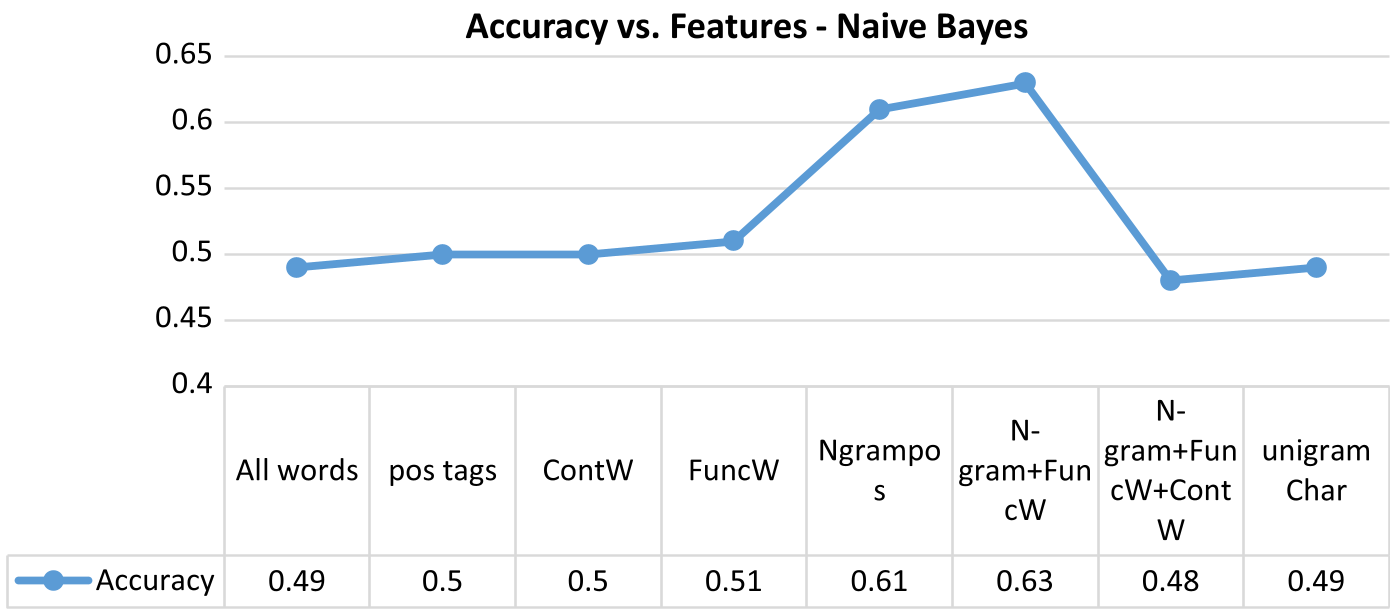 Figure: Comparison of Accuracy vs. Feature Type. Note how POS n-grams consistently outperform basic content words.
Experimental Results
The researchers progressively increased their dataset from 500 to 3,000 tweets. Unlike many content-heavy models that plateau, the authorial style approach showed linear improvement as the dataset grew, reaching 71% accuracy.
Competitive Benchmarking:
- Gender Genie: 61.69%
- Gender Guesser: 63.78%
- This Method: 71.00%
This 7-9% lead over commercial software proves that "style" is a more robust indicator than "vocabulary."
Critical Insights & Future Directions
Takeaway
For developers and marketers, this suggests that demographic profiling shouldn't just scan for hashtags or interests. Analyzing the frequency of function words provides a more stable, "universal" signal of gender that remains consistent across different conversational topics.
Limitations
While 71% is a strong baseline for microblogs, the reliance on manual labelling for the training set (to ensure purity) limits the scale. Additionally, the study focuses on binary gender, whereas modern social science acknowledges a spectrum that may require more nuanced stylistic clusters.
Future Work
The authors foresee applying these stylometric fingerprints to non-linear classifiers like SVMs and Neural Networks, and extending the logic to detect sarcasm—another linguistic nuance that relies heavily on style over literal word meaning.
Reference: Mukherjee, S., & Bala, P. K. (2016). Gender classification of microblog text based on authorial style. Springer-Verlag.