
Decoding the Digital Persona: Enhancing Gender Classification via Feature Selection
Gender Classification of Web Authors Using Feature Selection and Language Models
The paper presents a framework for the automatic gender classification of web blog authors using a diverse set of stylistic and linguistic features. By combining Language Models (LM), Part-of-Speech (POS) tagging, and statistical features with the ReliefF selection algorithm, the authors achieve a state-of-the-art accuracy of 70.50% using a Random Forest classifier.
TL;DR
This study investigates the effectiveness of feature selection in identifying the gender of blog authors. By extracting statistical, Part-of-Speech (POS), and Language Model (LM) features and refining them through the ReliefF algorithm, the researchers demonstrate that less is often more. The work achieves a peak accuracy of 70.50%, highlighting that character and word-level linguistic patterns are far more telling than traditional grammar-based tags.
Background & Motivation: The Subtle Signals of Text
In the era of "digital traces," every blog post contains latent metadata about its author. While e-commerce and security sectors crave demographic insights (age, gender, profession), extracting these from informal text is notoriously difficult. The authors posit that gender isn't just about what we say, but the linguistic choices we make—captured through n-gram likelihoods and stylistic entropy.
Methodology: The Three-Pillar Feature Set
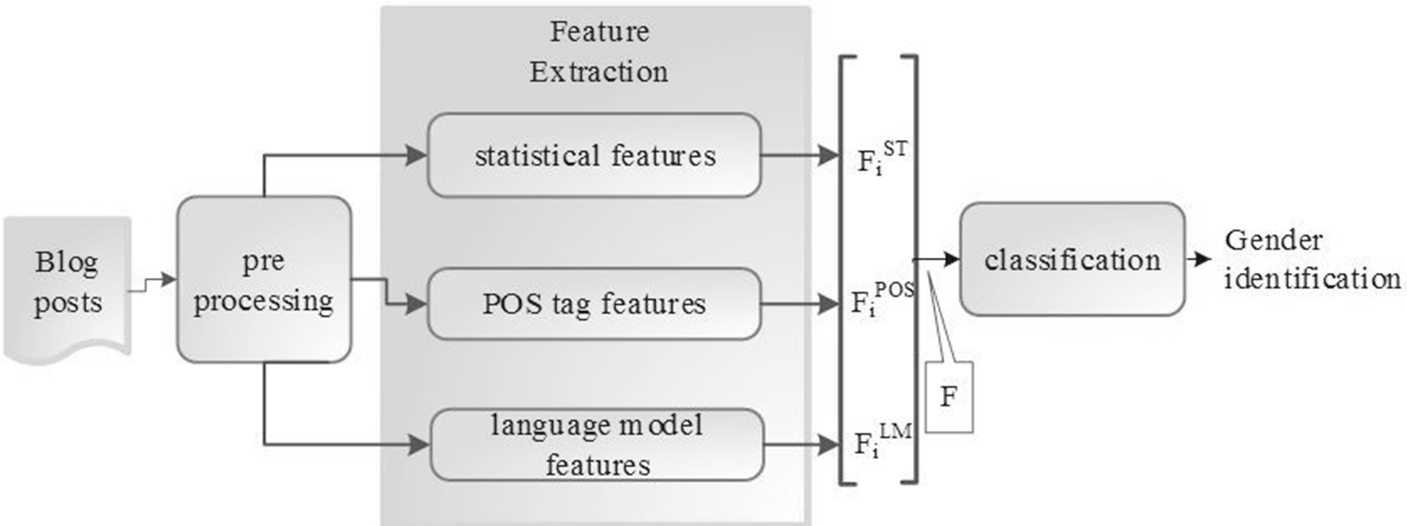
The researchers constructed a comprehensive 63-dimensional feature vector categorized into three domains:
- Statistical (30 features): Character counts, use of special symbols, word lengths, and punctuation habits.
- POS Tags (9 features): Frequency of nouns, verbs, adjectives, etc.
- Language Models (24 features): Log-likelihood and entropy from unigram, bigram, and trigram models specifically trained on female vs. male corpora.
Why Feature Selection?
Not all features are created equal. Using the ReliefF algorithm, the authors ranked these features to identify which actually help distinguish between genders. This approach mitigates the "curse of dimensionality," where irrelevant data (noise) confuses the machine learning model.
Experimental Insights: The Dominance of Language Models
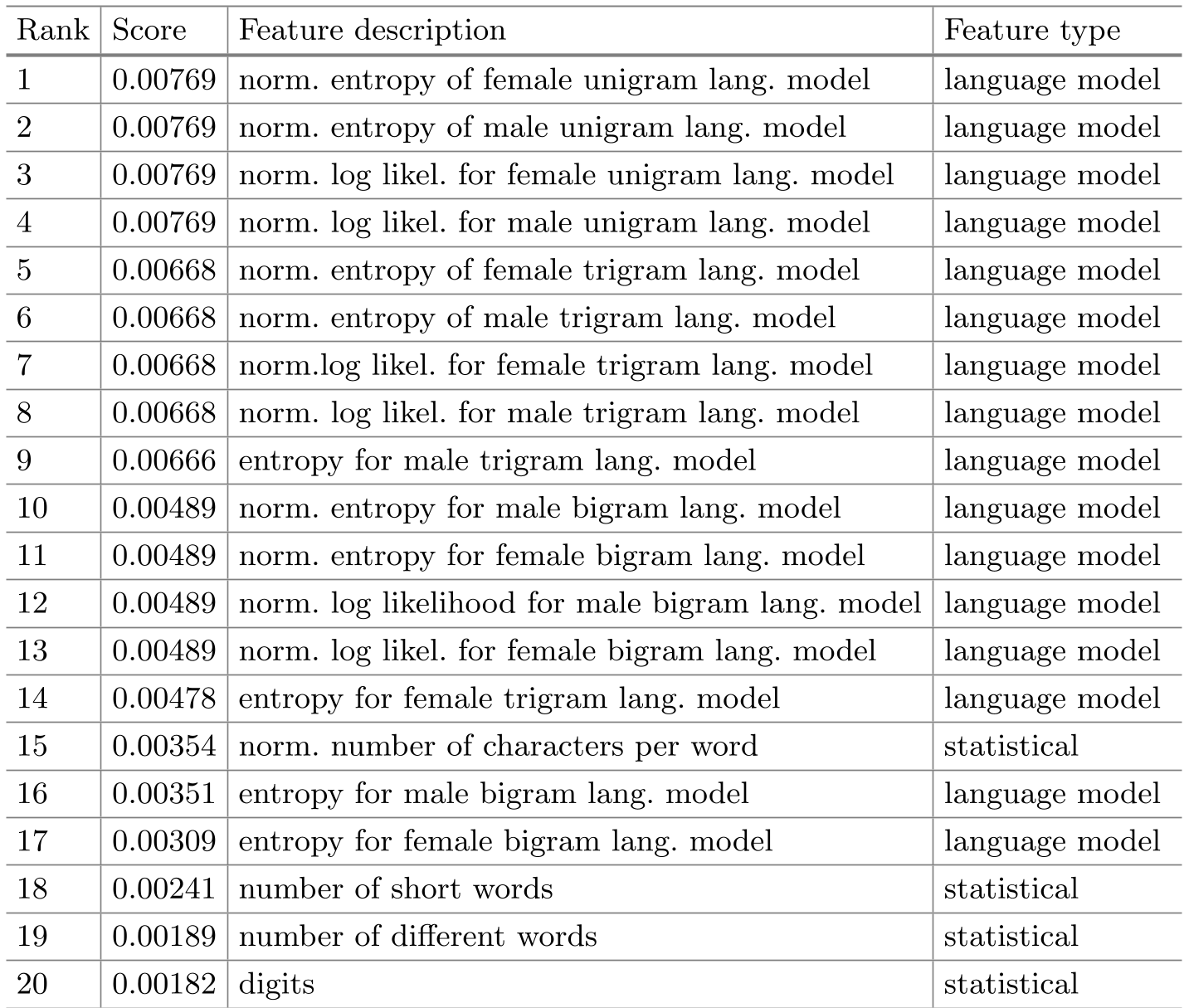
The results from the ReliefF ranking were revealing. 16 out of the top 20 features were derived from Language Models. Interestingly, POS tags were completely absent from the top 20, suggesting that the frequency of "verbs" or "nouns" is a weak indicator of gender compared to the specific sequences of words captured by n-grams.
Performance Breakthroughs
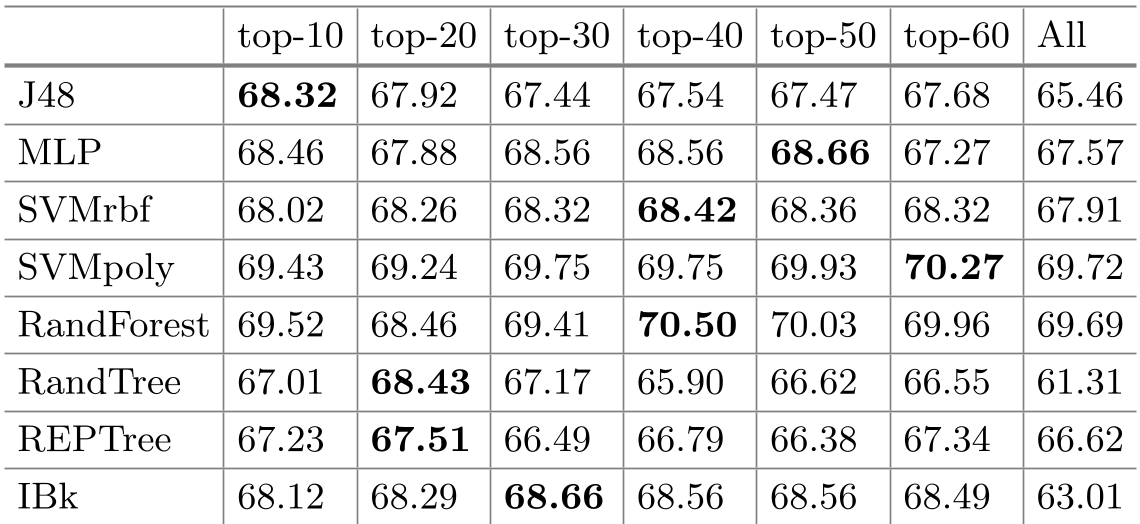
The team tested eight classifiers, including Support Vector Machines (SVM), Multi-Layer Perceptrons (MLP), and Decision Trees. Key findings include:
- The Random Forest Peak: Using the top 40 features, Random Forest hit the high mark of 70.50%.
- The Power of LM alone: Simply using the 24 LM features without any others yielded a surprising 69.35% accuracy.
- Robustness of SVM: SVM with a polynomial kernel was the most "stable," resisting accuracy drops even when using the full, noisy 63-feature set.
Deep Insight: Beyond Words
The success of "normalized entropy" and "log-likelihood" features suggests that gendered writing is defined by the predictability and variety of linguistic patterns. Men and women may utilize different "rhythms" in their writing, which n-gram entropy captures more effectively than static dictionaries of "gendered words."
Conclusion & Future Outlook
This paper rejuvenates the importance of feature engineering in an era often dominated by "black box" models. It proves that by selecting the right 15-20% of linguistic markers, we can significantly boost classification performance while reducing computational overhead.
Future Directions: While 70.5% is a strong baseline for traditional ML, the next frontier involves integrating these "hand-crafted" linguistic features with Transformers (like BERT or RoBERTa) to see if structural style and contextual embeddings can push accuracy beyond the 80% threshold.
Limitations: The study is currently focused on English blog posts. Given that LM features are "language independent" in methodology, a logical next step would be validating this approach on non-Indo-European languages.