
Formidability vs. Cooperation: How Group Peer Pressure Polarizes Gender Behavior
Gender differences in cooperation with group membership
This study explores gender differences in strategic cooperation using a Prisoner’s Dilemma game with salient same-gender group membership. Using an experimental design with a "partisan audience," the authors find that while aggregate cooperation rates are similar across genders, the presence of an in-group audience triggers polarized behavioral shifts: males cooperate significantly less (down to 28.9%) while females cooperate significantly more (up to 45.8%).
TL;DR
Why do men and women appear to cooperate at similar rates in the lab, but behave so differently in the real world? A landmark study by Charness and Rustichini reveals that the secret lies in the audience. When peers are watching, men become more aggressive (defecting) to signal "toughness," while women become more altruistic (cooperating) to signal "pro-sociality."
Identity in the Crosshairs
For decades, experimental economists were puzzled by the Prisoner's Dilemma. Despite clear differences in risk preferences and labor market competitiveness, men and women often showed nearly identical average cooperation rates in isolated lab settings.
The authors of this study argued that this lack of difference was an artifact of the laboratory's sterility. In reality, most strategic choices are witnessed by our social circles. By introducing a same-gender audience, the researchers found that "gender-neutral" behavior evaporates, replaced by a striking polarization of actions.
The Experimental Arena
The study utilized a Prisoner’s Dilemma matrix where two players—one from a "home" group and one from an "away" group—made choices while one of the groups sat behind their member as an audience.

The standard Prisoner's Dilemma: Payoffs reward mutual cooperation (5,5) but incentivize individual defection (7).
The sessions were divided into all-male, all-female, and mixed-gender groups. Crucially, the audience received a financial stake in the outcome (1/3 of the payoff), creating a "partisan" environment where players felt the weight of their peers' expectations.
Methodology: The Logic of Signaling
The core insight of the methodology is the shift from Outcome Maximization to Social Signaling.
- Males: The authors draw on evolutionary psychology to suggest that men seek status in larger hierarchies. In a conflict-prone game like Prisoner's Dilemma, defecting (playing "tough") signals that one is not a "sucker" and is formidable—a desirable trait in male peer groups.
- Females: Women are theorized to value "interdependent self-construal," where small-group bonds and social cohesion are paramount. Cooperating signals a willingness to invest in the collective good, securing one's place as a reliable partner.
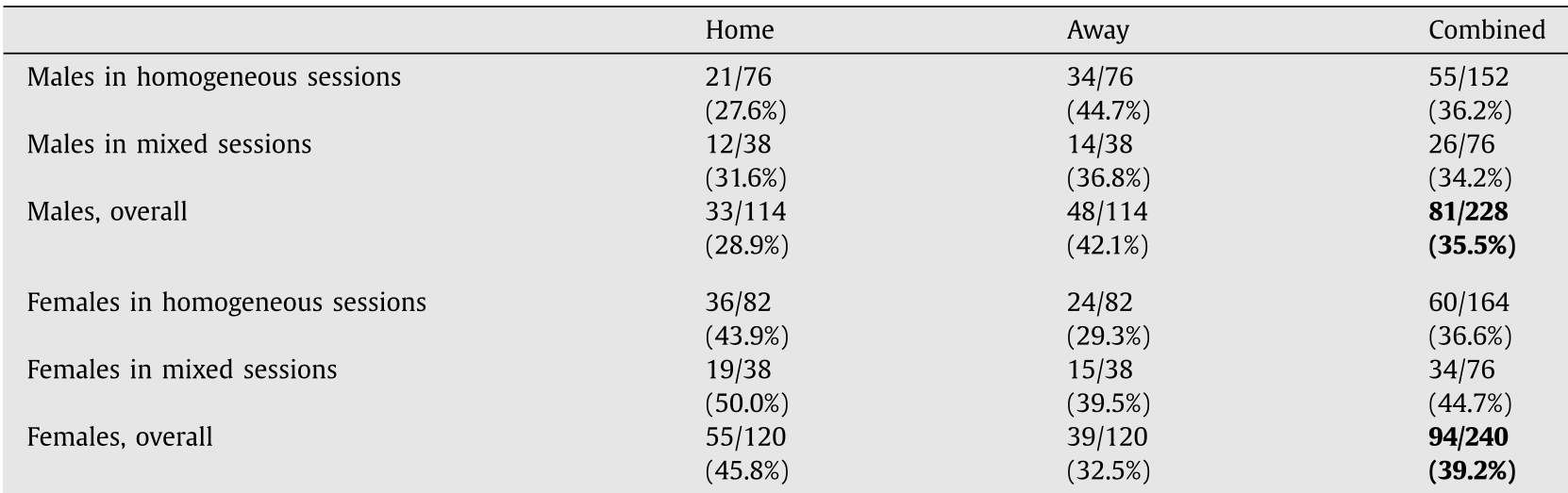
Table 1 illustrates the "The X-Pattern": Male cooperation drops at home, while female cooperation peaks at home.
Key Findings: The "At-Home" Effect
The statistical results were definitive:
- The Male Defection Shift: In all-male sessions, men cooperated only 27.6% of the time when playing in front of their friends ("at home"), but jumped to 44.7% when playing away.
- The Female Peer Boost: Conversely, women "at home" cooperated 43.9% of the time, dropping to 29.3% when their peers weren't watching.
- The Disappearing Gap: When playing "away" (in front of strangers), the male (42.1%) and female (32.5%) rates were statistically indistinguishable.
The "aggregate" similarity found in previous research was merely a mathematical coincidence—the result of averaging two opposite and powerful social reactions.
Critical Analysis & Conclusion
This paper serves as a vital reminder that social context is not "noise"; it is the signal.
Takeaway: The research effectively bridges the gap between economics and evolutionary psychology. It suggests that if we want to encourage cooperation in diverse organizations, we must understand that the "audience" an employee feels they are performing for changes the game entirely.
Limitations: The study focuses on undergraduates in a specific culture (UCSB). Whether these signaling motivations (Formidability vs. Cooperation) hold across different age groups or more "communal" cultures remains an open question for future cross-cultural research. Ultimately, this work provides a framework for understanding why "mixed" environments—like those seen in the study's mixed-gender sessions—tend to dampen these extreme signaling behaviors, potentially leading to more balanced outcomes.
Future Outlook: As we move toward more transparent, "observed" digital workplaces, understanding these deep-seated gendered responses to group membership will be essential for designing fair and effective incentive structures.