
Gender Dynamics in Engineering: From Support Roles to the Executive Suite
Gender Dynamics: A Case Study of Role Allocation in Engineering Education
This paper investigates gender dynamics and role allocation among third-year electrical engineering students at the University of Johannesburg. By analyzing small-group interactions in a design project, it evaluates how women students—a significant minority—navigate leadership, participation, and task assignment within simulated engineering companies.
TL;DR
A case study from the University of Johannesburg reveals a shift in engineering education: women are no longer just "observers" or "secretaries." In a high-stakes design project, 50% of women students assumed leadership roles (CEO/CFO). However, a critical "Technical Gap" remains—none of the women occupied direct engineering specialist roles, highlighting a new frontier in the fight for gender parity in STEM.
Perspective: The "Invisible" Barriers in the Classroom
For decades, the engineering "pipeline" has leaked. We've known what happens (women leave), but the how often happens in the minutiae of group work. This study moves beyond simple enrollment numbers to analyze the conversational physics of a student team. The authors ask: When the door is closed and a team of ten (mostly men) must build a car, where does the woman end up?
Methodology: Coding the Conversation
The researchers didn't just rely on surveys; they used video-taped conversational analysis. By coding every second of interaction into Speaking (S), Listening (L), and No Talking (NT), they mapped the social hierarchy of the teams.
 The study utilized a complex company simulation (SysCo, MechCo, EnergyCo, LogCo) to mirror real-world industry structures.
Key Findings: The Rise of the Female CEO
The data challenged the traditional stereotype that women are inherently less active in male-dominated groups.
- Leadership Success: Two women were elected as CEOs of their respective companies. Video analysis showed these individuals "orchestrated and managed" the group conversations, interacting with nearly every member.
- Resisting Stereotypes: In a telling moment, a male student suggested a female peer become the secretary "because they are girls." The response? A sharp, "Don’t even try me," followed by a successful move into a Marketing role.
 Visualizing authority: The mapping above shows how a female CEO (F2) dominated the interaction network, proving that leadership is driven by competency and personality over gender-based isolation.
The "Technical Gap": The Next Challenge
Despite the leadership success, the study uncovered a concerning trend: The total absence of women in technical specialist roles.
While women were trusted to manage the money (CFO) and lead the company (CEO), they either did not volunteer or were not selected for the "Specialist Engineer" roles (e.g., brakes, steering, propulsion). This suggests a lingering internal or external bias that frames "Technical Depth" as a masculine domain, while "Governance and Management" becomes the new acceptable space for women.
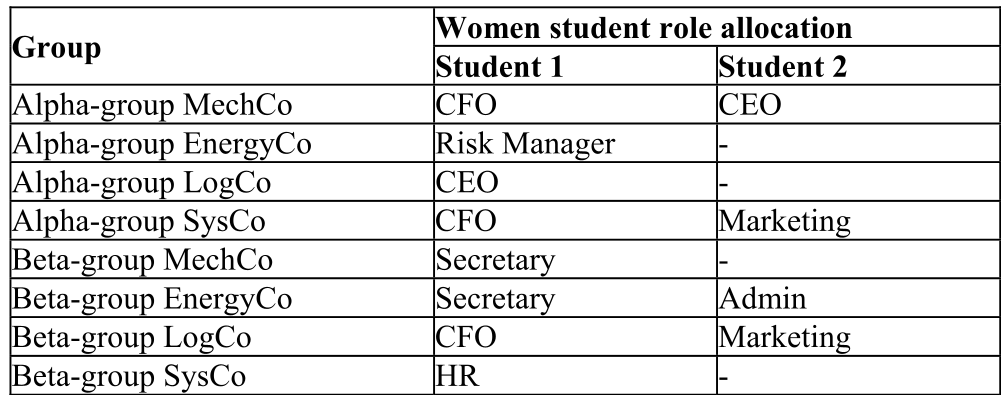 Table 2 shows the distribution: while many took leadership positions, the "Engineer" specialist slots remained exclusively male across all groups.
Critical Insight & Conclusion
This paper proves that the "damsel in distress" narrative in engineering education is largely dead. Women in this study were assertive, communicative, and often outperformed their male peers in leadership metrics.
However, the transition from Managing Engineers to Being the Engineer is the next hurdle. For industry leaders and educators, the takeaway is clear: encouraging women into leadership is working, but we must now ensure they are equally encouraged to take the "technical driver's seat" to prevent a new form of gender-segregated labor within the high-tech sector.