
Deciphering SNS Identities: Gender Estimation Through Automatic Image Annotation
Gender estimation for SNS user profiling using automatic image annotation
The paper proposes a novel method for SNS user gender estimation by leveraging automatic image annotation on shared photographs. Using a Bag-of-Features (BOF) model and Support Vector Machines, it converts image-level semantics into user-level profile predictions, achieving significant success on Twitter datasets.
TL;DR
While most social media analytics rely on "what users say" (text), this paper explores "what users show" (images). By applying automatic image annotation to Twitter photos, researchers from Fuji Xerox demonstrate that a user's gender can be accurately inferred by analyzing the semantic content of their shared visual gallery.
Background: The Hidden Value in Pixels
Social Network Services (SNS) like Twitter and Facebook are goldmines for marketers, yet demographic data like gender and age are often missing from public profiles. Most academic efforts have focused on Natural Language Processing (NLP) to mine tweets. However, with billions of photos uploaded daily, there is a massive "visual footprint" being ignored. This work is one of the first to bridge the gap between computer vision (image annotation) and social profiling.
Problem: The "Noisy" Nature of SNS Images
Why is it hard to guess gender from one photo?
- Ambiguity: A man might post a photo of a cake; a woman might post a photo of a gadget. A single image is rarely definitive.
- Diversity: SNS images range from screenshots and memes to professional photography and selfies.
- Scale: Manual labeling of millions of images is impossible, requiring a scalable automated pipeline.
Methodology: From Image Labels to User Profiles
The researchers developed a two-stage pipeline to move from pixel-level data to person-level insights.
1. Hybrid Image Annotation
Instead of just labeling an image as "Food" or "Person," the authors defined 30 hybrid labels. These labels combine the content and the likely gender of the uploader (e.g., female_person, male_goods, unknown_pet).
They utilized a Bag-of-Features (BOF) model:
- Feature Extraction: Dense SIFT descriptors.
- Encoding: Locality-constrained Linear Coding (LLC) with a 2,000-sized codebook.
- Spatial Context: Spatial Pyramid Matching (SPM) to capture the layout.
- Classification: SVM with a chi-squared kernel.
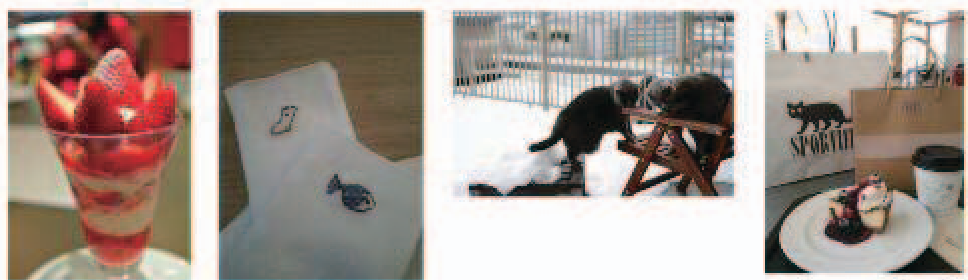 Typical items uploaded by different genders used to train the annotation model.
2. Score Consolidation
Since a user has multiple images (), the model calculates a cumulative score. They tested two strategies:
- Max-Score: Only the most "confident" label from each image contributes.
- Summation: All annotation scores across all images are summed up.
The final decision is simple: if the "Female" total score > "Male" total score , the user is classified as female.
Experiments & SOTA Comparison
The study used a dataset of 1,316 Twitter users with approximately 8,000 images. The labels were verified via Yahoo! Japan Crowdsourcing to ensure a high-quality ground truth.
Key Performance Metrics
| Category | Precision | Recall | F-measure |
|---|---|---|---|
| Female | 75.29% | 57.96% | 65.50% |
| Male | 53.20% | 71.52% | 61.02% |
The results proved that summing all scores worked best for large, objective datasets. The model showed a clear ability to distinguish gender based on the "visual themes" a user chooses to share.
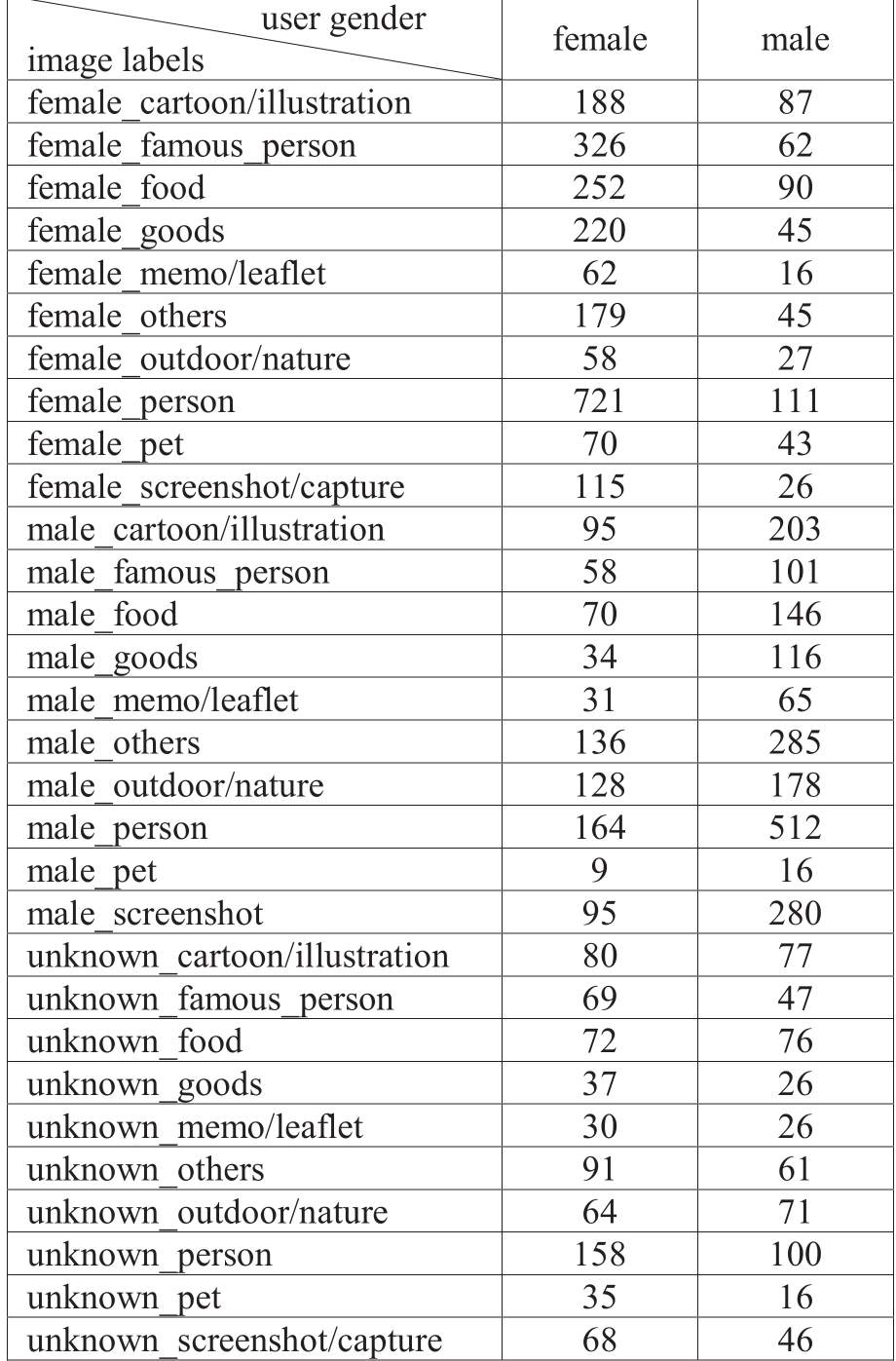 The statistical distribution of labels confirms that certain content types (e.g., 'female_person') are significantly more frequent among specific gender groups.
Critical Analysis & Future Outlook
Takeaway
This research validates that image-level metadata is a viable "soft biometric" for user profiling. It shifts the focus from purely linguistic cues to visual behavioral patterns.
Limitations
- Hand-crafted Features: The use of SIFT and BOF is somewhat dated compared to modern Deep Convolutional Neural Networks (CNNs) or CLIP-based models, which would likely yield even higher accuracy.
- Cultural Bias: The study was conducted on Japanese Twitter data; image-sharing habits might differ significantly across cultures.
Future Work
The authors suggest that Facial Recognition and Text-Image Fusion are the next frontiers. Integrating the "textual voice" of a user with their "visual eye" would create a highly robust profiling system for targeted marketing and social research.