
Gender in Web-Based EUD: Breaking the Legacy of the Spreadsheet Gap
Examining gender issues in perception and acceptance in web-based end-user development activities
This study investigates gender differences in user perception and technology acceptance within modern web-based End-User Development (EUD) environments. Using a natural language prototype tool for mobile app creation, the research measures constructs like Perceived-Ease of Use (PEOU), Risk-Perception (RP), and Self-Efficacy (SE) among 47 participants.
TL;DR
For decades, Human-Computer Interaction (HCI) research has suggested a persistent gender gap in software development tasks, often finding that female users face higher risk perception and lower self-efficacy. This paper challenges the status quo by examining whether these differences still hold in modern, web-based End-User Development (EUD) environments. Using a natural language prototype, the authors discovered that while some gaps (like Self-Efficacy) are closing, others (like Risk-Perception and Ease of Use) remain significant, demanding a shift toward gender-neutral design.
The Evolution of the End-User Developer
End-User Development (EUD) empowers non-professionals to create or modify software artifacts. Historically, EUD research lived in the world of desktop spreadsheets. However, as the digital landscape shifts to database-driven mobile and web apps, the "GenderHCI" dynamics are changing. The authors argue that legacy tools weren't optimized for user-centered design, potentially inflating gender disparities that might not be inherent to the task itself, but rather the interface.
Methodology: "Simple Talking" and Wizard Logic
To test their hypotheses, the researchers developed a prototype tool based on a "simple talking" approach. This allows users to design relational databases for mobile apps using simple words and a step-by-step wizard interface.
The Research Framework
The study measured five core dependent variables across a sample of 47 university students:
- Self-Efficacy (SE): Confidence in completing the task.
- Risk-Perception (RP): The perceived cost of making a mistake.
- Perceived-Ease of Use (PEOU): How effortless the system feels.
- Perceived-Usefulness (PU): The belief that the tool enhances performance.
- Willingness to Learn (WL): Motivation to explore deeper features.
 Figure 1: The theoretical intersection of EUD, Gender HCI, and Technology Acceptance.
Key Findings: Is the Gap Closing?
The results provide a nuanced view of gender in modern tech interaction. Unlike older studies, this research found no significant difference in Self-Efficacy or Willingness to Learn between men and women.
1. The Ease of Use Surprise
Contrary to the hypothesis that women might value ease of use more, male users actually perceived significantly higher Ease of Use (3.85) compared to female users (3.49). This suggests that even in modern interfaces, men may still feel a higher level of "fluency" with developmental logic.
2. Risk-Perception Persists
Women reported higher Risk-Perception (3.15 vs 2.81 for men). According to the Attention Investment Model, this higher perceived risk means women are more cautious about clicking buttons or "tinkering" with new features, as they perceive the cost of failure to be higher.
3. Correlation Divergence
The study found that for women, Self-Efficacy is strongly correlated with Perceived-Ease of Use, whereas for men, this link was non-significant. This implies that making a tool "easier" has a direct psychological boost for female users' confidence that isn't as pronounced in men.
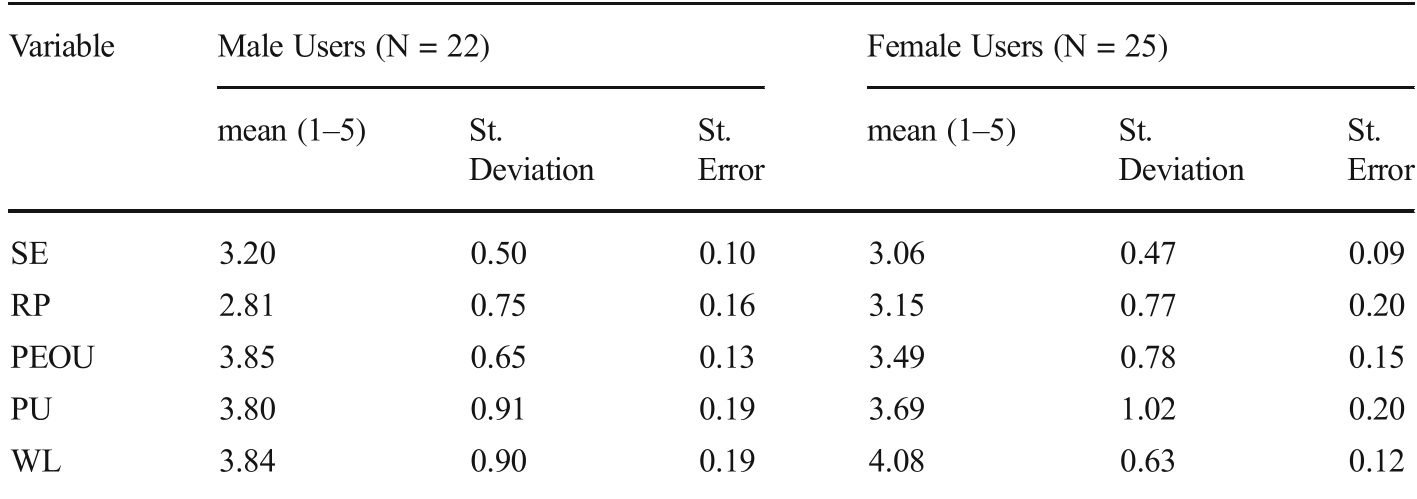 Table 1: Mean values of perception items across gender groups.
Critical Insight: The "Wizard" Effect
The authors suggest that the use of a wizard-based interface—which guides users through a structured path—may be the reason why the Self-Efficacy gap seen in spreadsheets (which are open-ended and daunting) has started to disappear. Wizards provide "scaffolding" that supports female users particularly well, aligning with prior findings that women prefer structured exploration over "blind" tinkering.
Conclusion and Future Outlook
This paper serves as a wake-up call for EUD designers. While we are moving away from the "hostile" environments of legacy software, gender-neutrality is not yet achieved.
The Takeaway: Future EUD systems should implement Self-Adaptive mechanisms. By monitoring behavioral cues (like mouse movement or risk-averse button clicks), a system could dynamically adjust its feedback or complexity level to boost a user's self-efficacy, effectively neutralizing gender-based hurdles in real-time.
Limitations
- Sample Size: The study relied on 47 participants, which may limit generalizability.
- Cultural Context: The research was localized to a Greek university population.
- Interface Bias: The wizard logic itself may have skewed results toward a more "female-friendly" experience, which might not be present in other modern EUD styles like "drag-and-drop" blocks.