
Decoding Gender: How Phonetic Cues Enhance BERT for Chinese Name Inference
Gender Prediction Based on Chinese Name
This paper introduces a BERT-based gender prediction framework for Chinese names that integrates both semantic (Hanzi) and phonetic (Pinyin) features. By releasing two large-scale datasets containing over 7 million labeled names, the authors achieve a State-of-the-Art (SOTA) test accuracy of 93.45%.
TL;DR
Predicting gender from Chinese names is deceptively complex due to the "logosyllabic" nature of the language. This paper presents a novel BERT-based architecture that uses Pinyin (phonetics) to augment Hanzi (semantics). By leveraging a massive new dataset of 6 million names, the researchers reached a record 93.45% accuracy, proving that how a name sounds is just as important as how it is written.
Background: Beyond the Dictionary
While gender prediction for English names often relies on suffix patterns (like "-a" or "-ia"), Chinese names are bound to specific characters and their cultural connotations. Parents choose characters not just for meaning but for the "prosody" or sound. Previous methods were either rigid rule-based systems or shallow machine learning models (SVM, GBDT) that failed to capture the deep contextual relationship between characters.
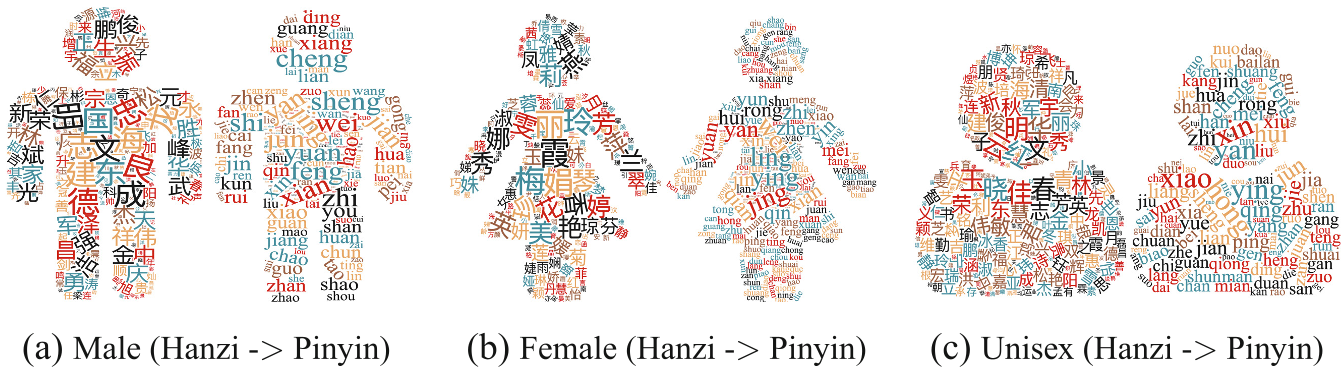
The authors identify a critical gap: Phonology matters. In Chinese, certain sounds (e.g., "qing", "qin") are traditionally associated with femininity, regardless of the specific character used.
Methodology: The Hanzi-Pinyin Fusion
The core innovation lies in the Character-Pinyin representation. Instead of feeding only the raw Chinese characters into the model, the authors convert the names into a dual-token format.
1. Feature Engineering
- Semantic Component: The actual Simplified Chinese characters.
- Phonetic Component: The Pinyin representation (e.g., "Wang Xiaoming" -> "Wang Xiao Ming").
2. Model Architecture
The researchers utilized the BERT-Base model. Unlike traditional word embeddings (like fastText) which produce static vectors, BERT's self-attention mechanism allows the model to learn the specific "gender-weight" of a character based on its interaction with its phonetic counterpart.
 Note: The model fine-tunes a pre-trained BERT transformer to classify the dual-input stream into binary gender categories.
Experiments and Results
The study compared four major approaches:
- Naive Bayes: A simple probabilistic baseline.
- GBDT: Using term frequency features.
- Random Forest (RF): Utilizing fastText embeddings.
- The Proposed BERT Model: Integrated character-pinyin data.
Performance Breakdown
The results clearly show that deep learning with dual features dominates traditional ML:
| Model | Mean Accuracy |
|---|---|
| Naive Bayes | 80.67% |
| Random Forest | 84.87% |
| Our BERT Model (Hanzi-Pinyin) | 93.45% |

The ablation study revealed a fascinating insight: Pinyin alone (69.64%) is weaker than Hanzi alone (90.89%), but when combined, Pinyin provides a essential "boost" that helps the model resolve ambiguous cases.
Critical Insight: Why Does This Work?
The effectiveness of this method stems from the Inductive Bias provided by phonetics. In Chinese culture:
- Male-inclined sounds: Often use stronger, fourth-tone sounds or characters like "Guo" (Country) or "De" (Virtue).
- Female-inclined sounds: Often use softer tones or phonetic components associated with beauty or nature.
By providing BERT with the Pinyin, the authors are essentially giving the model a "second set of eyes" to verify the gender signal coming from the character's radical or meaning.
Limitations and Future Work
Despite the high accuracy, the model still struggles with unisex names—names like "Xiao Ming" which can be used for both genders depending on the specific region or family tradition. Furthermore, the reliance on Simplified Chinese means the model might need adaptation for Traditional Chinese or regional dialects (Cantonese, Hokkien) where phonetic mappings differ significantly.
Conclusion
This work sets a new benchmark for Chinese demographic inference. By releasing a dataset of over 6 million full names, the authors have provided the community with the vital fuel needed for future NLP research in Asian languages. For practitioners, the takeaway is clear: In logosyllabic NLP, never ignore the sound of the word.